ANGEL
idea-no-tane の全引用から選んだ超精選による、概念ごとの読み物。
入口 THE WORD
この概念が扱うのは、神と人間のあいだに立つ仲介者である。天と地は遠く隔たり、言葉はそのままでは届かない。そのあいだを行き来して告げる者が「天使」である。場面の声は、その使者がそもそも何者なのか——身体を持たない知性なのか、神の臨在のしるしにすぎないのか、そして人間は天使という像に何を託してきたのか——をめぐって争う。
語源 ― angelos は「使者」
英語の angel は、後期ラテン語の angelus を経て、ギリシャ語の angelos に由来する。その文字どおりの意味は「使者、伝令」である(Merriam-Webster)。七十人訳と呼ばれるギリシャ語訳旧約聖書では、ヘブライ語の mal'akh の訳語に angelos が当てられた。mal'akh 自体は人間の使者にも使われる語で、性質を問わず「遣わされる者」を指した(Merriam-Webster「The History of 'Angel'」)。つまり天使という名は、本性ではなく職務——遣わされて、告げること——を指す名として始まった。なお angelos のさらに古い由来については、ペルシアの騎馬の伝令を指す angaros からの借用とする説もある(Beekes。Wikipedia「Angel」所引)。場面で争われる天使の存在様態——非物体的な実在か、しるしか——は、この「使者」という名をどう読むかの争いでもある。
日本語の「天使」 ― 天の使い、御使い
日本語の「天使」は「天の使い」の意の漢語で、聖書の翻訳を通じて angel の訳語として定着した。辞書では、神の使いとして天から遣わされる霊的存在と説明される(デジタル大辞泉)。同じ存在を「御使い(みつかい)」とも言う。また日常語の天使は、純真な人、とりわけ子供への比喩にも転じている。場面では、その比喩の使い方自体も問い直される。
場面 THE SCENE
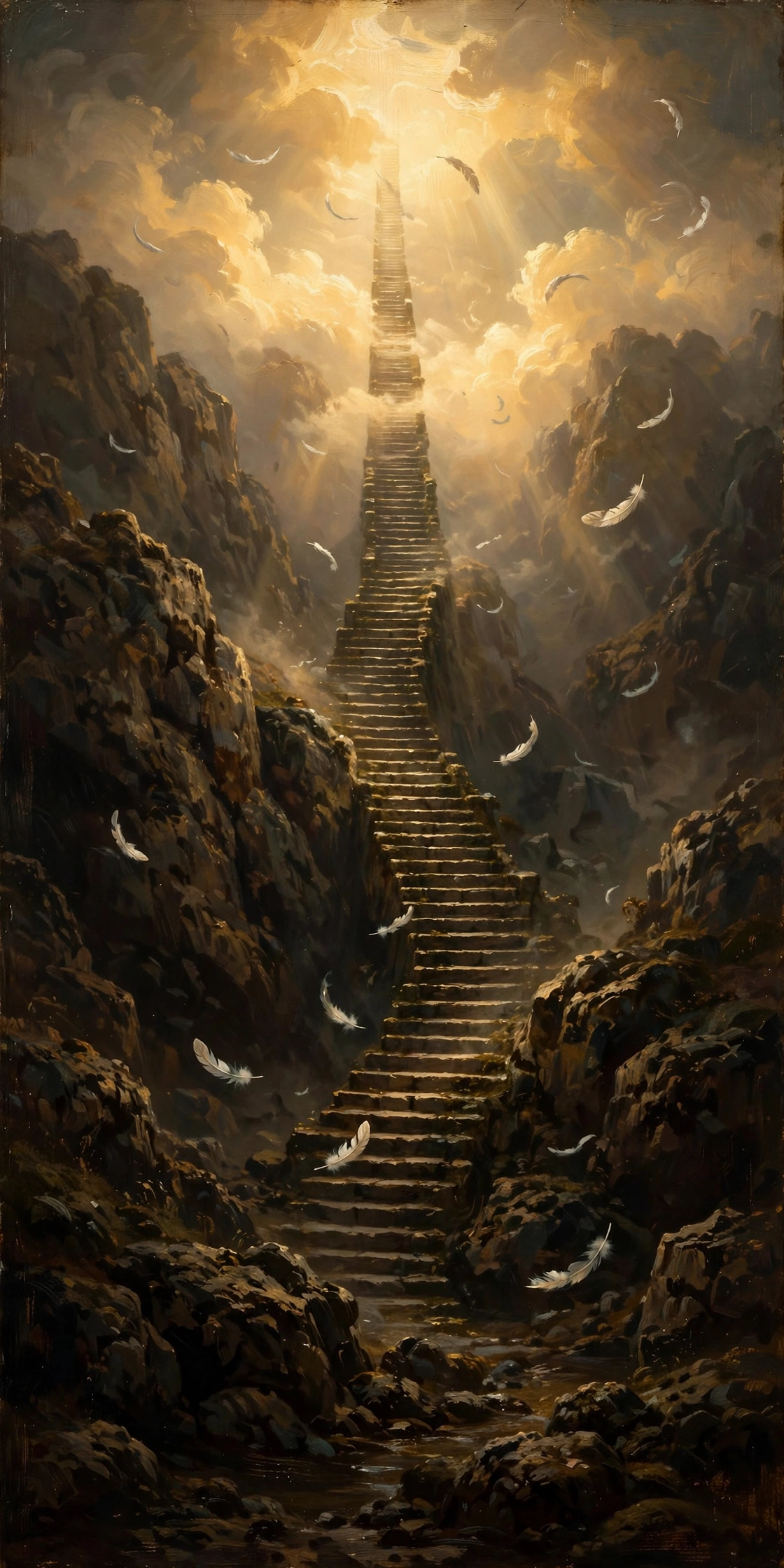
この絵について
描かれているのは、暗い岩の谷底から、雲の上のまばゆい光へとまっすぐ上っていく長い石の階段である。階段のまわりには白い羽根が数枚、静かに舞い落ちている。登る者も、下りる者も、描かれていない。
この階段は、入口で見た天使の像である。天使の名は「使者」を意味し、天と地のあいだを遣わされて行く者を指した。階段は、その往く道そのものである。場面で争われるのは、その道を往く者が、身体を持たない知性なのか、神の臨在を示すしるしなのか、そして人間がその像に何を託してきたのか、である。
※モチーフは、「天使」について一般に共有されている像(天と地を結ぶ階段と、翼の羽根)を既定として選んだ。天使そのものは描いていない。絵は差し替え可能とする。
天使とは何者か。——最初に口を開いたのは、プラトンの対話篇でソクラテスに愛を説いたディオティマだった。エロースは偉大なダイモーン(精霊)であり、すべての精霊と同じく、神的なものと死すべきものとの中間にある。死すべきものでも不死なるものでもなく、その両者の中間にある、と。「天使」の原型は、神でも人でもなく、あいだに立つ者として置かれて始まった。
Diotima(ディオティマ)立てる ― ダイモーンは神的なものと死すべきものの中間にある
「先の場合と同じく、彼は死すべきものでも不死なるものでもなく、その両者の中間にある」。 「では彼は何なのですか、ディオティマ」。 「彼は偉大なダイモーン(精霊)であり、すべての精霊と同じく、神的なものと死すべきものとの 中間にある」。
原文
'As in the former instance, he is neither mortal nor immortal, but in a mean between the two.' 'What is he, Diotima?' 'He is a great spirit (daimon), and like all spirits he is intermediate between the divine and the mortal.'
— Plato『Symposium』(Benjamin Jowett 訳) / `plato_symposium#L2177`
アクィナスは、その中間の者に、厳密な存在の規定を与えた。神は知性と意志によって被造物を生み出される。それゆえ宇宙の完全性は、知性的な被造物が存在することを要求する。ところが知性の働きは物体の働きではありえず、あらゆる物体は「ここ」と「今」に限られている。それゆえ宇宙の完全性は、非物体的な被造物が存在することを要求するのである、と。天使は、身体を持たない知性として、宇宙に欠けてはならない一員に数えられた。
Thomas Aquinas(トマス・アクィナス)非物体の側 ― 宇宙の完全性は、非物体的な知性的被造物を要求する
ところで神は知性と意志によって被造物を生み出される。 それゆえ宇宙の完全性は、知性的な被造物が存在することを要求する。 ところが知性の働きは、物体の働きでも、いかなる物体的な能力の働きでもありえない。 あらゆる物体は「ここ」と「今」に限られているからである。 それゆえ宇宙の完全性は、非物体的な被造物が存在することを要求するのである。
原文
Now, God produces the creature by His intellect and will (Q. 14, A. 8; Q. 19, A. 4). Hence the perfection of the universe requires that there should be intellectual creatures. Now intelligence cannot be the action of a body, nor of any corporeal faculty; for every body is limited to "here" and "now." Hence the perfection of the universe requires the existence of an incorporeal creature.
— Thomas Aquinas『Summa Theologica, Part I (Prima Pars)』 I, Q. 50, Art. 1(Fathers of the English Dominican Province 訳) / `aquinas_summa_prima_pars#L23991`
ホッブズは、その規定そのものを言葉の矛盾として退けた。実体と非物体的という二語は矛盾を含んでいる。天使や霊が非物体的な実体であると言うことは、実質的には、天使も霊も全く存在しないと言うことである。天使とは、想像の超自然な出現にほかならず、神がご自身の臨在と命令を人類に知らせるために起こされるものだ、と。天使は、存在の種類から、しるしの働きへと置き換えられた。
Thomas Hobbes(ホッブズ)覆す ― 「非物体的な実体」は矛盾であり、天使は神の臨在を示す出現である
実体と非物体的というこれらの語の意味を理解する人々にとって――非物体的が、微細な身体では なく、身体でないものとして取られるとき――、この二語は矛盾を含んでいる。 すなわち、天使や霊が(その意味で)非物体的な実体であると言うことは、実質的には、天使も霊 も全く存在しないと言うことである。したがって、旧約聖書における天使という語の意味と、自然 の通常の仕方で人に起こる夢や幻の本性とを考えて、私はこういう意見に傾いた。 天使とは、想像の超自然な出現にほかならず、神の特別で異常な働きによって起こされ、それによ って神がご自身の臨在と命令を人類に、とりわけご自身の民に知らせるのである。
原文
To men that understand the signification of these words, Substance, and Incorporeall; as Incorporeall is taken not for subtile body, but for Not Body, they imply a contradiction: insomuch as to say, an Angel, or Spirit is (in that sense) an Incorporeall Substance, is to say in effect, there is no Angel nor Spirit at all. Considering therefore the signification of the word Angel in the Old Testament, and the nature of Dreams and Visions that happen to men by the ordinary way of Nature; I was enclined to this opinion, that Angels were nothing but supernaturall apparitions of the Fancy, raised by the speciall and extraordinary operation of God, thereby to make his presence and commandements known to mankind, and chiefly to his own people.
— Thomas Hobbes『Leviathan』 CHAPTER XXXIV / `hobbes_leviathan#L13232`
そのとき、争いの外から、天使自身の声が割って入った。ヨハネが足もとにひれ伏して礼拝しようとすると、天使は言った。そうしてはならない、私はあなたと、あなたの兄弟である預言者たちと、この書物の言葉を守る者たちと、同じ僕なのだから、神を礼拝せよ、と。最も高い使者が、自分への礼拝を退けて、礼拝の向け先を神へ戻した。
Angel of Revelation(黙示録の天使)礼拝の拒否 ― 私はあなたと同じ僕である、神を礼拝せよ
二十二・九。その時、彼は私に言う、そうしてはならない、私はあなたと、あなたの兄弟である預 言者たちと、この書物の言葉を守る者たちと、同じ僕なのだから、神を礼拝せよ。
原文
22:9 Then saith he unto me, See thou do it not: for I am thy fellowservant, and of thy brethren the prophets, and of them which keep the sayings of this book: worship God.
— (various)『The King James Version of the Bible』 John the Divine 22:9(King James Version (1611) 訳) / `bible_kjv#L99572`
最後にマディソンが、天使を政治の物差しへ変えた。人間が天使なら、政府は必要ないだろう。天使が人間を統治するなら、政府に対する外部からの統制も内部からの統制も必要ないだろう、と。政府という仕組みの全体が、人間が天使ではないことへの省察として置かれて、議論は締められた。
James Madison(マディソン)締め ― 人間が天使なら、政府は必要ない
しかし、政府そのものとは、人間本性に関するあらゆる省察の中で最大のものではないか。 人間が天使なら、政府は必要ないだろう。 天使が人間を統治するなら、政府に対する外部からの統制も内部からの統制も必要ないだろう。
原文
But what is government itself, but the greatest of all reflections on human nature? If men were angels, no government would be necessary. If angels were to govern men, neither external nor internal controls on government would be necessary.
— Hamilton, Madison, Jay『The Federalist Papers』 No. LI / `federalist_papers#L11494`
中間にある精霊、非物体的な知性、臨在のしるしとしての出現、礼拝を拒む僕、そして政府の不要を測る物差し。——天使の姿は、声ごとに違う置き場所で描かれた。
控えの一句 ON THE BENCH
Augustine(アウグスティヌス)
軸2 ― 聖書は善い天使と悪い天使を語るが、「善いデーモン」とは決して言わない。この語が出てくる箇所では常に邪悪な霊にだけ当てはめられ、用法がそれを決めている。言葉の選択が神学の立場を決める場面
しかし、私がデーモン崇拝者とでも呼ぶ人々のうちのある者たち、ラベオもその一人だが、彼らが デーモンと呼ぶものを他の人々は天使と呼ぶと主張するので、私は、単なる言葉の争いと思われな いためには、善い天使について何か言わなければならない。 プラトン主義者はその存在を否定しないが、善いデーモンと呼ぶことを好む。 しかし我々は、我々がキリスト教徒である根拠である聖書に従って、天使のある者は善く、ある者 は悪いと学んだが、善いデーモンについては聖書で決して読んだことがない。 この語や同類の語が出てくる箇所では、それは常に邪悪な霊にだけ当てはめられている。 そしてこの用法は非常に普遍的になっているので、デーモンも神々も礼拝すべきだと主張する異教 徒と呼ばれる人々の間でも、どれほど学識ある人でも、自分の奴隷を褒めて「お前にはデーモンが いる」とあえて言う者はほとんどなく、そう言われた者がそれを呪いと受け取ることを疑う者もい ないだろう。ならば、なぜ我々は、「デーモン」という語を用いて不快を与えたときに言い繕わな ければならないという必要に、自らを服従させるのか。 誰もが、あるいはほとんど誰もが、この語に悪い意味を結びつけているのに、「天使」という語を 用いれば、その必要をたやすく回避できるのである。
原文
But as some of these demonolators, as I may call them, and among them Labeo, allege that those whom they call demons are by others called angels, I must, if I would not seem to dispute merely about words, say something about the good angels. The Platonists do not deny their existence, but prefer to call them good demons. But we, following Scripture, according to which we are Christians, have learned that some of the angels are good, some bad, but never have we read in Scripture of good demons; but wherever this or any cognate term occurs, it is applied only to wicked spirits. And this usage has become so universal, that, even among those who are called pagans, and who maintain that demons as well as gods should be worshipped, there is scarcely a man, no matter how well read and learned, who would dare to say by way of praise to his slave, You have a demon, or who could doubt that the man to whom he said this would consider it a curse? Why, then, are we to subject ourselves to the necessity of explaining away what we have said when we have given offence by using the word demon, with which every one, or almost every one, connects a bad meaning, while we can so easily evade this necessity by using the word angel?
— Augustine of Hippo『The City of God, Volume I』 BOOK NINTH(Marcus Dods 訳) / `augustine_city_of_god_v1#L15013`
Thomas Aquinas(トマス・アクィナス)
軸4(天使についての知識はどこから来るか) ― 上位の天使は下位の天使を照明する。第一に、その知的力を強めることによって。第二に、普遍的な把握で受けた真理を、下位の受け方に合わせて分節して伝えることによって。真理が位階の中で伝わる仕組み
第一に、その知的力を強めることによって。 すなわち、不完全な身体の力が、より完全な身体の近さによって強められるように――たとえば、 より熱いものの存在によって、熱さの劣るものがより熱くされるように――下位の天使の知的力は、 上位の天使が彼の方を向くことによって強められる。 霊的なものにおいては、一つのものが他のものの方を向くことが、物体的なものにおける近さに相 当するからである。第二に、一人の天使は、知られた事物の似姿に関して、真理を他の天使に示す。 というのは、上位の天使は真理の知識を一種の普遍的な把握によって受けるが、下位の天使の知性 はそれを受けるほど十分に力強くなく、より個別的な仕方で真理を受けることが彼には自然だから である。
原文
First, by strengthening his intellectual power; for just as the power of an imperfect body is strengthened by the neighborhood of a more perfect body--for instance, the less hot is made hotter by the presence of what is hotter; so the intellectual power of an inferior angel is strengthened by the superior angel turning to him: since in spiritual things, for one thing to turn to another, corresponds to neighborhood in corporeal things. Secondly, one angel manifests the truth to another as regards the likeness of the thing understood. For the superior angel receives the knowledge of truth by a kind of universal conception, to receive which the inferior angel's intellect is not sufficiently powerful, for it is natural to him to receive truth in a more particular manner.
— Thomas Aquinas『Summa Theologica, Part I (Prima Pars)』 I, Q. 106, Art. 1(Fathers of the English Dominican Province 訳) / `aquinas_summa_prima_pars#L48364`
Blaise Pascal(パスカル)
軸5(天使は人間の上に立つ完成形か) ― 「人間は天使でも獣でもなく、不幸なことに、天使を演じようとする者は誰でも獣を演じる」。人間の位置を一句で示す警句
人間は天使でも獣でもなく、不幸なことに、天使を演じようとする者は誰でも獣を演じる。
原文
Man is neither angel nor brute, and the misfortune is that whoever would play the angel plays the brute.
— Blaise Pascal『The Thoughts of Blaise Pascal』 THE GREATNESS AND LITTLENESS OF MAN(C. Kegan Paul 訳) / `pascal_thoughts#L1953`
Immanuel Kant(カント)
軸6 ― 「国家形成の問題は、どれほど難しく聞こえようとも、悪魔の種族にとってさえ、知性をもつと仮定すれば、解決できないものではない」。場面のマディソンと対になる、制度設計の前提を測る一句
国家形成の問題は、どれほど難しく聞こえようとも、悪魔の種族にとってさえ、知性をもつと仮定 すれば、解決できないものではない。
原文
The problem of the formation of the state, hard as it may sound, is not insoluble, even for a race of devils, granted that they have intelligence.
— Immanuel Kant『Perpetual Peace: A Philosophical Essay』 CONCERNING THE GUARANTEE OF PERPETUAL PEACE(Mary Campbell Smith 訳) / `kant_perpetual_peace#L4454`
John Locke(ロック)
軸4 ― 「この世界で分離した霊について知りたいと望むことは、ただ啓示からのみ期待しなければならない」。霊についての知識の線引き
物体についての知識は、その性質と相互の働きに注意を払うため、慎重に感官を用いて得なければ ならない、そして、この世界で分離した霊について知りたいと望むことは、思うに、ただ啓示から のみ期待しなければならない。
原文
The knowledge of BODIES we must get by our senses, warily employed in taking notice of their qualities and operations on one another: and what we hope to know of SEPARATE SPIRITS in this world, we must, I think, expect only from revelation.
— John Locke『An Essay Concerning Humane Understanding, Volume 2』 CHAPTER XII / `locke_essay_human_understanding_v2#L10028`