ANIMAL
idea-no-tane の全引用から選んだ超精選による、概念ごとの読み物。
入口 THE WORD
この概念が扱うのは、人間と他の生き物の境である。人間も動物なのか、動物ではない何かなのか。場面の声は、その境の引き方をめぐって争う。
語源 ― animal は「息」を持つもの
英語の animal は、14世紀初めに「感覚を持つあらゆる生き物」という意味で入ってきた語であり、当初は人間も含んでいた。もとはラテン語の animale「呼吸する存在」で、anima「息、魂」に由来する(Etymonline)。anima の底には、印欧祖語の *ane-「息をする」がある。ギリシャ語では zōion(ゾーイオン)が生き物一般を指し、zōē「生」に由来する(Springer『Animals in Premodern Japan』所引)。動物とは、まず「息をして生きているもの」の名だった。
日本語との対応 ― 「動く物」
日本語の「動物」は「動く物」と書く。中国の古典『周礼』には「其動物宜毛物、其植物宜早物」とあり、動くものと植わるもの(植物)の対で使われていた(Wiktionary「動物」所引)。ただし、古典中国語に生き物全体を一つの範疇にまとめる語が厳密にあったわけではなく、animal の訳語として日本で定着したのは19世紀のことである(同書、Sterckx の指摘)。「息」の側から切る西洋の語と、「動き」の側から切る東洋の語——切り口は違っても、どちらも生の兆候を名前にしている。場面で争われるのは、その生き物と人間のあいだに線を引けるのか、引くならどこなのか、である。
場面 THE SCENE
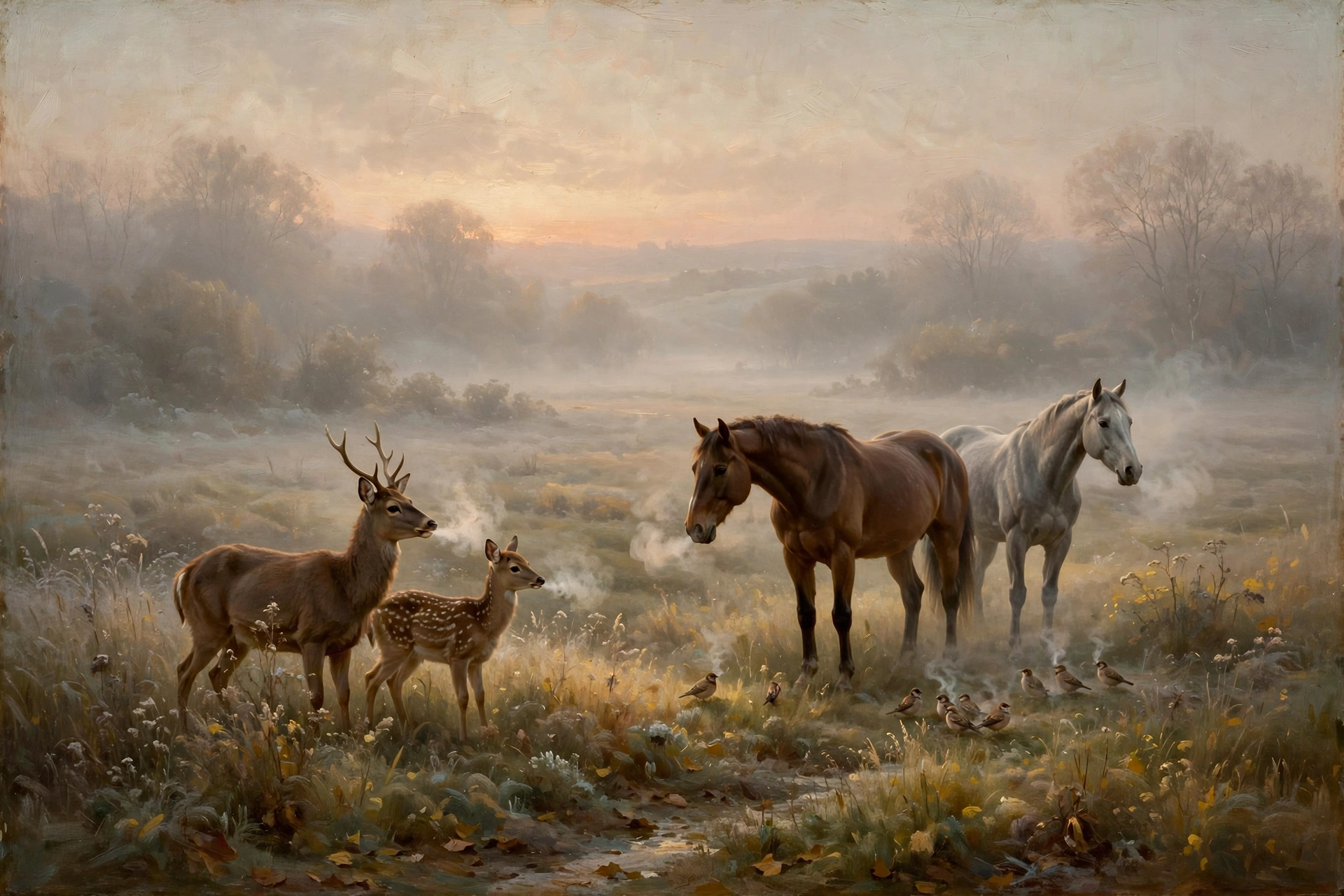
この絵について
描かれているのは、霧の立ちこめる夜明けの草原である。牡鹿と小鹿、二頭の馬が草の中に立ち、足もとには小鳥たちが集まっている。冷えた空気の中で、獣たちの口元からは白い息が立ちのぼっている。人は描かれていない。
この白い息は、入口で見た anima の像である。animal の底には「息、魂」があった。息をしていること、それが動物の最も古い定義だった。場面で争われるのは、その息を持つものと人間のあいだに、理性や言葉や苦しみで線が引けるのか、である。
※モチーフは、「動物」について一般に共有されている像(野に集う獣たち)を既定として選び、入口の根の像(anima=息)と重ねた。絵は差し替え可能とする。
動物とは何か。——最初に口を開いたのはアリストテレスだった。人間と牛はともに『動物』であり、名前だけでなく定義も両者において同じだ、と言う。それぞれが動物である意味を述べれば、一方の説明は他方の説明と同一になる。人間は、分類の上では牛と同じ側にいる、と。
Aristotle(アリストテレス)立てる ― 人間も牛も、名前だけでなく定義も同じく動物である
人間と牛はともに「動物」であり、その名称だけでなく定義も両者において同じであるため、一義 的にそう名づけられる。というのも、それぞれがいかなる意味で動物であるかを述べるなら、一方 の説明は他方の説明と同一になるからである。
原文
A man and an ox are both 'animal', and these are univocally so named, inasmuch as not only the name, but also the definition, is the same in both cases: for if a man should state in what sense each is an animal, the statement in the one case would be identical with that in the other.
— Aristotle『The Categories』 Part 1(E. M. Edghill 訳) / `aristotle_categories#L68`
デカルトは、その同列を断ち切った。言葉を結び合わせ、自分の思考を理解させる言明を組み立てることができる動物は、どれほど完全で恵まれた境遇にあってもいない。この不能は器官の欠如から生じるのではない。獣は人間より少ない理性を持つのではなく、まったく持たないのだ、と。
Rene Descartes(デカルト)覆す ― 獣は人間より理性が少ないのではなく、まったく持たない
また、この二つの判定法によって、人間と獣との相違も同様に知ることができる。 注目に値するのは、異なる言葉を結び合わせ、それによって自分の思考を理解させる言明を組み立 てることができないほど鈍く愚かな人間は、知的障害のある者にさえいないのに、他方では、どれ ほど完全で恵まれた境遇にあっても、同じことができる他の動物はいないということである。 またこの不能は器官の欠如から生じるのではない。 カササギや鸚鵡はわれわれと同じように言葉を発するが、われわれのように、すなわち自分が言う ことを理解していると示すように話すことはできないからである。 これに対して、生まれつき耳が聞こえず話せない人は、他の人が話すために使う器官を獣に劣らず、 むしろ獣以上に欠いていながら、普通は身近にいてその言語を学ぶ暇のある人々に思考を知らせる ため、ある種の記号を自発的に発明する。 そしてこれは、獣が人間より少ない理性を持つだけでなく、まったく持たないことを証明する。 話せるようになるにはごくわずかな理性しか要らないことをわれわれは見ており、人間同様、同種 の動物の間にも能力の不均等が認められ、あるものは他より教えられやすい以上、獣の魂がわれわ れの魂とはまったく異なる本性であるのでなければ、その種で最も完全な猿や鸚鵡が、この点で最 も愚かな人間の幼児、少なくとも知性の損なわれた幼児に等しくないとは信じ難いからである。 そして言葉を、情念を示し、動物が表すのと同様に機械でも模倣できる自然な運動と混同すべきで はなく、また古代のある人々とともに、われわれには言語が理解できないものの、獣も話すと考え てはならない。
原文
Again, by means of these two tests we may likewise know the difference between men and brutes. For it is highly deserving of remark, that there are no men so dull and stupid, not even idiots, as to be incapable of joining together different words, and thereby constructing a declaration by which to make their thoughts understood; and that on the other hand, there is no other animal, however perfect or happily circumstanced, which can do the like. Nor does this inability arise from want of organs: for we observe that magpies and parrots can utter words like ourselves, and are yet unable to speak as we do, that is, so as to show that they understand what they say; in place of which men born deaf and dumb, and thus not less, but rather more than the brutes, destitute of the organs which others use in speaking, are in the habit of spontaneously inventing certain signs by which they discover their thoughts to those who, being usually in their company, have leisure to learn their language. And this proves not only that the brutes have less reason than man, but that they have none at all: for we see that very little is required to enable a person to speak; and since a certain inequality of capacity is observable among animals of the same species, as well as among men, and since some are more capable of being instructed than others, it is incredible that the most perfect ape or parrot of its species, should not in this be equal to the most stupid infant of its kind or at least to one that was crack-brained, unless the soul of brutes were of a nature wholly different from ours. And we ought not to confound speech with the natural movements which indicate the passions, and can be imitated by machines as well as manifested by animals; nor must it be thought with certain of the ancients, that the brutes speak, although we do not understand their language.
— Rene Descartes『Discourse on the Method』 PART V(John Veitch 訳) / `descartes_discourse_on_method#L1498`
ヒュームは、人間の側を引き下げた。我々が獣と共有し、生活の営み全体が依存する経験的推論そのものが、我々自身の知らないところで働く一種の本能、あるいは機械的能力にすぎない。誇る推論は、獣と地続きだった、と。
David Hume(ヒューム)ずらす ― 人間の経験的推論も、獣と共有する本能にすぎない
しかし、われわれが獣と共有し、生活の営み全体が依存する経験的推論そのものが、われわれ自身 の知らないところで働く一種の本能または機械的能力にすぎず、その主要な作用において、知的能 力の固有の対象であるような観念の関係や比較によって導かれるのではないと考えれば、驚きはお そらく消えるか減るだろう。
原文
But our wonder will, perhaps, cease or diminish, when we consider, that the experimental reasoning itself, which we possess in common with beasts, and on which the whole conduct of life depends, is nothing but a species of instinct or mechanical power, that acts in us unknown to ourselves; and in its chief operations, is not directed by any such relations or comparisons of ideas, as are the proper objects of our intellectual faculties.
— David Hume『An Enquiry Concerning Human Understanding』 SECTION IX / `hume_enquiry_human_understanding#L3345`
ダーウィンは、その地続きを系統の言葉で言い直した。それでも人間と高等動物との精神の相違は、いかに大きくとも、確かに種類の相違ではなく程度の相違である、と。
Charles Darwin(ダーウィン)受けて推す ― 精神の相違は種類の相違ではなく程度の相違である
それでも人間と高等動物との精神の相違は、いかに大きくとも、確かに種類の相違ではなく程度の 相違である。
原文
Nevertheless the difference in mind between man and the higher animals, great as it is, certainly is one of degree and not of kind.
— Charles Darwin『The Descent of Man』 CHAPTER IV / `darwin_descent_of_man#L5644`
最後にベンサムが、問いそのものを取り替えた。脚の数や皮膚の毛深さが、感覚を持つ存在を同じ運命へ引き渡す理由として不十分であるのと同じく、理性や言語の能力も線引きの根拠にはならない。問題は、彼らが理性を働かせうるか、ではない。彼らが語りうるか、でもない。彼らが苦しみうるか、である、と。
Jeremy Bentham(ベンサム)問いを変える ― 問題は、彼らが苦しみうるか、である
いつの日か、**脚の数や、皮膚の毛深さや、仙骨の末端のかたちが、感覚を持つ存在を同じ運命 へ引き渡す理由としては同じく不十分である**、と認められるようになるかもしれない。 ほかに何が、越えがたい一線を引くべきものであろうか。 理性の能力であろうか、それともおそらくは言語の能力であろうか。 しかし成長した馬や犬は、生後一日の、あるいは一週間の、あるいは一か月の乳児よりも、比べも のにならぬほど理性的であり、また会話も通じる動物である。 しかし仮にそうでなかったとして、それが何の役に立とうか。 **問題は、彼らが理性を働かせうるか、ではない。 彼らが語りうるか、でもない。彼らが苦しみうるか、である。 **
原文
It may come one day to be recognized, that the number of the legs, the villosity of the skin, or the termination of the os sacrum, are reasons equally insufficient for abandoning a sensitive being to the same fate. What else is it that should trace the insuperable line? Is it the faculty of reason, or, perhaps, the faculty of discourse? But a full-grown horse or dog is beyond comparison a more rational, as well as a more conversable animal, than an infant of a day, or a week, or even a month, old. But suppose the case were otherwise, what would it avail? the question is not, Can they reason? nor, Can they talk? but, Can they suffer?
— Jeremy Bentham『An Introduction to the Principles of Morals and Legislation』 NOTES (CHAPTER XVII) / `bentham_principles_of_morals_and_legislation#L13274`
同じ定義の中にいる同類、理性を持たない獣、推論を共有する本能、程度の差でつながる系統、そして苦しみうるかで測られる存在。——動物と人間の境は、声ごとに違う場所に引かれた。
控えの一句 ON THE BENCH
Jean-Jacques Rousseau(ルソー)
軸1 ― 「人間と獣の種に固有の相違を構成するのは、知性というよりも、自由に行う人間の特質である」。境界の置き直し
すべての動物は感覚を持つ以上、観念を持ち、ある程度はその観念を結び合わせさえする。 そしてこの点で人間が獣と異なるのは、程度においてだけである。 ある人間と別の人間との間には、ある人間とある獣との間よりも大きな相違があると主張した哲学 者さえいる。したがって人間と獣の種に固有の相違を構成するのは、知性というよりも、自由に行 為するという人間の特質である。自然はすべての動物に命令を課し、獣はその声に従う。 人間も同じ衝動を受けるが、同時に従うことも抵抗することも自由だと知っており、とりわけこの 自由の意識に、その魂の精神性が現れるのである。
原文
Every animal has ideas, since it has senses; it even combines those ideas in a certain degree; and it is only in degree that man differs, in this respect, from the brute. Some philosophers have even maintained that there is a greater difference between one man and another than between some men and some beasts. It is not, therefore, so much the understanding that constitutes the specific difference between the man and the brute, as the human quality of free-agency. Nature lays her commands on every animal, and the brute obeys her voice. Man receives the same impulsion, but at the same time knows himself at liberty to acquiesce or resist: and it is particularly in his consciousness of this liberty that the spirituality of his soul is displayed.
— Jean-Jacques Rousseau『A Discourse on the Origin of Inequality』 THE FIRST PART(G. D. H. Cole 訳) / `rousseau_origin_of_inequality#L8557`
Henri Bergson(ベルクソン)
軸1 ― 「完成された本能は有機的な道具を用いる能力、完成された知性は無機的な道具を作り用いる能力」。道具の種類による区別
知性と本能が完全に勝利している典型的な場合だけを考えるなら、両者の本質的な違いはこうなる。 完成された本能は有機的な道具を用い、さらには構成する能力であり、完成された知性は無機的な 道具を作り用いる能力である。
原文
Thus, if we consider only those typical cases in which the complete triumph of intelligence and of instinct is seen, we find this essential difference between them: _instinct perfected is a faculty of using and even of constructing organized instruments; intelligence perfected is the faculty of making and using unorganized instruments_.
— Henri Bergson『Creative Evolution』 Ch. II(Arthur Mitchell 訳) / `bergson_creative_evolution#L4501`
Benedict de Spinoza(スピノザ)
軸2/軸3 ― 「私は獣が感じることを否定しない。否定するのは、自分の利益を考え好きなように獣を用いてはならないということである」。感じることを認めても利用を認める立場
いや、各々の権利はその徳または力によって定義されるので、人間は獣に対して、獣が人間に対し て持つよりはるかに大きな権利を持つ。 それでも私は獣が感じることを否定しない。 否定するのは、われわれが自分の利益を考慮し、好きなように獣を用い、自分に最も適する仕方で 扱ってはならないということである。その本性はわれわれと似ておらず、その情動も自然に人間の 情動と異なるからである(三。
原文
Nay, as everyone's right is defined by his virtue, or power, men have far greater rights over beasts than beasts have over men. Still I do not deny that beasts feel: what I deny is, that we may not consult our own advantage and use them as we please, treating them in the way which best suits us; for their nature is not like ours, and their emotions are naturally different from human emotions (III.
— Benedict de Spinoza『Ethics』 PART IV(R. H. M. Elwes 訳) / `spinoza_ethics#L7246`
Thomas Aquinas(トマス・アクィナス)
軸2 ― 獣に親切にする習慣によって、他の人間にも残酷になりにくくしようと主は望まれた。残酷回避の間接的な理由
同じ理由から、窒息させたり絞め殺したりした動物を食べることも禁じられた。 そのような動物では血が身体から分離しないからであり、またこの死に方は犠牲となる動物に非常 な苦痛を与えるからでもあり、主は非理性的な動物に対してさえ残酷さから遠ざけ、獣に親切にす る習慣によって他の人間にも残酷になりにくくしようと望まれたのである。 脂肪を食べることが禁じられたのは、偶像崇拝者が神々をたたえてそれを食べていたからであり、 またそれが神をたたえて焼かれる習わしであったからであり、さらに血と脂肪には栄養がないから でもある。これがラビ・モーセの挙げる理由である(『導き』。
原文
For the same reason they were forbidden to eat animals that had been suffocated or strangled: because the blood of these animals would not be separated from the body: or because this form of death is very painful to the victim; and the Lord wished to withdraw them from cruelty even in regard to irrational animals, so as to be less inclined to be cruel to other men, through being used to be kind to beasts. They were forbidden to eat the fat: both because idolaters ate it in honor of their gods; and because it used to be burnt in honor of God; and, again, because blood and fat are not nutritious, which is the cause assigned by Rabbi Moses (Doct.
— Thomas Aquinas『Summa Theologica, Part I-II (Prima Secundae)』 I-II, Q. 102, Art. 6(Fathers of the English Dominican Province 訳) / `aquinas_summa_prima_secundae#L46851`
Friedrich Nietzsche(ニーチェ)
軸4 ― 「約束できる動物を育てること。これこそ自然が人間に関して自らに課した逆説的な課題ではないか」。人間を動物として定義し直す一句
約束できる動物を育てること。これこそまさに、自然が人間に関して自らに課した逆説的な課題で はないか。
原文
The breeding of an animal that _can promise_--is not this just that very paradox of a task which nature has set itself in regard to man?
— Friedrich Nietzsche『The Genealogy of Morals』 SECOND ESSAY. "GUILT," "BAD CONSCIENCE," AND THE LIKE(Horace B. Samuel 訳) / `nietzsche_genealogy_of_morals#L1448`