CITIZEN
idea-no-tane の全引用から選んだ超精選による、概念ごとの読み物。
入口 THE WORD
この概念が扱うのは、市民とは誰か、という問いである。都市に住む者なら誰でも市民なのか。統治に参与する者だけが市民なのか。それとも、参与できなくても失われない成員としての資格が市民なのか。場面の声は、市民の核心と、その境界をめぐって争う。
語源 ― civis と politēs、「都市の人」
ギリシャ語の politēs は、都市国家(ポリス)の成員を指した。ラテン語では civis が市民、civitas が市民の身分と、その共同体そのものを指す。英語の citizen は、1300年ごろに「都市や町に住む者」の意味で現れ、アングロ・フランス語の citeien(都市からの語)に由来する。「外国人ではなく、国家や国民の成員・自由人である」という意味は14世紀末のことである(Etymonline「citizenship」)。つまりこの語は、「都市に住む」という事実の側から、「共同体の成員である」という資格の側へ、意味を広げてきた。
フランス革命の1795年には、citoyen(シトワイヤン)が Monsieur に代わる共和的な呼びかけの語として使われた(Etymonline「citizenship」)。また「世界市民」は、ラテン語の civem totius mundi とギリシャ語の kosmopolitēs の翻訳として15世紀末に現れている(同)。一つの都市の成員という像と、世界全体の成員という像が、同じ語の系譜の中に同居している。
日本語の「市民」 ― 市中の商売人から、参与する成員へ
日本語の「市民」は、中世以来の和製漢語で、もとは「市中にある民」、つまり商売人を意味した(Wikipedia「市民」)。それが明治時代に、英語の citizen、フランス語の citoyen、ドイツ語の Bürger の訳語として採用され、意味が大きく組み替えられた。1862年の日本最初の英和辞書『英和対訳袖珍辞書』では、Citizen は「素性正しき市井の人、市井の住民」と訳され、福沢諭吉の『西洋事情外編』(1867年)にも「市民」が現れる(同)。さらに bourgeois(ブルジョワ)にも「市民」の訳が当てられたため、この語には都市の住民、主権への参与者、そして商工業者の階級という、複数の像が重なって残った。
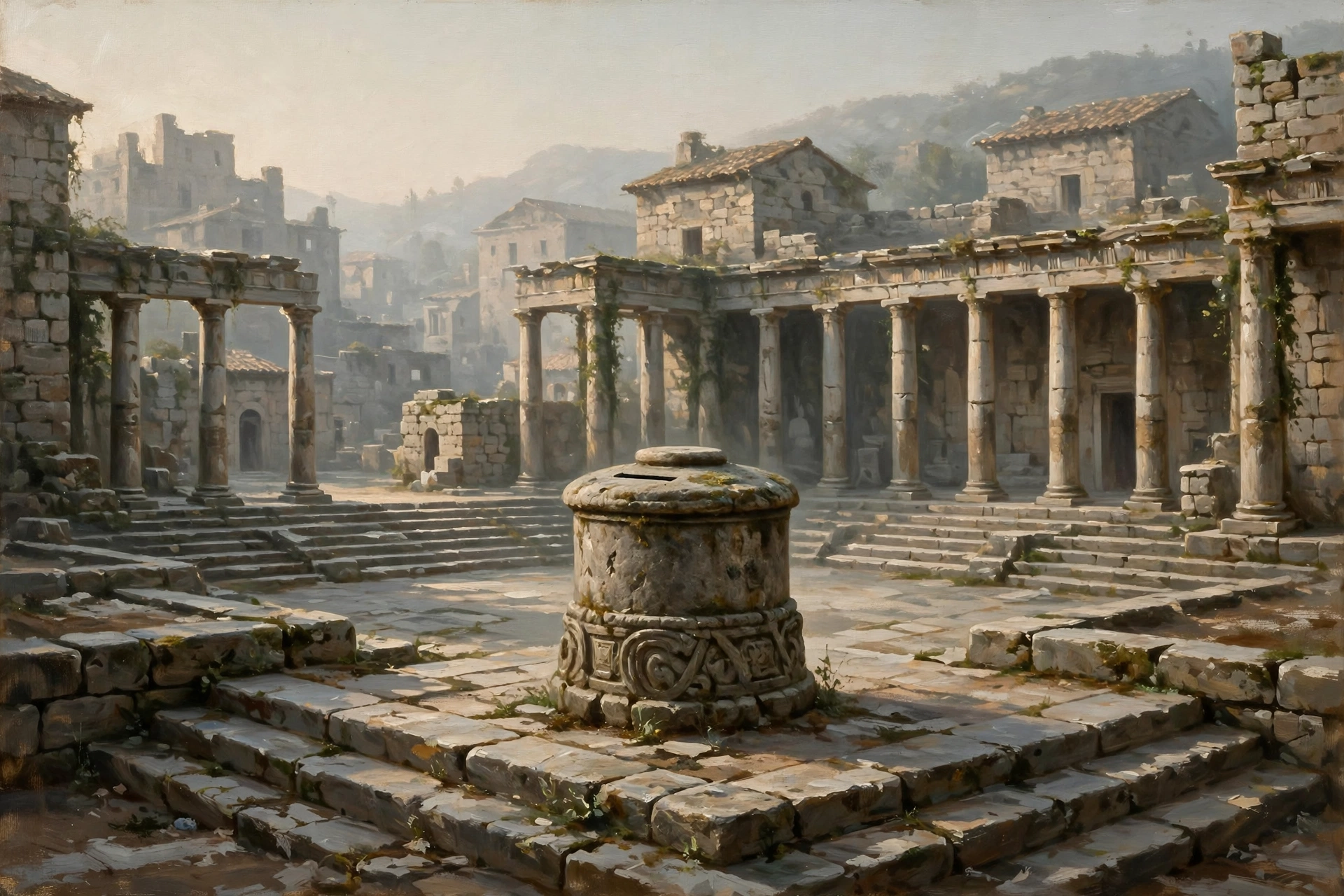
場面の絵に選んだのは、石造りの都市の広場と、その中央に置かれた投票の壺である。市民の核心を「参与」に見る立場にとって、壺は資格そのものの器である。ただし場面では、参与できない者にも市民資格はあるという声が、それに抗して置かれる。
場面 THE SCENE
この絵について
描かれているのは、古代の石造りの都市の広場である。中央には蓋のついた大きな石の壺が置かれ、周囲を列柱と石段が取り囲んでいる。壺の蓋には、票を投げ入れるための細い口が開いている。人は描かれていない。
この壺は、入口で見た市民の像の一つである。市民の核心を「統治への参与」に見る立場にとって、投票の壺は資格そのものの器である。だが場面では、票を入れられない者にも市民の資格は失われないという声と、広場の外へ目を向けて世界市民を語る声が、この器の意味を問い直す。
※モチーフは、「市民」について一般に共有されている像(都市の広場と参与の器)を既定として選んだ。絵は差し替え可能とする。
市民とは誰か。——最初に口を開いたのはアリストテレスだった。ある都市で統治の裁判と執行の部分に参与する権利をもつ者を、その場所の市民と呼ぶ。都市とは一言で言えば、生活のあらゆる目的に自足する、そのような人々の集合体なのである、と。市民はまず、そこに住む者ではなく、治めることと裁くことに参与する者として置かれて始まった。
Aristotle(アリストテレス)立てる ― 市民とは、統治の裁判と執行に参与する権利をもつ者である
しかし先の市民の説明は修正しうる。ある政体では陪審員と民会議員の職務は無限定なものではな く、そのための特定の人々が任命されるからであり、市民の一部または全員が、あらゆる訴訟と公 務すべてについて、あるいはある特定のものについて、陪審員または民会議員に任命されるのであ る。これで市民とは何かを示すには十分だろう。 ある都市で統治の裁判と執行の部分に参与する権利をもつ者を、その場所の市民と呼び、都市とは 一言で言えば、生活のあらゆる目的に自足する、そのような人々の集合体なのである。
原文
But our former description of a citizen will admit of correction; for in some governments the office of a juryman and a member of the general assembly is not an indeterminate one; but there are particular persons appointed for these purposes, some or all of the citizens being appointed jurymen or members of the general assembly, and this either for all causes and all public business whatsoever, or else for some particular one: and this may be sufficient to show what a citizen is; for he who has a right to a share in the judicial and executive part of government in any city, him we call a citizen of that place; and a city, in one word, is a collective body of such persons sufficient in themselves to all the purposes of life.
— Aristotle『Politics: A Treatise on Government』 CHAPTER I(William Ellis 訳) / `aristotle_politics#L2802`
ルソーは、その参与の代価を最も厳しい形で示した。他人の犠牲で自分の生命を守ろうとする者は、必要なときには、他人のために生命を捨てる覚悟もあるべきである。さらに市民は、統治者が「あなたが死ぬことが国家のために得策である」と言うなら、死ぬべきである。その条件によってのみ今まで安全に生きてきたのであり、その生命はもはや自然の単なる恵みではなく、国家が条件つきで与えた贈り物だからである、と。市民であることは、生命を担保とする資格として置かれた。
Jean-Jacques Rousseau(ルソー)条件 ― 市民の生命は、国家が条件つきで与えた贈り物である
他人の犠牲で自分の生命を守ろうとする者は、必要なときには、他人のために生命を捨てる覚悟も あるべきである。さらに市民は、法律が自分にさらされるよう求める危険の裁判官ではもはやなく、 統治者が「あなたが死ぬことが国家のために得策である」と言うなら、死ぬべきである。 その条件によってのみ今まで安全に生きてきたのであり、その生命はもはや自然の単なる恵みでは なく、国家が条件つきで与えた贈り物だからである。
原文
He who wishes to preserve his life at others expense should also, when it is necessary, be ready to give it up for their sake. Furthermore, the citizen is no longer the judge of the dangers to which the law desires him to expose himself; and when the prince says to him: "It is expedient for the State that you should die," he ought to die, because it is only on that condition that he has been living in security up to the present, and because his life is no longer a mere bounty of nature, but a gift made conditionally by the State.
— Jean-Jacques Rousseau『The Social Contract & Discourses』 CHAPTER V(G. D. H. Cole 訳) / `rousseau_social_contract#L2726`
ソローは、その服従の要求を良心の側から切り返した。多数者が事実上正邪を決めるのではなく、良心が決め、多数者は便宜の規則が適用できる問題だけを決めるような政府はありえないのか。市民は一瞬たりとも、あるいは最小限にせよ、自分の良心を立法者に委ねなければならないのか、と。市民の資格は、国家への担保から、国家に委ねてはならない良心の保持へと置き直された。
Henry David Thoreau(ソロー)覆す ― 市民は、一瞬たりとも良心を立法者に委ねてはならない
多数者が事実上正邪を決めるのではなく、良心が決め、多数者は便宜の規則が適用できる問題だけ を決めるような政府はありえないのか。 市民は一瞬たりとも、あるいは最小限にせよ、自分の良心を立法者に委ねなければならないのか。
原文
Can there not be a government in which the majorities do not virtually decide right and wrong, but conscience?—in which majorities decide only those questions to which the rule of expediency is applicable? Must the citizen ever for a moment, or in the least degree, resign his conscience to the legislator?
— Henry David Thoreau『On the Duty of Civil Disobedience』 / `thoreau_civil_disobedience#L95`
ハーランは、市民の内部に引かれた線を否定した。憲法に照らし、法の目から見れば、この国に上位の、支配的な、統治する市民階級は存在しない。ここにカーストは存在しない。われわれの憲法は色を見分けず、市民の間に階級を認めも許しもしない。市民的権利に関して、すべての市民は法の前で平等である。最も卑しい者も最も強大な者と同等である、と。これは判決の多数意見ではなく、反対意見として述べられた。市民の平等は、結論としてではなく、少数意見の側に置かれて残った。
John Marshall Harlan(ハーラン)平等 ― 法の前に、支配的な市民階級は存在しない
しかし憲法に照らし、法の目から見れば、この国に上位の、支配的な、統治する市民階級は存在し ない。ここにカーストは存在しない。われわれの憲法は色を見分けず、市民の間に階級を認めも許 しもしない。市民的権利に関して、すべての市民は法の前で平等である。 最も卑しい者も最も強大な者と同等である。
原文
But in view of the constitution, in the eye of the law, there is in this country no superior, dominant, ruling class of citizens. There is no caste here. Our constitution is color-blind, and neither knows nor tolerates classes among citizens. In respect of civil rights, all citizens are equal before the law. The humblest is the peer of the most powerful.
— Supreme Court of the United States『Plessy v. Ferguson, 163 U.S. 537 (1896)』 Plessy v. Ferguson, 163 U.S. 537 (1896) / `case_plessy_v_ferguson_1896#L701`
最後にセネカが、市民の枠を外側へ開いた。市民の身分を失ったと仮定しよう。それなら人間の身分を行使すればよい。われわれが高邁にも一つの都市の壁の内に閉じこもるのを拒み、あらゆる土地との交わりを享受するため出かけ、世界市民であると公言してきた理由は、そうすることで徳を示すためのより広い舞台を得るためである、と。参与の資格として始まった市民は、人間としての身分と、世界への所属として置かれて、議論は締められた。
Seneca(セネカ)締め ― 市民の身分を失えば、人間の身分を行使すればよい
市民の身分を失ったと仮定しよう。それなら人間の身分を行使すればよい。 われわれが高邁にも一つの都市の壁の内に閉じこもるのを拒み、あらゆる土地との交わりを享受す るため出かけ、世界市民であると公言してきた理由は、そうすることで徳を示すためのより広い舞 台を得るためである。
原文
Suppose that he has lost the status of a citizen; then let him exercise that of a man: our reason for magnanimously refusing to confine ourselves within the walls of one city, for having gone forth to enjoy intercourse with all lands and for professing ourselves to be citizens of the world is that we may thus obtain a wider theatre on which to display our virtue.
— Seneca『Minor Dialogues, Together With the Dialogue on Clemency』 THE NINTH BOOK(Aubrey Stewart 訳) / `seneca_minor_dialogues#L8249`
参与する権利としての市民、生命を担保とする条件、委ねてはならない良心、法の前の平等、そして世界市民。——市民の姿は、声ごとに違う資格の測り方で描かれた。
控えの一句 ON THE BENCH
Benjamin R. Curtis(カーティス)
軸1(法的所属の側) ― 「市民たることは、特定の政治的権利や、さらには市民的権利すべての所有にも依存しない」。投票も公職もできない者が市民でありうるという、ドレッド・スコット事件の反対意見。場面のアリストテレス(参与の側)と対になる
しかし帰化すれば直ちに、その者は確かに合衆国の市民である。 またコロンビア特別区あるいはいずれの準州の住民も、合衆国市民でありうるが、連邦議会の上院 議員や下院議員の職に就く資格はない。 同様に、すべての州で、多数の者が市民であるにもかかわらず、年齢、性別、または必要な法的資 格の欠如のために、投票できず、あるいは公職に就けない。 真実は、合衆国憲法の下で、市民たることは特定の政治的権利や、さらには市民的権利すべてを所 有することにも依存しないということであり、そのように定義しようとすれば必ず誤りに至る。 どの市民に選挙権を委ねるかは、各州がその状況の必要性や便宜についての自身の見解に従って決 定すべき問題である。
原文
Yet, as soon as naturalized, he is certainly a citizen of the United States. Nor is any inhabitant of the District of Columbia, or of either of the Territories, eligible to the office of Senator or Representative in Congress, though they may be citizens of the United States. So, in all the States, numerous persons, though citizens, cannot vote, or cannot hold office, either on account of their age, or sex, or the want of the necessary legal qualifications. The truth is, that citizenship, under the Constitution of the United States, is not dependent on the possession of any particular political or even of all civil rights; and any attempt so to define it must lead to error. To what citizens the elective franchise shall be confided, is a question to be determined by each State, in accordance with its own views of the necessities or expediencies of its condition.
— Supreme Court of the United States『Scott v. Sandford, 60 U.S. 393 (1857)』 Scott v. Sandford, 60 U.S. 393 (1857) / `case_scott_v_sandford_1857#L8385`
Immanuel Kant(カント)
軸3(善い市民は善い人間と同じか) ― 道徳的に善い人間ではない者も、制度の仕組みによって「少なくとも善い市民となるよう強いられる」。国家形成の問題は、悪魔の種族にとってさえ解決不可能ではないという、制度の側の答え
それゆえ理性の観点からは、結果は両方の力が存在しない場合と同じになり、各個人は、道徳的に 善い人間ではないにせよ、少なくとも善い市民となるよう強いられる。 国家形成の問題は、どれほど難しく聞こえようと、知性をもつことが認められるなら、悪魔の種族 にとってさえ解決不可能ではない。
原文
And hence, from the standpoint of reason, the result will be the same as if both forces did not exist, and each individual is compelled to be, if not a morally good man, yet at least a good citizen. The problem of the formation of the state, hard as it may sound, is not insoluble, even for a race of devils, granted that they have intelligence.
— Immanuel Kant『Perpetual Peace: A Philosophical Essay』 CONCERNING THE GUARANTEE OF PERPETUAL PEACE(Mary Campbell Smith 訳) / `kant_perpetual_peace#L4451`
Robert H. Jackson(ジャクソン)
軸6(市民教育は異論を守るか) ― 「われわれの憲法の星座に不動の星があるとすれば、それは、高官であれ小役人であれ、何が正統であるべきかを定めたり、それへの信仰を告白するよう市民に強いたりできない、ということである」。国旗への敬礼の強制を退けたバーネット事件の判決
われわれの憲法の星座に不動の星があるとすれば、それは、高官であれ小役人であれ、政治、国粋 主義、宗教、その他の意見の問題で何が正統であるべきかを定めたり、それへの信仰を言葉や行為 で告白するよう市民に強いたりできない、ということである。 例外を許す事情があるとしても、今われわれには思い当たらない。
原文
If there is any fixed star in our constitutional constellation, it is that no official, high or petty, can prescribe what shall be orthodox in politics, nationalism, religion, or other matters of opinion or force citizens to confess by word or act their faith therein. If there are any circumstances which permit an exception, they do not now occur to us.
— Supreme Court of the United States『West Virginia State Board of Education v. Barnette, 319 U.S. 624 (1943)』 West Virginia State Board of Education v. Barnette, 319 U.S. 624 (1943) / `case_west_virginia_state_board_of_education_v_barnette_1943#L404`
Mary Wollstonecraft(ウルストンクラフト)
軸2/軸10(財産・労働・家庭は資格を狭めるか) ― 「女性を理性的被造物と自由な市民にすれば、すぐに善い妻、善い母となるだろう」。市民の範囲から外されてきた者を、内側へ招く一句
私が引き出したい結論は明らかである。 女性を理性的被造物と自由な市民にすれば、すぐに善い妻、善い母となるだろう。 つまり、男が夫と父の義務を怠らなければ、である。
原文
The conclusion which I wish to draw is obvious; make women rational creatures and free citizens, and they will quickly become good wives, and mothers; that is--if men do not neglect the duties of husbands and fathers.
— Mary Wollstonecraft『A Vindication of the Rights of Woman』 CHAPTER 12 / `wollstonecraft_vindication_of_woman#L8342`
Niccolo Machiavelli(マキャヴェッリ)
軸9(市民団を閉じることは自由を守るか)の傍ら ― 共和国は評判の善い市民なしには存続しないが、特定の市民が享受する信用は、しばしば僭主制の樹立に至る。市民は、国家とその自由を益する振る舞いによってのみ信用を得るよう仕組まれなければならない
そして問題をさらに十分に論じるために言うが、共和国は評判の善い市民なしには長く存続するこ とも、仕事を有利に運ぶこともできない一方、特定の市民が享受する信用は、しばしば僭主制の樹 立に至る。そのような理由から、また物事を安全に進めるため、市民は、国家とその自由を害する 振る舞いではなく、益する振る舞いによってのみ信用を得るよう、仕組まれなければならない。
原文
And to treat the matter with greater fulness, I say, that while a republic can never maintain itself long, or manage its affairs to advantage, without citizens of good reputation, on the other hand the credit enjoyed by particular citizens often leads to the establishment of a tyranny. For which reasons, and that things may take a safe course, it should be so arranged that a citizen shall have credit only for such behaviour as benefits, and not for such as injures the State and its liberties.
— Niccolo Machiavelli『Discourses on the First Decade of Titus Livius』 CHAPTER XXVIII(Ninian Hill Thomson 訳) / `machiavelli_discourses_livy#L12281`