CONSTITUTION
idea-no-tane の全引用から選んだ超精選による、概念ごとの読み物。
入口 THE WORD
この概念が扱うのは、国家の骨格である。最高権力がどこに置かれるかという「国制」の配置から、成文の最高法としての憲法までがここに入る。場面に入る前に、まずこの語そのものの旅をたどる。語源は「真の意味」ではない。だが、語がどこから来て、どう意味を変えてきたかという経緯は、後ろに並ぶ偉人たちの議論を読むための地図になる。
語源 ― constituere「立たせる、据える」
英語の constitution は、ラテン語の constitutio に由来する。constitutio は constituere「立たせる、据える、定める、秩序づける」から来ていて、constituere は com-(共に)と statuere(置く)から成り、その根は印欧祖語の *sta-「立つ」である(Etymonline)。つまり constitution とは本来、「立てて据えること」であり、「立てて据えられた状態」の名だった。英語での意味の広がりもこの順をたどる。「国家の組織の様式」の意味は1600年頃、「共同体を統治する基本原理の体系」は1730年代、そしてアメリカとフランスの憲法以後、1780年代からは「成文の文書に体現された基本原理」を指すようになった。なお constitution には「身体の体質、気質」という意味もある(1550年代から)。一つの語が、国の骨格と身体の構成の両方を担っている。このページのキー画像の石柱と礎石は、「立たせる、据える」という根の比喩による。
ギリシャ ― politeia(国制)
場面の最初に置いたアリストテレスの定義で「国制」と訳されている語は、ギリシャ語の politeia(ポリテイア)である。アリストテレスにとって国制とは、個々の法律のことではなく、国家のすべての官職、とりわけ最高権力が置かれる官職の秩序づけそのものだった。憲法というと成文の法典を思い浮かべるが、この概念の議論は、法典以前の「権力の配置」の層から始まっている。
日本語との対応 ― 憲法
日本語の「憲法」は、もとは十七条憲法のように「きまり、おきて」を意味する語だった。英語 constitution の訳語としては、当初「国憲」「国制」「朝綱」といった語が充てられたが、1882年(明治15年)頃から「憲法」が充てられるようになり、訳語として確立した(Weblio辞書「憲法」の解説)。近代の日本語で「憲法」と言えば成文の最高法規を指すのが普通だが、英語の constitution は今も、英国のような成文法典を持たない国の「国制」全体をも指すことができる。訳語の「憲法」が法典の像に寄った分だけ、原語の持つ「配置・骨格」の像が薄れた。このずれが、この概念の議論の振幅を作っている。
語の旅をまとめると、憲法は「立てて据えること」の言葉として生まれ、ギリシャでは権力の配置の名となり、日本語では成文の最高法規の名として迎えられた。このあとの場面で争われるのは、まさにその骨格の正体である。憲法は人民が作るものか、歴史が育てるものか。そして、悪しき憲法に従う義務はあるのか。
場面 THE SCENE
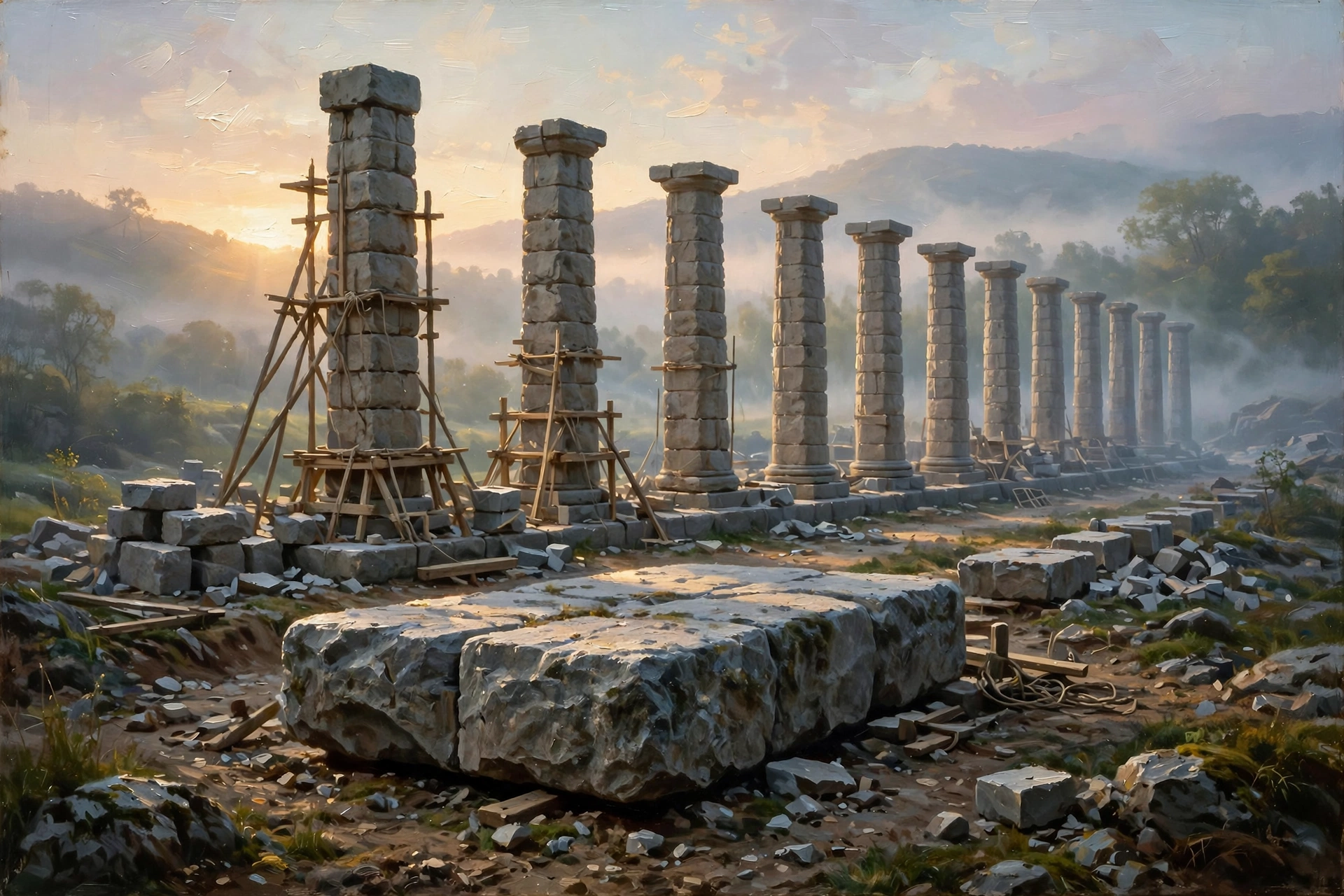
この絵について
描かれているのは、夜明けの光の中で建設途中の石柱の列である。何本かはすでに立ち、残りには足場がかかり、手前には据えられたばかりの大きな礎石がある。人物は一人もいない。
柱と礎石は、国の骨格について一般に共有されている像である。そしてこの概念の語の根にも「立てる」ことがある。ラテン語の constitutio は constituere「立たせる、据える」から来た(入口参照)。この場面で五人が争うのは、その骨格を誰が据えるのか——人民か、歴史か——であり、据えられた骨格が悪でありうるかどうかである。建設途中の姿にしたのは、憲法が完成品ではなく、世代を超えて立て続けられるものだからである。
※モチーフは、「憲法」について一般に共有されている像(建設途中の石柱と礎石)を既定として選んだ。絵は差し替え可能とする。
憲法とは何か。——最初に口を開いたのは、法典ではなく権力の配置として国制を定義したアリストテレスだった。
Aristotle(アリストテレス)立てる ― 国制は最高権力の配置
以上の点を確定したので、次に、ただ一つの国制だけを設けるべきか、それとも複数を設けるべき か、そして複数ならばいくつ、どのような種類で、それらのあいだにはどのような相違があるのか を考察しよう。国制とは、国家とその内部のすべての官職、とりわけ最高権力が置かれる官職の秩 序づけと規制である。そしてこの権力はつねに統治機関が有するが、統治機関そのものが、どの国 家にも設けられている特定の国制なのである。 したがって民主制では最高権力は人民全体に置かれ、反対に寡頭政では少数者の手中にある。 それゆえわれわれは、これらの国家では国制が異なると言うのであり、他の国家についても同じこ とが成り立つと分かるだろう。
原文
Having established these points, we proceed next to consider whether one form of government only should be established, or more than one; and if more, how many, and of what sort, and what are the differences between them. The form of government is the ordering and regulating of the city, and all the offices in it, particularly those wherein the supreme power is lodged; and this power is always possessed by the administration; but the administration itself is that particular form of government which is established in any state: thus in a democracy the supreme power is lodged in the whole people; on the contrary, in an oligarchy it is in the hands of a few. We say then, that the form of government in these states is different, and we shall find the same thing hold good in others.
— Aristotle『Politics: A Treatise on Government』 CHAPTER VI(William Ellis 訳) / `aristotle_politics#L3093`
ペインは、その定義を作り主の側から組み替えた。憲法は政府の行為ではなく、人民の行為だ、と。
Thomas Paine(ペイン)立てる ― 人民の行為としての憲法
憲法は名目だけのものではなく、事実としてのものである。 観念的な存在ではなく、現実の存在を有する。 そして目に見える形で提示できないところには、憲法は存在しない。 憲法は政府に先立つものであり、政府は憲法の被造物にすぎない。 一国の憲法はその政府の行為ではなく、その政府を構成する人民の行為である。
原文
A constitution is not a thing in name only, but in fact. It has not an ideal, but a real existence; and wherever it cannot be produced in a visible form, there is none. A constitution is a thing antecedent to a government, and a government is only the creature of a constitution. The constitution of a country is not the act of its government, but of the people constituting its government.
— Thomas Paine『The Writings of Thomas Paine — Volume 2 (1779-1792): The Rights of Man』 / `paine_rights_of_man#L1682`
バークはペインに反対した。憲法は一挙に作る設計図ではなく、相反する諸力の均衡だ、と。
Edmund Burke(バーク)覆す ― 諸力の均衡としての憲法
諸君の憲法は完成する前に停止された。 しかし諸君には、望みうる限りほぼ最良の憲法の諸要素があった。 旧来の諸身分には、諸君の共同体を幸いにも構成していたさまざまな階層に対応する多様な部分が あった。そこには、あらゆる利害の結合と対立、あの作用と反作用があり、それは自然界でも政治 の世界でも、不調和な諸力の相互の闘争から宇宙の調和を引き出すものであった。
原文
Your Constitution was suspended before it was perfected; but you had the elements of a Constitution very nearly as good as could be wished. In your old states you possessed that variety of parts corresponding with the various descriptions of which your community was happily composed; you had all that combination and all that opposition of interests, you had that action and counteraction, which, in the natural and in the political world, from the reciprocal struggle of discordant powers draws out the harmony of the universe.
— Edmund Burke『Reflections on the Revolution in France (The Works of Edmund Burke, vol. 3)』 / `burke_reflections_revolution_france#L7659`
マーシャル判事は、成文憲法の定義から結論を引き出した。至上の法に反する立法は、無効でなければならない、と。
John Marshall(マーシャル)進める ― 成文憲法の最高法性
(後者が真なら)成文憲法とは、本性上無制限な権力を制限しようとする人民の側の馬鹿げた試み だということになる。**成文憲法を定めた者は皆、それを国の根本的かつ至上の法とみなしてい る。したがってそのような政府の理論は、憲法に反する立法府の行為は無効である、というもので なければならない。**
原文
then written constitutions are absurd attempts, on the part of the people, to limit a power in its own nature illimitable. Certainly all those who have framed written constitutions contemplate them as forming the fundamental and paramount law of the nation, and consequently the theory of every such government must be, that an act of the legislature repugnant to the constitution is void.
— Supreme Court of the United States『Marbury v. Madison, 5 U.S. 137 (1803)』 Marbury v. Madison, 5 U.S. 137 (1803) / `case_marbury_v_madison_1803#L896`
最後にソローが、場面の前提そのものを疑った。憲法が正しいとは、誰が決めたのか、と。
Henry David Thoreau(ソロー)締め ― 憲法そのものが悪
しかしこの場合、国家は何の手段も用意していない。 その憲法そのものが悪なのである。
原文
But in this case the State has provided no way: its very Constitution is the evil.
— Henry David Thoreau『On the Duty of Civil Disobedience』 / `thoreau_civil_disobedience#L372`
議論は決着しなかった。ただ五人は、憲法が権力の配置でも、人民の行為でも、歴史の均衡でも、至上の法でも、そして悪でありうるものでもなることを、同じ卓の上に置いて帰った。
控えの一句 ON THE BENCH
場面には出なかったが、場面と並べて置く5件。引用はすべて idea-no-tane の精選から一字一句そのまま写したものである。
Alexis de Tocqueville(トクヴィル)
軸1「憲法とは何か」― 憲法は立法者をも支配する第一の法であるという、アメリカ型の構造
合衆国では、憲法は私人と同じく立法者をも支配する。 憲法は第一の法であるから、法律によって改められえず、したがって裁判所が、いかなる法律より も憲法に従うのは正しい。この条件は司法権にとって本質的である。 自分が最も厳格に拘束される法的義務を選ぶのは、すべての為政者の自然な権利だからである。
原文
In the United States the constitution governs the legislator as much as the private citizen; as it is the first of laws it cannot be modified by a law, and it is therefore just that the tribunals should obey the constitution in preference to any law. This condition is essential to the power of the judicature, for to select that legal obligation by which he is most strictly bound is the natural right of every magistrate.
— Alexis de Tocqueville『Democracy in America, Volume 1』 Chapter VI(Henry Reeve 訳) / `tocqueville_democracy_in_america_v1#L4390`
William Blackstone(ブラックストン)
軸3「混合と分立」― 三つの権力のどれかが独立を失えば国制は終わるという、英国国制観の要点
三者のうち一つでも独立を失い、あるいは他の二者のいずれかの意向に従属することがあれば、や がてわれわれの国制は終わるであろう。 立法府は、社会の一般的な同意と根本的な行為によって当初設けられたものから変えられてしまう。 そのような変化は、どのようにして生じたにせよ、ロック氏(おそらく理論を行き過ぎるほど推し 進めた人だが)によれば、統治の絆の完全な解体であり、人民は無政府状態に陥って、新たな立法 権を自ら構成する自由をもつことになる。
原文
For if ever it should happen that the independence of any one of the three should be lost, or that it should become subservient to the views of either of the other two, there would soon be an end of our constitution. The legislature would be changed from that, which was originally set up by the general consent and fundamental act of the society; and such a change, however effected, is according to Mr Locke[h] (who perhaps carries his theory too far) at once an entire dissolution of the bands of government; and the people would be reduced to a state of anarchy, with liberty to constitute to themselves a new legislative power.
— William Blackstone『Commentaries on the Laws of England, Book the First』 OF THE NATURE OF LAWS IN GENERAL / `blackstone_commentaries_v1#L2168`
James Madison(マディソン)
軸4「憲法の実効性」― 憲法上の障壁(紙の障壁)だけでは、権力の自己保存の衝動を抑えられないという現実主義
自己保存の衝動に対して憲法上の障壁を対置するのは無益である。 無益以上に悪い。それは必要な権力の簒奪を憲法そのものに植えつけ、その先例のひとつひとつが、 不必要で増殖する反復の萌芽となるからである。
原文
It is in vain to oppose constitutional barriers to the impulse of self-preservation. It is worse than in vain; because it plants in the Constitution itself necessary usurpations of power, every precedent of which is a germ of unnecessary and multiplied repetitions.
— Hamilton, Madison, Jay『The Federalist Papers』 No. XLI / `federalist_papers#L9085`
Oliver Wendell Holmes Jr.(ホームズ)
軸5「憲法の解釈」― 憲法は異なる見解の共存枠であるという、司法的自己抑制の一句
これらの法律のうちのあるものは、裁判官が共有しそうな確信や偏見を具体化しており、あるもの はそうではない。しかし**憲法は、特定の経済理論を具体化するよう意図されたものではない。 **家父長主義と市民の国家への有機的関係の理論であれ、自由放任の理論であれ。 **憲法は根本的に異なる見解を持つ人々のために作られている。 **ある意見を自然でなじみあるものと感じるか、目新しく衝撃的とさえ感じるかという偶然は、 それを具体化した法律が合衆国憲法に反するかどうかという問いについての我々の判断を決めては ならない。
原文
Some of these laws embody convictions or prejudices which judges are likely to share. Some may not. But a Constitution is not intended to embody a particular economic theory, whether of paternalism and the organic relation of the citizen to the state or of laissez faire. It is made for people of fundamentally differing views, and the accident of our finding certain opinions natural and familiar, or novel, and even shocking, ought not to conclude our judgment upon the question whether statutes embodying them conflict with the Constitution of the United States.
— Supreme Court of the United States『Lochner v. New York, 198 U.S. 45 (1905)』 Lochner v. New York, 198 U.S. 45 (1905) (Holmes, J., dissenting) / `case_lochner_v_new_york_1905#L853`
Jean-Jacques Rousseau(ルソー)
軸6「憲法と自由」― 自由は統治の形態の中ではなく、自由な人の心の中にあるという、国制論への逆説
自由はどんな統治の形態にも見いだされない。 自由は自由な人の心の中にあり、彼はどこへでもそれを携えていく。
原文
Liberty is not to be found in any form of government, she is in the heart of the free man, he bears her with him everywhere.
— Jean-Jacques Rousseau『Emile』 BOOK V([要確認] 訳) / `rousseau_emile#L23121`