CONTRACT
idea-no-tane の全引用から選んだ超精選による、概念ごとの読み物。
入口 THE WORD
この概念が扱うのは、約束が人を縛るということ——契約とは何か、なぜ守らなければならないのかという問いである。場面に入る前に、まずこの語そのものの旅をたどる。語源は「真の意味」ではない。だが、語がどこから来て、どう意味を変えてきたかという経緯は、後ろに並ぶ偉人たちの議論を読むための地図になる。
語源 ― contract は「引き合わせる」、covenant は「ともに来る」
英語の contract は、ラテン語の contractus に由来し、その動詞 contrahere は com「ともに」と trahere「引く」から成る——「引き合わせる、引き寄せる」である(Etymonline)。名詞としての contract は14世紀初頭に「二人以上のあいだの取り決め」を意味し、もともとはとりわけ結婚の取り決めを指した。取り決めそのものではなく、それを書いた文書を指すようになるのは1610年代のことである(Etymonline)。ホッブズが場面で定義する「信約」の原語 covenant は兄弟の語で、古フランス語の covenant——動詞 covenir の現在分詞——に由来し、その底のラテン語 convenire は「ともに来る、集まる、一致する」(com+venire「来る」)である(Etymonline)。一方は当事者が「引き寄せられた」姿、他方は当事者が同じ場所へ「歩いて来る」姿。契約の言葉の底には、二者が近づく運動の像が、二通り沈んでいる。
日本語との対応 ― 「契」は割り符だった
日本語の「契約」の「契」は、もともと割り符のことだった。1枚の板の中心に文字を書き、それを二つに割って双方がそれぞれ所持し、後日の証明としたのである(コトバンク『中日辞典』「契」)。字の上部の「㓞」は、目印を刻んだ札に刀を添えた形で、刀で刻み目を入れることを示す。昔は木や竹の札に刻み目を入れ、それを割符として約束の証とした。ここから「刻む」「約束する」「契約」の意味が生まれた(モジディク漢字辞典「契」の成り立ち)。もう一字の「約」は、糸を束ねて引き締める字であり、『説文解字』は「契、契刻なり」「約、束なり」と記す。つまり日本語の「契約」の底には、言葉ではなく物がある——刻んで、割って、別々に持ち、後日合わせる木の札である。このページのキー画像の割り符は、その像そのものである。約束の証は、心の中ではなく、合わさる刻み目のほうに置かれた。
語の旅をまとめると、契約は「引き合わされた者同士」「ともに来た者同士」の言葉として生まれ、日本語では「割って合わせる札」の名で迎えられた。このあとの場面で争われるのは、まさにその正体である。契約は正義の源か、言葉の定義か、人の発明か、損得の交換か、それとも約束できる動物を育てる営みか。
場面 THE SCENE
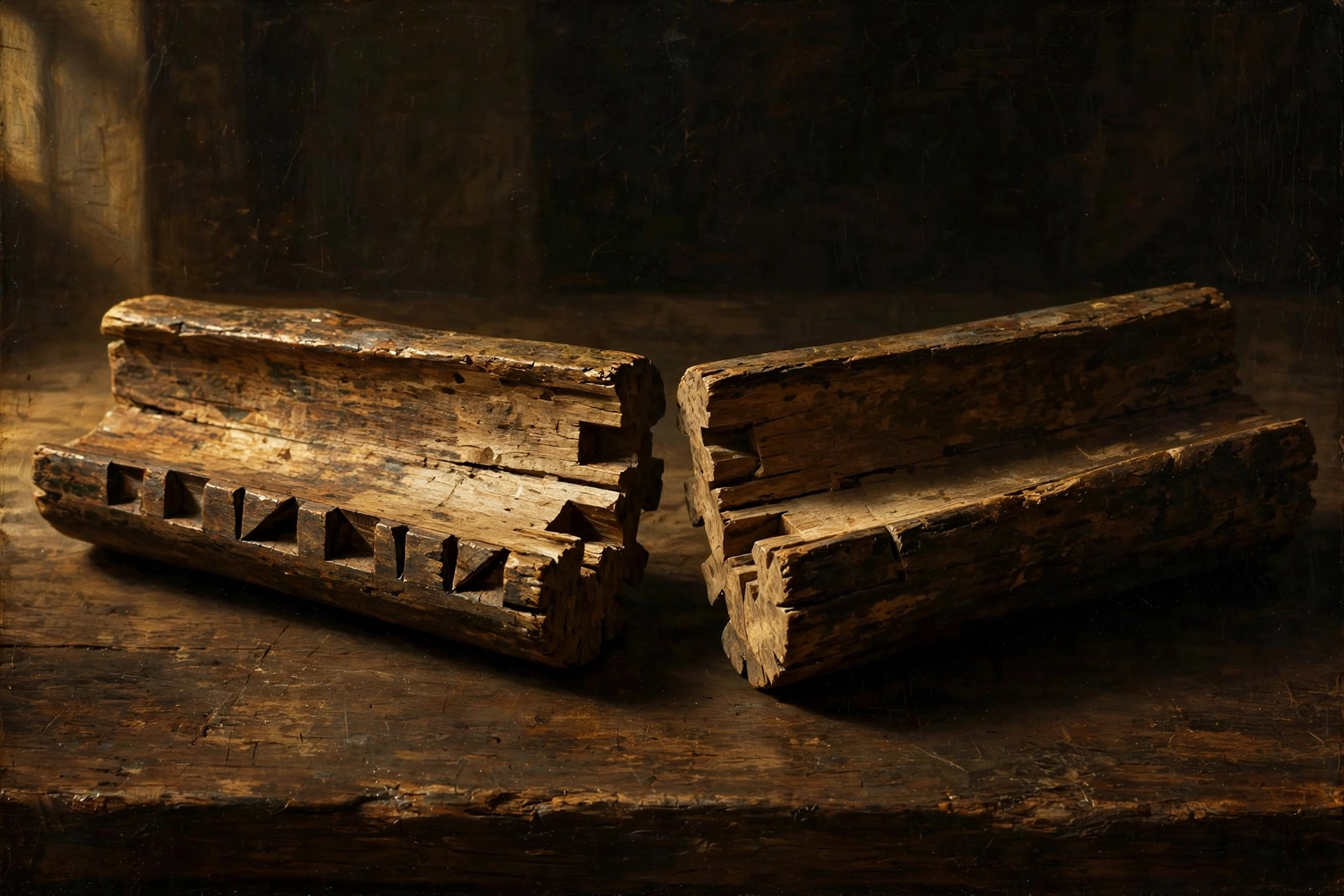
この絵について
描かれているのは、暗い木のテーブルの上に置かれた、二つに割れた木の札である。割れ目に沿った刻み目は、合わせれば互いにつながる形をしている。人は描かれていない。
入口で見たとおり、「契」は割り符の字だった。約束の証は言葉ではなく、刻んで、割って、別々に持ち、後日合わせる物に置かれた。この二つの半分は契約という営みの最古の姿である——引き合わされた者同士が、それぞれ証拠の半分を持つ。
※モチーフは、「契約」について一般に共有されている像(割り符)を既定として選んだ。絵は差し替え可能とする。
契約とは何か。——最初に口を開いたのは、最も古い源流、エピクロスだった。正義は、それ自体では存在しない。相互の契約から生じる、と。
Epicurus(エピクロス)立てる・源流 ― 正義は相互の契約から生じる
「正義はそれ自体で存在するものではない。 それは相互の契約から生じ、互いに害を加えたり受けたりしないように用心するという相互の約束 がなされる場所ならどこでも成立する。」
原文
“Justice has no independent existence; it results from mutual contracts, and establishes itself wherever there is a mutual engagement to guard against doing or sustaining mutual injury.
— Diogenes Laertius『The Lives and Opinions of Eminent Philosophers』 BOOK X(Charles Duke Yonge 訳) / `diogenes_laertius_lives#L18127`
ホッブズは、それに定義を与えた。先に渡し、後で履行させる取り決め——信約、と。
Thomas Hobbes(ホッブズ)立てる・定義 ― 信約(covenant)とは、履行が後に回る契約
また、契約者の一方は、契約された物を自分の側から引き渡し、他方には後の一定の時点に自分の 側の履行を行わせ、それまでの間信頼してもよい。 そのとき、その者の側の契約は「信約」(PACT)あるいは「盟約」(COVENANT)と呼 ばれる。あるいは双方が今契約して、将来履行することもありうる。 この場合、将来履行すべき者は信頼されているのであり、その履行は「約束を守ること」あるいは 「信義」と呼ばれ、履行の不履行は(それが自発的なものならば)「信義の違反」と呼ばれる。
原文
Again, one of the Contractors, may deliver the Thing contracted for on his part, and leave the other to perform his part at some determinate time after, and in the mean time be trusted; and then the Contract on his part, is called PACT, or COVENANT: Or both parts may contract now, to performe hereafter: in which cases, he that is to performe in time to come, being trusted, his performance is called Keeping Of Promise, or Faith; and the fayling of performance (if it be voluntary) Violation Of Faith.
— Thomas Hobbes『Leviathan』 CHAPTER XIV / `hobbes_leviathan#L4299`
ヒュームは、その土台を引いた。約束を守る義務は、自然の心の働きではない。社会の必要に基づく人間の発明だ、と。
David Hume(ヒューム)覆す ― 約束は人間の発明である
私は、これら二つの点のいずれも証明することは不可能であると考える。 それゆえ私は、約束は社会の必要と利益に基づく人間の発明であると結論することにあえてふみき る。
原文
I presume, that it is impossible to prove either of these two points; and therefore I venture to conclude that promises are human inventions, founded on the necessities and interests of society.
— David Hume『A Treatise of Human Nature』 PART II / `hume_treatise_human_nature#L18044`
ルソーは問いを国家の大きさに広げた。社会契約で人は何を失い、何を得るのか、と。
Jean-Jacques Rousseau(ルソー)ずらす ― 社会契約で失うものと得るもの
人間が社会契約によって失うのは、その自然的自由と、彼が得ようとして得ることができるあらゆ るものに対する無制限の権利である。彼が得るのは、市民的自由と、彼が持つすべてのものの所有 権である。
原文
What man loses by the social contract in his natural liberty and an unlimited right to everything he tries to get and succeeds in getting; what he gains is civil liberty and the proprietorship of all he possesses.
— Jean-Jacques Rousseau『The Social Contract & Discourses』 CHAPTER VIII(G. D. H. Cole 訳) / `rousseau_social_contract#L2264`
最後にニーチェが、契約を人間の形成の問題に変えた。約束できる動物を育て上げること——それが課題だ、と。
Friedrich Nietzsche(ニーチェ)締め ― 約束することのできる動物を育て上げる
約束することのできる動物を育て上げること——これこそ、自然が人間に関して自らに課した、あ の逆説的な課題そのものではないか。
原文
The breeding of an animal that _can promise_--is not this just that very paradox of a task which nature has set itself in regard to man?
— Friedrich Nietzsche『The Genealogy of Morals』 SECOND ESSAY. "GUILT," "BAD CONSCIENCE," AND THE LIKE(Horace B. Samuel 訳) / `nietzsche_genealogy_of_morals#L1448`
正義の源、言葉の定義、人の発明、損と得、そして育成。——契約の正体は、声ごとに違う顔を見せた。
控えの一句 ON THE BENCH
Immanuel Kant(カント)
軸:約束の道徳性(軸1)。偽りの約束は普遍的法則になりうるか
しかし、偽りの約束が義務と両立するかというこの問いへの答えを見いだす、もっとも短く誤りの ない道は、自分にこう問うことである。 「(偽りの約束によって困難から抜け出すという)私の格率が、私自身にとっても他人にとっても、 普遍的法則として妥当することに、私は満足できるだろうか」。
原文
The shortest way, however, and an unerring one, to discover the answer to this question whether a lying promise is consistent with duty, is to ask myself, "Should I be content that my maxim (to extricate myself from difficulty by a false promise) should hold good as a universal law, for myself as well as for others?"
— Immanuel Kant『Fundamental Principles of the Metaphysic of Morals』 FIRST SECTION(Thomas Kingsmill Abbott 訳) / `kant_metaphysic_of_morals#L665`
Edmund Burke(バーク)
軸:社会契約の格(軸2)。国家は胡椒やコーヒーの取引の組合ではない
社会は確かに契約である。一時的な利害を対象とする下位の契約は随意に解消してよい。 だが国家を、胡椒やコーヒー、キャラコや煙草の取引の組合契約程度のものと見なすべきではない。…… それはあらゆる学問における協同、あらゆる技芸における協同、あらゆる徳とあらゆる完成におけ る協同である。そのような協同の目的は多くの世代を経なければ達成できないので、それは生きて いる者のあいだだけでなく、生きている者、死んだ者、これから生まれる者のあいだの協同となる。 個々の国家の契約は、永遠の社会の偉大な原初の契約の一条項にすぎない。 その契約は、低い本性を高い本性へと結び、見える世界と見えない世界をつなぎ、あらゆる物理的・ 道徳的な本性をそれぞれ定められた場所に保つ不可侵の誓いによって裁可された固定の盟約に従っ ている。
原文
Society is, indeed, a contract. Subordinate contracts for objects of mere occasional interest may be dissolved at pleasure; but the state ought not to be considered as nothing better than a partnership agreement in a trade of pepper and coffee, calico or tobacco, or some other such low concern, to be taken up for a little temporary interest, and to be dissolved by the fancy of the parties. It is to be looked on with other reverence; because it is not a partnership in things subservient only to the gross animal existence of a temporary and perishable nature. It is a partnership in all science, a partnership in all art, a partnership in every virtue and in all perfection. As the ends of such a partnership cannot be obtained in many generations, it becomes a partnership not only between those who are living, but between those who are living, those who are dead, and those who are to be born. Each contract of each particular state is but a clause in the great primeval contract of eternal society, linking the lower with the higher natures, connecting the visible and invisible world, according to a fixed compact sanctioned by the inviolable oath which holds all physical and all moral natures each in their appointed place.
— Edmund Burke『Reflections on the Revolution in France (The Works of Edmund Burke, vol. 3)』 / `burke_reflections_revolution_france#L9787`
Henry Sumner Maine(メイン)
軸:契約の歴史(軸3)。進歩的社会の運動は身分から契約へ
「身分」という語は、ここに示された進歩の法則を表す定式を作るのに有益に用いうる。…… そこで、最良の著作家たちの用法に従い、「身分」をこれら人格的な条件のみを指すものとして用 い、合意の直接または間接の結果であるような条件にはこの語を適用しないことにすれば、**進 歩的社会の運動はこれまでのところ身分から契約への運動であった、と言うことができる。 **
原文
The word Status may be usefully employed to construct a formula expressing the law of progress thus indicated, which, whatever be its value, seems to me to be sufficiently ascertained. All the forms of Status taken notice of in the Law of Persons were derived from, and to some extent are still coloured by, the powers and privileges anciently residing in the Family. If then we employ Status, agreeably with the usage of the best writers, to signify these personal conditions only, and avoid applying the term to such conditions as are the immediate or remote result of agreement, we may say that the movement of the progressive societies has hitherto been a movement _from Status to Contract_.
— Henry Sumner Maine『Ancient Law』 CH V / `maine_ancient_law#L4250`
Oliver Wendell Holmes Jr.(ホームズ)
軸:守る義務の実質(軸3)。守る義務とは賠償を払う予測
コモン・ローにおいて契約を守る義務とは、それを守らなければ損害賠償を払わなければならない という予測を意味し、それ以外の何ものでもない。
原文
The duty to keep a contract at common law means a prediction that you must pay damages if you do not keep it--and nothing else.
— Oliver Wendell Holmes Jr.『The Path of the Law』 / `holmes_path_of_the_law#L230`
God(神)
軸:宗教的契約(軸4)。律法を心に書きつける新しい契約
「それらの日の後にわたしがイスラエルの家と結ぶ契約はこうである、と主は言われる。 わたしはわたしの律法を彼らの思いのなかに入れ、彼らの心にそれを書きつける。 わたしは彼らの神となり、彼らはわたしの民となる。」 「また、彼らはもはや、それぞれ自分の隣人に、それぞれ自分の兄弟に、『主を知れ』と教えるこ とはない。小さな者から大きな者まで、すべての者がわたしを知るからである。」
原文
8:10 For this is the covenant that I will make with the house of Israel after those days, saith the Lord; I will put my laws into their mind, and write them in their hearts: and I will be to them a God, and they shall be to me a people: 8:11 And they shall not teach every man his neighbour, and every man his brother, saying, Know the Lord: for all shall know me, from the least to the greatest.
— (various)『The King James Version of the Bible』 Hebrews 8:10(King James Version (1611) 訳) / `bible_kjv#L96398`