DOUBT
idea-no-tane の全引用から選んだ超精選による、概念ごとの読み物。
入口 THE WORD
問題の像
この概念が扱うのは、「判断を保留し、確かさを疑うこと(懐疑・懐疑論)」と、裁判における「合理的な疑い」である(概念の定義)。疑いの語の旅は、一つの数の像から始まる。二つ、である。
語源 ―「二つ」のあいだで
英語の doubt は、古フランス語 doter を経て、ラテン語の dubitare(疑う、ためらう、意見に揺れる)に由来する。dubitare は dubius(不確かな)と同系で、さらに duo「二つ」に結びつけられてきた。語源的には「二つのもののあいだで、心が決めかねていること」「二つのあいだから選ばなければならないこと」を表す(Etymonline「doubt」)。
なお、doubt の綴りの b は発音されない。この b は14〜16世紀に書記がラテン語の綴りに倣って挿入したもので、フランス語では後に脱落したが、英語には残った(Etymonline)。
「二つ」の像は、他の言語にも繰り返し現れる。ドイツ語の Zweifel(疑い)は zwei「二つ」から作られた語であり(Etymonline の比較)、doubt に置き換えられる前の古英語にも、tweon「二つ」に基づく tweogan(疑う)があった(Etymonline)。疑いとは、二つの道のあいだに立つことだという像が、言語を越えて共有されている。
ギリシャ語側 ― 懐疑とは「よく見ること」
疑いのもう一つの系譜は、懐疑(scepticism)である。sceptic(懐疑論者)のもとのギリシャ語 skeptikos は「よく考える、吟味する」の意で、動詞 skeptesthai「見る、考察する」に由来する(Merriam-Webster「skeptic」)。懐疑の語の芯は、信じないことではなく「よく見ること」にある。
古代の懐疑論(ピュロン派)は、対立する理由が釣り合うところで判断を留保すること(エポケー)を態度とした。本概念の検索語にも "suspend judgment"(判断の留保)が含まれている(concepts/doubt.yaml)。疑いはここでは、心の弱さではなく、見ることの徹底である。
法の場面 ― 合理的な疑い
doubt の第三の顔は法廷にある。刑事裁判で有罪を言い渡すには、「合理的な疑いを超える証明(beyond a reasonable doubt)」が必要とされる。この基準は戦後、英米法から日本の刑事訴訟にも導入された。最高裁判所は平成19年(2007年)の決定で、「合理的な疑いを差し挟む余地がない」というのは、反対事実が存在する抽象的な可能性まで消し去ることではなく、健全な社会常識に照らして合理性のない疑いは有罪認定を妨げないという趣旨だ、と説明している(「合理的な疑い」条、最判平成19年10月16日)。場面の控えに置いたモンテーニュの一句(疑わしい事実のまま人を罰する残酷さ)は、この法の疑いと響き合う。
日本語との対応 ― 疑いと懐疑
日本語の「疑い」は、和語の「うたがう」に基づく日常語で、対象は人にも事柄にも向かう。これに対して「懐疑(かいぎ)」は「疑いを懐(いだ)く」という漢語で、英語の doubt および skepticism の訳語として、哲学的な判断留保の態度を指すのに使われる(Cambridge 日英辞典「懐疑」:疑いを持つこと、doubt / skepticism)。
つまり日本語は、日常の「疑い」、態度としての「懐疑」、そして法の「合理的な疑い」とで、この概念の三つの顔を使い分けている。語源の「二つのあいだ」という像は、この三つのどの顔にも通じている。
場面 THE SCENE
この絵について
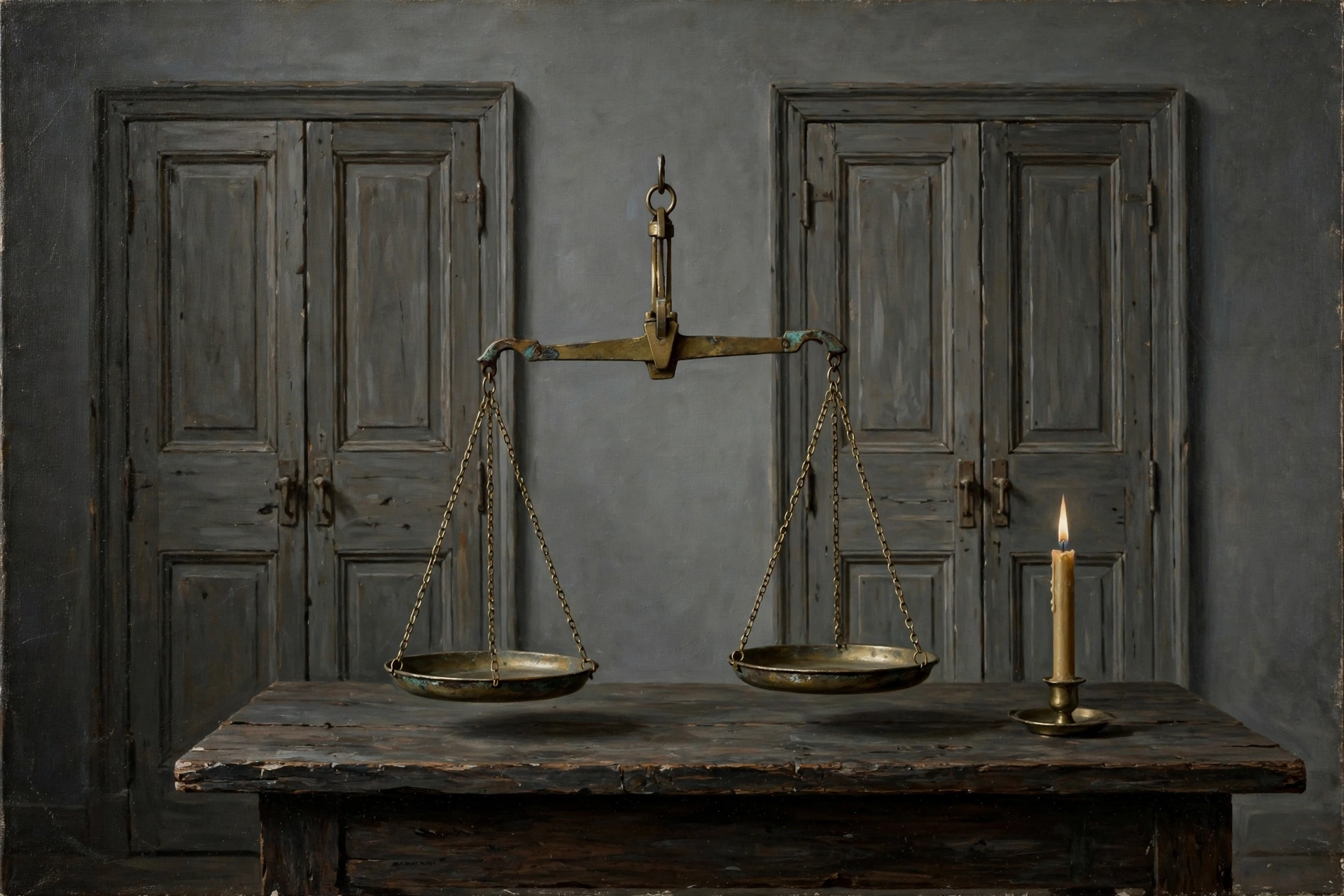
描かれているのは、灰色の部屋のテーブルの上に置かれた真鍮の天秤である。二つの皿は釣り合ったまま、どちらも沈まない。背後には、同じ形をした閉じた扉が二つ並んでいる。
入口で見た通り、疑いの語源はラテン語の duo「二つ」にあり、二つのあいだで決めかねる心を表した。釣り合って下りない天秤と、どちらを開くか決まらない二つの扉は、その「二つのあいだ」の像である。
※モチーフは、この概念について一般に共有されている像を既定として選んだ。絵は後から差し替え可能とする。
ベーコンは、疑いに仕事を与えた。疑難は双方の理由を比べさせ、誤りを防ぐ。だが、疑いを解かずに権威ある疑いとして温存する知性は、知の目的に反する、と。
Francis Bacon(フランシス・ベーコン)立てる ― 疑難の効用
第一のものについては、アリストテレスの『問題集』にその好例を見るが、これはもっとよく継続 されるに値した。しかしそれでも、警告を発し、受け止めるべき点が一つある。 疑念を記録することには二つの優れた用途がある。 一つは、十分に明らかでないものを断定としてまとめず、誤りが誤りを引き寄せないよう疑念のま ま留保することで、哲学を誤謬と虚偽から救うこと。 もう一つは、疑念を記すことが、知識の効用を吸い上げる数多くの吸い枝ないし海綿のようになる ことである。すなわち、疑念が先行しなければ人が決して気づかず、注意もせずに見過ごしたであ ろうことが、疑念の示唆と促しによって、注意を向けられ応用されるようになる。 しかしこの二つの利点も、締め出さなければ入り込んでくる不都合をほとんど埋め合わせない。 その不都合とは、ひとたび疑念が受け入れられると、人々はそれを解く方法よりも、いつまでも疑 念のまま保つ方法に力を注ぎ、それに応じて知力を傾けることである。 この身近な例を法律家と学者に見ることができる。 どちらも、ひとたび疑念を認めると、それはその後ずっと権威ある疑念として通用する。 しかし許されるべき知力と知識の用い方は、疑わしい事柄を確実にしようと努めるものであって、 確実な事柄を疑わしくしようと努めるものではない。
原文
For the first, we see a good example thereof in Aristotle’s Problems which deserved to have had a better continuance; but so nevertheless as there is one point whereof warning is to be given and taken. The registering of doubts hath two excellent uses: the one, that it saveth philosophy from errors and falsehoods; when that which is not fully appearing is not collected into assertion, whereby error might draw error, but reserved in doubt; the other, that the entry of doubts are as so many suckers or sponges to draw use of knowledge; insomuch as that which if doubts had not preceded, a man should never have advised, but passed it over without note, by the suggestion and solicitation of doubts is made to be attended and applied. But both these commodities do scarcely countervail and inconvenience, which will intrude itself if it be not debarred; which is, that when a doubt is once received, men labour rather how to keep it a doubt still, than how to solve it, and accordingly bend their wits. Of this we see the familiar example in lawyers and scholars, both which, if they have once admitted a doubt, it goeth ever after authorised for a doubt. But that use of wit and knowledge is to be allowed, which laboureth to make doubtful things certain, and not those which labour to make certain things doubtful.
— Francis Bacon『The Advancement of Learning』 THE SECOND BOOK / `bacon_advancement_of_learning#L3644`
カントは、懐疑の使い方を分けた。対立する主張を意図的に衝突させる懐疑的方法は、知識を壊す懐疑論とは違う。それは理性を独断の夢から覚ます手段だ、と。
Immanuel Kant(カント)ずらす ― 懐疑的方法
主張同士の対立を観察する、というよりむしろ生じさせるこの方法は、最終的にどちらか一方を支 持する決定を下すためではなく、争いの対象が、双方とも到達しようとしてむなしく努めるだけで、 到達しても何の利益にもならない単なる幻影ではないかを発見するためのものであり、この手続き は懐疑的方法と呼ぶことができる。それは懐疑論、すなわち、あらゆる知識の基礎を掘り崩し、で きるなら知識へのわれわれの信念と信頼を破壊しようとする、技術的かつ学問的な無知の原理とは まったく異なる。というのも懐疑的方法は、双方が誠実かつ知的に進めるこの種の対立のなかに誤 解の所在を発見しようと努めることで、確実性を目指すからである。 それはちょうど、賢明な立法者が、訴訟における裁判官の困惑から、制定法の欠陥があり明確に定 められていない部分について情報を得るようなものである。
原文
This method of watching, or rather of originating, a conflict of assertions, not for the purpose of finally deciding in favour of either side, but to discover whether the object of the struggle is not a mere illusion, which each strives in vain to reach, but which would be no gain even when reached—this procedure, I say, may be termed the sceptical method. It is thoroughly distinct from scepticism—the principle of a technical and scientific ignorance, which undermines the foundations of all knowledge, in order, if possible, to destroy our belief and confidence therein. For the sceptical method aims at certainty, by endeavouring to discover in a conflict of this kind, conducted honestly and intelligently on both sides, the point of misunderstanding; just as wise legislators derive, from the embarrassment of judges in lawsuits, information in regard to the defective and ill-defined parts of their statutes.
— Immanuel Kant『The Critique of Pure Reason』 Chapter II(J. M. D. Meiklejohn 訳) / `kant_critique_of_pure_reason#L11343`
ヒュームは、懐疑を極限まで押し進めた。そして、自分の疑いそのものをも疑う地点に立った。
David Hume(デイヴィッド・ヒューム)覆す ― 疑いを疑う
このように無頓着な仕方で哲学を研究する人の振る舞いは、哲学への傾向を自ら感じながらも疑念 と良心のためらいに圧倒され、哲学を完全に退ける人の振る舞いよりも、真に懐疑的である。 真の懐疑論者は、哲学上の確信だけでなく哲学上の疑念をも疑い、どちらかを理由として、差し出 される無害な満足を決して拒まない。
原文
The conduct of a man, who studies philosophy in this careless manner, is more truly sceptical than that of one, who feeling in himself an inclination to it, is yet so overwhelmed with doubts and scruples, as totally to reject it. A true sceptic will be diffident of his philosophical doubts, as well as of his philosophical conviction; and will never refuse any innocent satisfaction, which offers itself, upon account of either of them.
— David Hume『A Treatise of Human Nature』 PART IV / `hume_treatise_human_nature#L9675`
ニーチェは、疑いの価値を反転させた。疑いは弱さではない。確信という牢獄から自由であることこそ、精神の強さだ、と。
Friedrich Nietzsche(ニーチェ)ずらす ― 疑いは強さ
欺かれてはならない。偉大な知性は懐疑的である。 ツァラトゥストラは懐疑家である。知的な力から、知的な力の過剰から生じる強さ、自由は、懐疑 として現れる。確信をもった人間は、価値と無価値において何が根本的かを決める場面では数に入 らない。確信の人は囚人である。
原文
Do not let yourself be deceived: great intellects are sceptical. Zarathustra is a sceptic. The strength, the _freedom_ which proceed from intellectual power, from a superabundance of intellectual power, _manifest_ themselves as scepticism. Men of fixed convictions do not count when it comes to determining what is fundamental in values and lack of values. Men of convictions are prisoners.
— Friedrich Nietzsche『The Antichrist』 §54(H. L. Mencken 訳) / `nietzsche_antichrist#L2854`
ウィトゲンシュタインは、疑いの境界を引いた。疑いは、問いが立つところにしか存在しない。問いようのない場所を疑うことは、反駁できないのではなく、無意味なのだ、と。
Ludwig Wittgenstein(ウィトゲンシュタイン)締め ― 疑いの境界
懐疑論は反駁不能なのではなく、問いを立てられないところで疑おうとするなら明らかに無意味で ある。疑いは問いのあるところにしかありえず、問いは答えのあるところにしか、答えは何かが語 られうるところにしかありえないからである。
原文
Scepticism is not irrefutable, but palpably senseless, if it would doubt where a question cannot be asked. For doubt can only exist where there is a question; a question only where there is an answer, and this only where something can be said.
— Ludwig Wittgenstein『Tractatus Logico-Philosophicus』 §6.51(C. K. Ogden 訳) / `wittgenstein_tractatus#L4734`
疑いは、出発点か、方法か、深淵か、強さか、それとも意味の境界で消えるものか。五つの声は、疑いの地図の五つの地点である。
控えの一句 ON THE BENCH
場面には出なかったが、場面と並べて置く五件。引用はすべて idea-no-tane の精選から一字一句そのまま写したものである。
John Dewey(ジョン・デューイ)
軸1「探究を動かす」・軸3「疑いは行為を伴う」――思考は疑いから始まる探究の態度
これに対して思考は、すでに見たように、疑念または不確実性から始まる。 それは、支配し所有する態度ではなく、問い、追い求め、探し求める態度を示す。
原文
Thinking on the contrary, starts, as we have seen, from doubt or uncertainty. It marks an inquiring, hunting, searching attitude, instead of one of mastery and possession.
— John Dewey『Democracy and Education』 / `dewey_democracy_and_education#L10597`
David Hume(デイヴィッド・ヒューム)
軸2「判断を留保する」――理性と感覚への懐疑は反省とともに増す
理性と感覚の双方に関するこの懐疑的な疑念は、根本的には決して治癒できず、われわれがどれほ ど追い払おうとも、また時にはまったく免れたように見えようとも、刻々と戻ってこざるをえない 病である。いかなる体系によっても、われわれの知性や感覚を擁護することは不可能であり、その ような仕方で正当化しようとすれば、かえってそれらをいっそう危険にさらすだけである。 懐疑的な疑念は、それらの主題についての深く強烈な反省から自然に生じるので、われわれが反省 を進めれば進めるほど、それに反対しようと従おうと、常に増大する。
原文
This sceptical doubt, both with respect to reason and the senses, is a malady, which can never be radically cured, but must return upon us every moment, however we may chace it away, and sometimes may seem entirely free from it. It is impossible upon any system to defend either our understanding or senses; and we but expose them farther when we endeavour to justify them in that manner. As the sceptical doubt arises naturally from a profound and intense reflection on those subjects, it always encreases, the farther we carry our reflections, whether in opposition or conformity to it.
— David Hume『A Treatise of Human Nature』 PART IV / `hume_treatise_human_nature#L7872`
Blaise Pascal(パスカル)
軸2「徹底的懐疑の不可能」・軸3――疑うことは不幸だが、疑いながら探求することは義務
したがって、疑うことは不幸だが、疑いながら探究することは不可欠な義務である。 それゆえ、疑いながら探究しない者は、不幸であると同時に不公正である。
原文
To doubt is then a misfortune, but to seek when in doubt is an indispensable duty. So he who doubts and seeks not is at once unfortunate and unfair.
— Blaise Pascal『The Thoughts of Blaise Pascal』 FOR THE GENERAL INTRODUCTION(C. Kegan Paul 訳) / `pascal_thoughts#L742`
Benedict de Spinoza(スピノザ)
軸4「疑いの不在は確実性ではない」――確実性は積極的な状態である
というのも、確実性とは、単に疑念がないことではなく、ある積極的なものを意味するからである (第二部定理四三および注解)。
原文
For by certainty we mean something positive (II. xliii. and note), not merely the absence of doubt.
— Benedict de Spinoza『Ethics』 Part II(R. H. M. Elwes 訳) / `spinoza_ethics#L3344`
Michel de Montaigne(モンテーニュ)
軸6「誠実さと正義の見込み」――事実に疑いがあるのに人を罰する残酷さ
この点でギリシア人やローマ人より野蛮でない多くの国民は、まだ疑いのある過ちのために人を拷 問し、八つ裂きにすることを、恐ろしく残酷だと考える。 どうすれば、その人があなたの無知を救えるのか。
原文
Many nations less barbarous in this than the Greeks and Romans who call them so, repute it horrible and cruel to torment and pull a man to pieces for a fault of which they are yet in doubt. How can he help your ignorance?
— Michel de Montaigne『Essays of Michel de Montaigne — Complete』 CHAPTER V(Charles Cotton 訳) / `montaigne_essays_complete#L17930`