INTENTION
idea-no-tane の全引用から選んだ超精選による、概念ごとの読み物。
入口 THE WORD
この概念が扱うのは、行為の手前にある「こうしよう」という心の向きである。行為の価値はその向きで決まるのか、それとも結果で決まるのか。場面の声は、意図の重さをめぐって争う。
語源 ― intentio は「張りつめること」
英語の intention は、ラテン語の intentio(インテンティオ)に由来し、その原義は「伸ばすこと、張りつめること、努力、注意」だった。動詞 intendere は、in-「〜へ向けて」と tendere「伸ばす、張る」からなり、文字どおり「〜へ向けて張る」ことである(Etymonline)。tendere は弓の弦を張る語でもある。心を目的へ向けて張りつめる——意図の語の底には、的に向けて弓を引く姿がある。カトリック百科事典は intention を「手段を用いて目的へと到達しようと有効に望む、意志の働き」と定義する(Catholic Encyclopedia「Intention」)。
日本語との対応 ― 「心で図る」
日本語の「意図」は、「意」(心に思うこと)と「図」(計画、はかりごと)からなり、「こうしようと考えること」「おもわく」を意味する(旺文社国語辞典)。ラテン語の側が「張る」という身体の像で意図を捉えたのに対し、日本語の側は「心で図る」という像で捉えた。張る像は力の向きを、図る像はあらかじめ描くことを強調する。なお、「意図」が intention の訳語として定着した経緯の詳細は未確認である。場面で争われるのは、その心の向きが行為の価値を決めるのか、それとも傷ついた者には届かないのか、である。
場面 THE SCENE
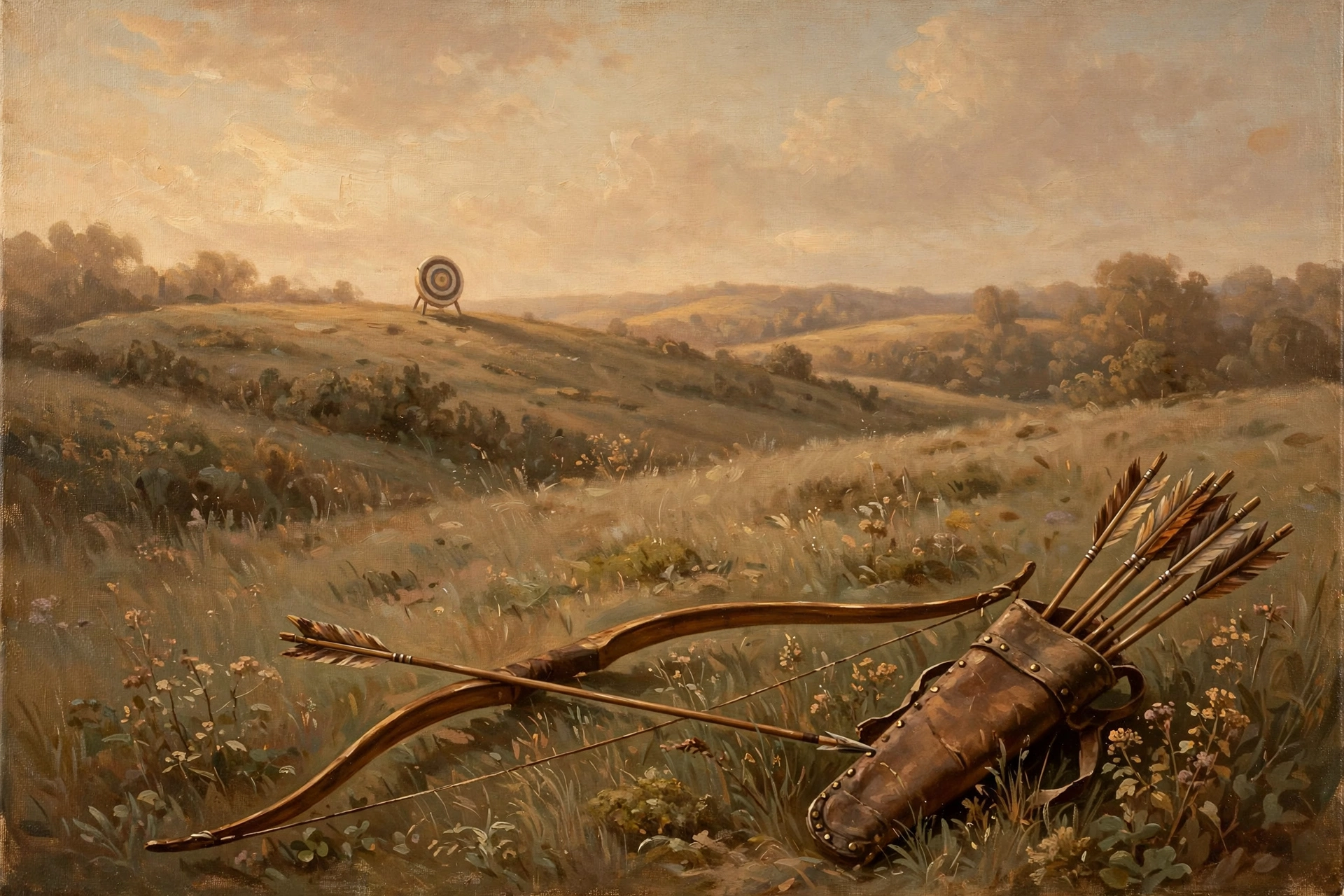
この絵について
描かれているのは、草原の前景に置かれた木の弓と矢筒、そして遠くの丘の上に立つ一つの的である。弓は草の上に横たわり、矢はまだ放たれていない。射手は描かれていない。
的へ向けて張られる前の、この静止した道具の姿は、入口で見た intentio の像である。意図とは、もとは「〜へ向けて張りつめること」だった。張られた心は、まだ行為ではなく、結果でもない。場面で争われるのは、その張りつめた向きが行為の価値を決めるのか、である。
※モチーフは、「意図」について一般に共有されている像(的へ向かう弓矢)を既定として選んだ。絵は差し替え可能とする。
意図とは何か。——最初に口を開いたのはアクィナスだった。意思は秩序づけるのではなく、理性の秩序に従って何ものかへ向かう。したがって『意図』という語は、理性が何ものかを目的へと秩序づける働きを前提とする、意思の働きを示すのだ、と。
Thomas Aquinas(トマス・アクィナス)立てる ― 意図とは、理性の秩序に従って目的へ向かう意思の働きである
3:意思は秩序づけるのではなく、理性の秩序に従って何ものかへ向かう。 したがって「意図」という語は、理性が何ものかを目的へと秩序づける働きを前提とする、意思の 働きを示す。
原文
3: The will does not ordain, but tends to something according to the order of reason. Consequently this word "intention" indicates an act of the will, presupposing the act whereby the reason orders something to the end.
— Thomas Aquinas『Summa Theologica, Part I-II (Prima Secundae)』 I-II, Q. 12, Art. 1(Fathers of the English Dominican Province 訳) / `aquinas_summa_prima_secundae#L5844`
ミルは、その意図を動機から切り分けた。行為の道徳性は、完全に意図、すなわち行為者が何を意志して行うかにかかっている。しかし動機、すなわち彼にそう意志させる感情は、行為に違いをもたらさないときには、道徳性にも違いをもたらさないのだ、と。
John Stuart Mill(ミル)区別する ― 行為の道徳性は意図にかかり、動機はそれを変えない
デイヴィス氏は、まったく許されるほどにありふれた見落としによって、この場合、動機と意図と いうまったく異なる観念を混同している。 功利主義の思想家たち(とりわけベンサム)が、これ以上に説明に労を惜しまなかった点はない。 行為の道徳性は、完全に意図、すなわち行為者が何を意志して行うかにかかっている。 しかし動機、すなわち彼にそう意志させる感情は、行為に違いをもたらさないときには、道徳性に も違いをもたらさない。もっとも、それは行為者に対するわれわれの道徳的評価には大きな違いを もたらす。とりわけ、そこから有益な行為が、あるいは有害な行為が生じそうな、習慣的な気質、 すなわち性格の傾きを示す場合にはそうである。
原文
Davis, by an oversight too common not to be quite venial, has in this case confounded the very different ideas of Motive and Intention. There is no point which utilitarian thinkers (and Bentham pre-eminently) have taken more pains to illustrate than this. The morality of the action depends entirely upon the intention--that is, upon what the agent _wills to do_. But the motive, that is, the feeling which makes him will so to do, when it makes no difference in the act, makes none in the morality: though it makes a great difference in our moral estimation of the agent, especially if it indicates a good or a bad habitual _disposition_--a bent of character from which useful, or from which hurtful actions are likely to arise.
— John Stuart Mill『Utilitarianism』 CHAPTER II / `mill_utilitarianism#L1045`
パスカルは、傷つけられた者の側から覆した。傷つけた者の意図は、傷つけられた者に何の慰めも与えない。その哀れな者には、あなたが語る密かな方向づけは何も見えず、ただ自分に加えられた一撃の方向を感じるだけである、と。
Blaise Pascal(パスカル)覆す ― 傷つけた者の意図は、傷つけられた者に何の慰めも与えない
結局のところ、傷つけた者の意図は、傷つけられた者に何の慰めも与えない。 その哀れな者には、あなたが語る密かな方向づけは何も見えず、ただ自分に加えられた一撃の方向 を感じるだけである。
原文
For, after all, the intention of the wounder conveys no comfort to the wounded. The poor man sees nothing of that secret direction of which you speak; he is only sensible of the direction of the blow that is dealt him.
— Blaise Pascal『The Provincial Letters』(Thomas M'Crie 訳) / `pascal_provincial_letters#L6415`
ニーチェは、意図中心の道徳そのものを解体した。行為の起源が、意図からの起源として解釈され、行為の価値はその意図の価値にあるという信念で人々は一致した。この偏見の影響のもとに、道徳的な称賛と非難が与えられ、人間は今日に至るまで判断し、哲学してきたのだ、と。
Friedrich Nietzsche(ニーチェ)解体する ― 行為の価値は意図の価値にあるという信念は偏見である
確かに、不吉な新しい迷信、特異な解釈の狭隘さが、まさにそれによって支配権を得た。 行為の起源が、可能なかぎり明確な意味で、意図からの起源として解釈され、行為の価値はその意 図の価値にあるという信念で人々は一致した。 意図が行為の唯一の起源であり前史であるとされた。 この偏見の影響のもとに、道徳的な称賛と非難が与えられ、人間は今日に至るまでほとんど判断し、 さらには哲学してきたのである。
原文
To be sure, an ominous new superstition, a peculiar narrowness of interpretation, attained supremacy precisely thereby: the origin of an action was interpreted in the most definite sense possible, as origin out of an INTENTION; people were agreed in the belief that the value of an action lay in the value of its intention. The intention as the sole origin and antecedent history of an action: under the influence of this prejudice moral praise and blame have been bestowed, and men have judged and even philosophized almost up to the present day.
— Friedrich Nietzsche『Beyond Good and Evil』 CHAPTER II(Helen Zimmern 訳) / `nietzsche_beyond_good_and_evil#L1109`
最後にセネカが、意図の側に残るものを言った。われわれは意図において打ち負かされることはなく、力の及ばぬものに屈して恥辱を受けることもありえない。結果は運に委ねられても、意図は自分の側に残るのだ、と。
Seneca(セネカ)締め ― われわれは意図において打ち負かされることはない
われわれは意図において打ち負かされることはなく、力の及ばぬものに屈して恥辱を受けることも ありえない。
原文
We can neither be conquered in intention, nor can we be disgraced by yielding to what is beyond our strength to contend with.
— Seneca『L. Annaeus Seneca on Benefits』 BOOK V(Aubrey Stewart 訳) / `seneca_on_benefits#L4099`
目的へ向かう意思の働きとしての意図、動機と切り分けられる意図、傷ついた者には届かない意図、偏見としての意図中心主義、そして打ち負かされない意図。——意図の重さは、声ごとに違う場所に置かれた。
控えの一句 ON THE BENCH
Jeremy Bentham(ベンサム)
軸2 ― 「行為は、その結果が意図されていなくても、きわめて容易に意図的でありうる」。意図的な行為と意図された結果の切り分け
三 行為は、その結果が意図されていなくても、きわめて容易に意図的でありうるし、実際しばし ばそうである。
原文
III. The act may very easily be intentional without the consequences; and often is so.
— Jeremy Bentham『An Introduction to the Principles of Morals and Legislation』 Chapter VIII / `bentham_principles_of_morals_and_legislation#L2774`
the Jesuit father(イエズス会の神父)
軸4 ― 「意図を方向づける」方法。許される対象を目的に置き、目的の善さによって手段の悪さを正すという技法。話者は母データの表記のまま
あなたはいつも極端から極端へ飛ぶ。……我々がなんでも許しているわけではないことを示すため に言えば、罪を犯すことだけを目的とした形式的な罪の意図は決して認めない。…… しかしその人がそれほど邪悪な性質でないなら、我々は「意図を方向づける」方法を実践させる。 それは単に、自分の行為の目的として何か許される対象を自分に提示することである。…… 行為を防げないときは、少なくとも動機を清める。 こうして目的の善さによって手段の悪さを正すのである。
原文
“You always fly from the one extreme to the other,” replied the monk: “prithee avoid that habit. For just to show you that we are far from permitting everything, let me tell you that we never suffer such a thing as a formal intention to sin, with the sole design of sinning; and if any person whatever should persist in having no other end but evil in the evil that he does, we break with him at once: such conduct is diabolical. This holds true, without exception of age, sex, or rank. But when the person is not of such a wretched disposition as this, we try to put in practice our method of _directing the intention_, which simply consists in his proposing to himself, as the end of his actions, some allowable object. Not that we do not endeavor, as far as we can, to dissuade men from doing things forbidden; but when we cannot prevent the action, we at least purify the motive, and thus correct the viciousness of the mean by the goodness of the end.
— Blaise Pascal『The Provincial Letters』 Letter VII(Thomas M'Crie 訳) / `pascal_provincial_letters#L5942`
Oliver Wendell Holmes Jr.(ホームズ)
軸2 ― 法において悪意、意図、過失が意味するのは、行為者の知っていた状況のもとで危険が明白であったことだけだという、外的基準への置き換え
私は、悪意、意図、過失が通常意味するのは、行為者の知っていた状況のもとで危険が多かれ少な かれ明白であったということだけだと考える。 ただし、特権の場合には、悪意が現実の悪意ある動機を意味することがあり、そのような動機は、 公共の優越的な善のあれこれの根拠に基づいて本来なら認められたはずの、害を知りつつ加える許 しを奪うことがある。
原文
I think that commonly malice, intent, and negligence mean only that the danger was manifest to a greater or less degree, under the circumstances known to the actor, although in some cases of privilege malice may mean an actual malevolent motive, and such a motive may take away a permission knowingly to inflict harm, which otherwise would be granted on this or that ground of dominant public good.
— Oliver Wendell Holmes Jr.『The Path of the Law』 / `holmes_path_of_the_law#L595`
David Hume(ヒューム)
軸3 ― 「われわれは意図によって行為を判断し、それが善いか悪いかに応じて、行為は愛や憎しみの原因となる」。偶然に害した者は敵にならない
さらに別の条件を加え、苦痛や快楽がその人から生じるだけでなく、それが知りつつ、特定の企図 と意図をもって生じることを求める者もいる。 偶然にわれわれを傷つけ害した人は、それだけでは敵にならず、同じ仕方でわれわれに何か奉仕を した人に対しても、感謝の絆に縛られているとは思わない。 われわれは意図によって行為を判断し、それが善いか悪いかに応じて、行為は愛や憎しみの原因と なる。
原文
There are some, who add another condition, and require not only that the pain and pleasure arise from the person, but likewise that it arise knowingly, and with a particular design and intention. A man, who wounds and harms us by accident, becomes not our enemy upon that account, nor do we think ourselves bound by any ties of gratitude to one, who does us any service after the same manner. By the intention we judge of the actions, and according as that is good or bad, they become causes of love or hatred.
— David Hume『A Treatise of Human Nature』 PART II / `hume_treatise_human_nature#L12151`
Karl Marx(マルクス)
軸4 ― 「地獄への道は善意で敷き詰められている」。善意批判の決まり文句
地獄への道は善意で敷き詰められている。 そして彼は、まったく生産せずに金をもうけるつもりだったとしても、同じようにたやすくそうあ りえた。
原文
The way to Hell is paved with good intentions, and he might just as easily have intended to make money, without producing at all.
— Karl Marx『Capital: A Critique of Political Economy, Vol. 1』 SECTION 2(Samuel Moore and Edward Aveling 訳) / `marx_capital_v1#L9926`