JUSTICE
idea-no-tane の全引用から選んだ超精選による、概念ごとの読み物。
入口 THE WORD
この概念が扱うのは「正しさ」の中でも、とりわけ人に何が帰属し、何がなされるべきかという正義である。場面に入る前に、まずこの語そのものの旅をたどる。語源は「真の意味」ではない。だが、語がどこから来て、どう意味を変えてきたかという経緯は、後ろに並ぶ偉人たちの議論を読むための地図になる。
語源 ― ius(権利・法)から
英語の justice は12世紀半ばに現れ、古フランス語の justice を経て、ラテン語の iustitia に由来する。iustitia は「正しさ、衡平」を意味し、iustus「正しい、合法の」から、さらに ius「権利、法」から来ている(Etymonline)。ius のさらに先については、印欧祖語の「聖なる定め(定式)」に関わる語根に遡るとする説がある(Wiktionary)。つまり justice の語の底には、道徳的な「正しさ」の前に、まず「法・権利」という制度の言葉が沈んでいる。
ギリシャ語 ― dikaiosyne(ディカイオシュネー)
ギリシャ語の正義は dikaiosyne である。その核にある dike(ディケー)は、もともと「慣習、ならわし」を指す語で、「示す」という意味の印欧祖語の語根に結びつけられる(Etymonline)。正義はギリシャでも、「示された道筋=慣習」から出発した。ディケーは正義の女神として擬人化され、ローマのユースティティア(Justitia)は天秤と剣を持つ姿で描かれるようになる。このページのキー画像の天秤と剣は、この図像の伝統による。なお、ユースティティアの目隠しも広く知られた要素だが、その成立の時期は本調査では未確認である。
英語の辞書的意味
現代の英語で justice の中心にあるのは「公正であること、正当さ」だが、この語は同時に「法の執行、司法」そのものも指し、裁判官の敬称(Justice)にもなる。一つの語が「徳としての正しさ」と「制度としての司法」を兼ねていることが、この概念の議論の振幅を作っている。
フランス語・ドイツ語
フランス語の justice も同じラテン語の系統である。これに対してドイツ語では、正義は Gerechtigkeit(ゲレヒティヒカイト)といい、法・権利を指す Recht とは語が分かれている。英語の justice が一語で担うものを、ドイツ語は二つの語に分けている。
日本語との対応 ― 正義
日本語の「正義」は、もとは儒学の用語で、「人として踏み行うべき正しい道理」を意味した。古くは「正しい解釈・注釈」の意味でも使われ、『五経正義』の「正義」はその例である。幕末の1862年に出た『英和対訳袖珍辞書』では、justice は「正直ナルコト、公事ノ捌キ、捌く人、裁判役人」などと訳され、「正義」の訳語はまだ確立していなかった。井上哲次郎の編んだ『哲学字彙』(1881)には「Justice 正義」とあり、思想史家の家永三郎は、justice の意味で「正義」が使われ始めたのはおそらく明治以後だろうと述べている。訳語としての「正義」は儒学の「正しい道理」の響きを引き継いだため、英語の justice がもともと持っていた「裁判・公正・平等」の制度の色が薄まった、という指摘もある(以上、国立国会図書館レファレンス協同データベースの事例が引く『日本国語大辞典』『哲学・思想翻訳語事典』などによる)。
語の旅をまとめると、正義は「法と権利」の制度の言葉として生まれ、「正しい道理」の徳の言葉として日本語に迎えられた。このあとの場面で争われるのは、まさにこの二つの顔である。正義は決まりなのか、心の正しさなのか、それとも力の別名なのか。
場面 THE SCENE
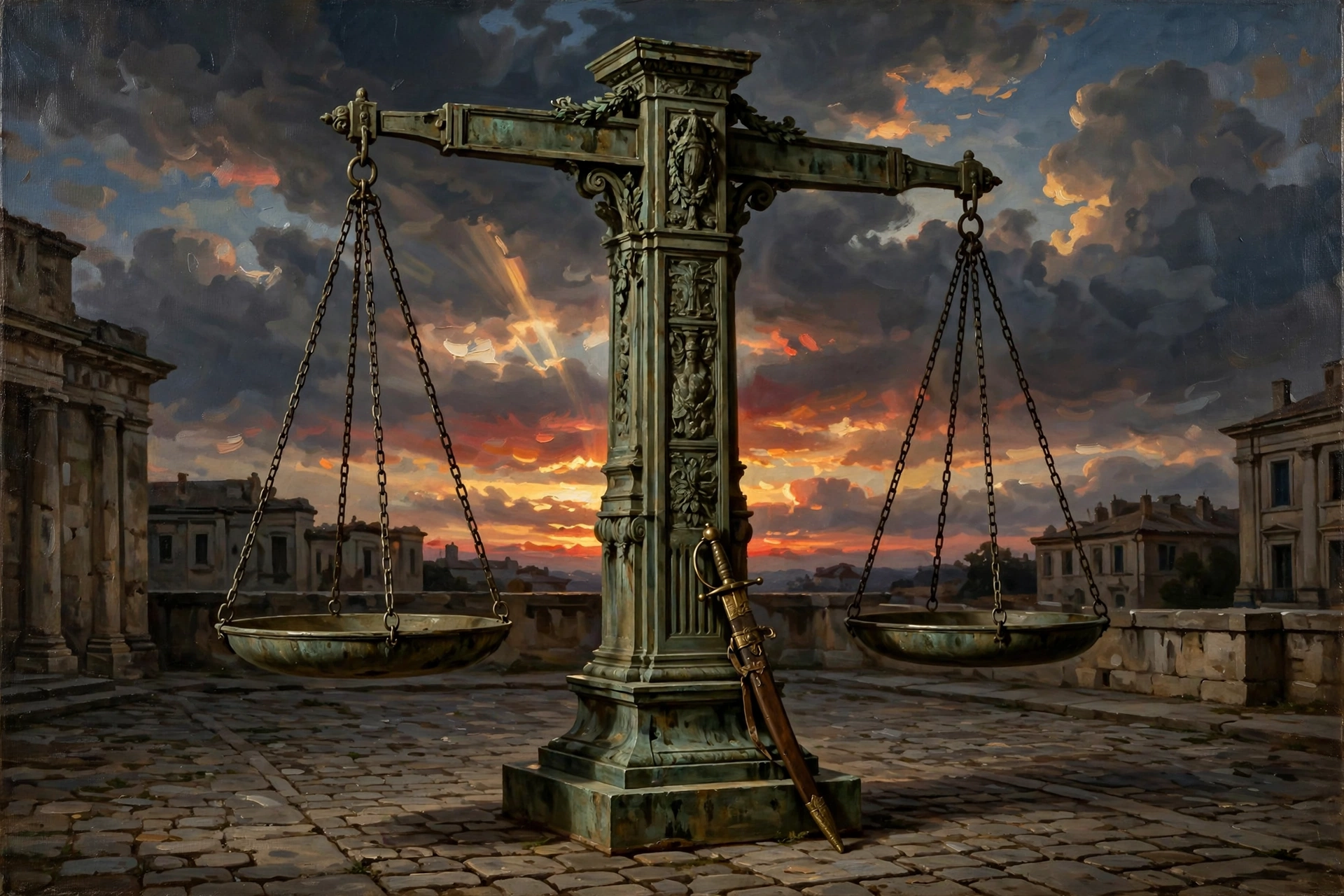
この絵について
描かれているのは、夕暮れの石畳の広場に立つ、巨大な青銅の天秤である。両方の皿は釣り合い、どちらにも何も載っていない。中央の柱の脇には、鞘に収まった剣が立てかけられている。人物は一人もいない。
天秤と剣は、正義の女神ユースティティアの持ち物として広く共有されてきた像である。天秤は「各人に各人のものを」を量る物差しであり、剣はその判断を執行する力である。この場面で五人が争うのは、まさにこの二つのあいだの関係——正義は量ることなのか、力なのか——である。剣が抜かれずに立てかけられているのは、力が正義に仕えるときの姿として置いた。
※モチーフは、「正義」について一般に共有されている像(天秤と剣)を既定として選んだ。絵は差し替え可能とする。
正義とは何か。——法を定めた皇帝から、力こそ正義と言い放つ男まで、五人が一つの問いのまわりに集まった。最初に口を開いたのは、定義を与える者だった。
Justinian(ユスティニアヌス)立てる ― 定義
正義とは、各人に各人のものを与えようとする、恒常不断の意志である。
原文
Justice is the set and constant purpose which gives to every man his due.
— Justinian I『The Institutes of Justinian』 BK I(J. B. Moyle 訳) / `justinian_institutes#L161`
定義が置かれるや否や、それを根元から覆す声が上がった。正義とは、支配者の利益にほかならない、と。
Thrasymachus(トラシュマコス)覆す ― 強者の利益
そして、さまざまな形態の政体は、それぞれ自分たちの利益を目当てにして、民主制的な法、貴族 制的な法、僭主制的な法を作る。そしてこれらの法、すなわち彼らが自分自身の利益のために作っ た法こそを、彼らは正義として臣民に手渡すのであり、それを犯す者を法の破壊者・不正な者とし て罰する。あらゆる国家において正義の原理は同一であり、それは支配者の利益である、と私が言 うのはこの意味だ。そして支配者は権力を持つと想定されねばならない以上、唯一の理に適った結 論はこうなる——いたるところで正義の原理は一つ、すなわち強者の利益である。
原文
And the different forms of government make laws democratical, aristocratical, tyrannical, with a view to their several interests; and these laws, which are made by them for their own interests, are the justice which they deliver to their subjects, and him who transgresses them they punish as a breaker of the law, and unjust. And that is what I mean when I say that in all states there is the same principle of justice, which is the interest of the government; and as the government must be supposed to have power, the only reasonable conclusion is, that everywhere there is one principle of justice, which is the interest of the stronger.
— Plato『The Republic』 BK I(Benjamin Jowett 訳) / `plato_republic#L9343`
ソクラテスは問いの向きを変えた。正義が何であるかの前に、不正を行うことと被ることの、どちらを選ぶか——と。
Socrates(ソクラテス)ずらす ― 不正は受ける方がまし
私はどちらも望まない。しかし、もし二つのうちどちらかを選ばねばならないなら、私は不正を行 うよりも不正を受けるほうを選ぶ。
原文
I should not like either, but if I must choose between them, I would rather suffer than do.
— Plato『Gorgias』(Benjamin Jowett 訳) / `plato_gorgias#L3470`
アリストテレスは法の文字の側に留保を置いた。一般には正しい法でも、その文言を不利な側に押しつけないことがある。それが衡平だ、と。
Aristotle(アリストテレス)ずらす ― 衡平
こうして衡平が何であるかは明らかである。 すなわちそれは正しいものでありながら、一種の正しさよりも優れたものである。 したがって衡平な人が誰であるかも明らかになる。 衡平な人とは、これらの原理を選び実行する傾向を持ち、法の文言を不利な側に押しつけようとせ ず、法に支えられていてもなお自らの厳格な要求を控えることをよしとする人である。 そしてこの道徳的状態が衡平であり、それは正義の一種であって、正義とは別の道徳的状態ではな い。
原文
It is clear then what the Equitable is; namely that it is Just but better than one form of Just: and hence it appears too who the Equitable man is: he is one who has a tendency to choose and carry out these principles, and who is not apt to press the letter of the law on the worse side but content to waive his strict claims though backed by the law: and this moral state is Equity, being a species of Justice, not a different moral state from Justice.
— Aristotle『The Nicomachean Ethics of Aristotle』 BK V(D. P. Chase 訳) / `aristotle_nicomachean_ethics#L5432`
最後にパスカルが、定義でも徳でもなく、力との関係で正義を締めた。
Blaise Pascal(ブレーズ・パスカル)締め ― 力と正義
力なき正義は無力であり、正義なき力は暴虐である。 力なき正義は反対される、悪人は常に存在するからだ。 正義なき力は弾劾される。ゆえに我々は正義と力とを結び合わせ、正しいものを強く、強いものを 正しくしなければならない。
原文
Justice without power is unavailing, power without justice is tyrannical. Justice without power is gainsaid, because the wicked always exist, power without justice is condemned. We must therefore combine justice and power, making what is just strong, and what is strong just.
— Blaise Pascal『The Thoughts of Blaise Pascal』 OF JUSTICE, CUSTOMS, AND PREJUDICES(C. Kegan Paul 訳) / `pascal_thoughts#L2790`
議論は決着しなかった。ただ五人は、正義が定義と力と徳と衡平のあいだで揺れ続けることを、同じ卓の上に置いて帰った。
控えの一句 ON THE BENCH
場面には出なかったが、場面と並べて置く5件。引用はすべて idea-no-tane の精選から一字一句そのまま写したものである。
Thomas Aquinas(トマス・アクィナス)
軸3「法と正義」― 正しくないものは法でない側
(第一巻第五章)「正しくないものは法ではないと思われる」。 それゆえ法の力は、その正しさの程度にかかっている。 ところで人間のことがらにおいては、あるものが正しいと言われるのは、それが理性の規則にした がって正しいからである。しかし理性の第一の規則は自然法である。 これは先に述べられたところから明らかである(Q. 91, A. 2, ad 2)。 したがって、あらゆる人定法は、自然法から導かれる限りにおいて、それだけ法の性格を持つ。
原文
i, 5) "that which is not just seems to be no law at all": wherefore the force of a law depends on the extent of its justice. Now in human affairs a thing is said to be just, from being right, according to the rule of reason. But the first rule of reason is the law of nature, as is clear from what has been stated above (Q. 91, A. 2, ad 2). Consequently every human law has just so much of the nature of law, as it is derived from the law of nature.
— Thomas Aquinas『Summa Theologica, Part I-II (Prima Secundae)』 I-II, Q. 95, Art. 2(Fathers of the English Dominican Province 訳) / `aquinas_summa_prima_secundae#L40998`
Michel de Montaigne(ミシェル・ド・モンテーニュ)
軸3「法と正義」― 法は正しいからではなく法だから信用される側(アクィナスへの対句)
さて、法がその信用を保つのは、正しいからではなく、法だからである。 それが、その権威の神秘的な基礎であって、他に基礎はなく、それで彼らの目的には十分にかなっ ている。法はしばしば愚か者によって作られ、さらにしばしば、平等を憎むがゆえに衡平を欠く人 々によって作られるが、常に、虚栄心が強く決断力のない作者である人間によって作られる。
原文
Now, the laws keep up their credit, not for being just, but because they are laws; ‘tis the mystic foundation of their authority; they have no other, and it well answers their purpose. They are often made by fools, still oftener by men who, out of hatred to equality, fail in equity, but always by men, vain and irresolute authors.
— Michel de Montaigne『Essays of Michel de Montaigne — Complete』 CHAPTER XIII(Charles Cotton 訳) / `montaigne_essays_complete#L48883`
Blaise Pascal(ブレーズ・パスカル)
軸6「正義は普遍か」― 緯度が変われば正義も変わる
今や我々は、緯度が変われば性質を変えないような正義も不正も見ない。 緯度三度が全法学をくつがえし、一本の子午線が何が真理かを決める。 基本法も数年の占有ののちには変わり、権利にはその時代があり、獅子宮への土星の入りが我々に とってはこれこれの犯罪の起源を画する。 一筋の川で区切られるとは、おかしな正義だ。 ピレネー山脈のこちら側では真理、あちら側では誤謬。
原文
whereas now we see neither justice nor injustice which does not change its quality upon changing its climate. Three degrees of latitude reverse all jurisprudence, a meridian decides what is truth, fundamental laws change after a few years of possession, right has its epochs, the entrance of Saturn into the Lion marks for us the origin of such and such a crime. That is droll justice which is bounded by a stream! Truth on this side of the Pyrenees, error on that.
— Blaise Pascal『The Thoughts of Blaise Pascal』 OF JUSTICE, CUSTOMS, AND PREJUDICES(C. Kegan Paul 訳) / `pascal_thoughts#L2578`
Francis Bacon(フランシス・ベーコン)
軸5「正義と応報」― 復讐は一種の野生の正義
復讐は一種の野生の正義である。人の本性がそれへ走れば走るほど、法はいっそうそれを取り除か ねばならない。最初の不正は法を害するにとどまるが、その不正への復讐は法を職務から追い出し てしまうからだ。確かに復讐においては、人は敵と同等になるにすぎない。 しかしそれを見過ごすとき、人は敵より上にある。 赦すことは君主の務めなのだから。
原文
REVENGE is a kind of wild justice; which the more man's nature runs to, the more ought law to weed it out. For as for the first wrong, it doth but offend the law; but the revenge of that wrong, putteth the law out of office. Certainly, in taking revenge, a man is but even with his enemy; but in passing it over, he is superior; for it is a prince's part to pardon.
— Francis Bacon『The Essays or Counsels, Civil and Moral』 Of Revenge / `bacon_essays#L416`
Glaucon(グラウコン)
軸1・2 ― ギュゲスの指輪。正義は力が無いから守られるだけか
さて、正義を行う者は、不正をなす力をもたないがゆえに、非自発的に行うのだということは、次 のような状況を想像すればもっともよく明らかになる。 正しい者にも不正な者にも、したいことを何でもできる力を与え、欲望がどこへ彼らを導くかを見 守るのだ。すると、正しい者と不正な者が同じ道を進み、すべての本性が自らの善と見なす自分の 利益を追っているのが、まさに行為のうちに見いだされ、ただ法の力によって正義の道へそらされ ているにすぎないことがわかるだろう。 われわれが想定する自由は、クロイソスの祖先であるリュディア人ギュゲスが持っていたと言われ る力の形で、最も完全に与えられるだろう。
原文
Now that those who practise justice do so involuntarily and because they have not the power to be unjust will best appear if we imagine something of this kind: having given both to the just and the unjust power to do what they will, let us watch and see whither desire will lead them; then we shall discover in the very act the just and unjust man to be proceeding along the same road, following their interest, which all natures deem to be their good, and are only diverted into the path of justice by the force of law. The liberty which we are supposing may be most completely given to them in the form of such a power as is said to have been possessed by Gyges, the ancestor of Croesus the Lydian.
— Plato『The Republic』 BOOK II(Benjamin Jowett 訳) / `plato_republic#L10438`