LABOR
idea-no-tane の全引用から選んだ超精選による、概念ごとの読み物。
入口 THE WORD
この概念が扱うのは、人が生きるために費やす労苦である。それは罰か、誇りか、奪われるものか。場面の声は、労働の意味をめぐって争う。
語源 ― labor の起源は定かでない
英語の labor は、ラテン語の labor「労苦、骨折り、苦痛、疲労」に由来するが、その起源は確かでない。「重荷の下でよろめく」という像から、labere「よろめく」と結びつける説があるが、デ・ファーンはこれを説得力なしと退けている(Etymonline)。英語本来の語は work であり、labor は労苦の色を帯びて入ってきた借り物だった。語源が定かでないこと自体が、この語の古さと重さを物語る。
勞の字 ― 火の下で力を尽くす
漢字の「勞(労)」について、『説文解字』は「勞、劇也(はげしいこと)。从力、熒省。熒火燒冂、用力者勞(熒は火が覆いを焼くさま。力を用いる者が労する)」と解く。甲骨文は、火の下で衣を縫う辛労の姿だったとされる(香港中文大学「漢語多功能字庫」の形義通解)。日本語の「労働」は、明治期に labor の訳語として作られた語で、「労」に国字の「働」(人偏に動)を組み合わせたものである(翻訳語辞典「労働」/コトバンク「労働」)。西洋でも東洋でも、労働の語の底には「苦しみながら力を出す」姿がある。場面で争われるのは、その労苦が罰なのか、所有の根拠なのか、誰かに吸い取られるものなのか、である。
場面 THE SCENE
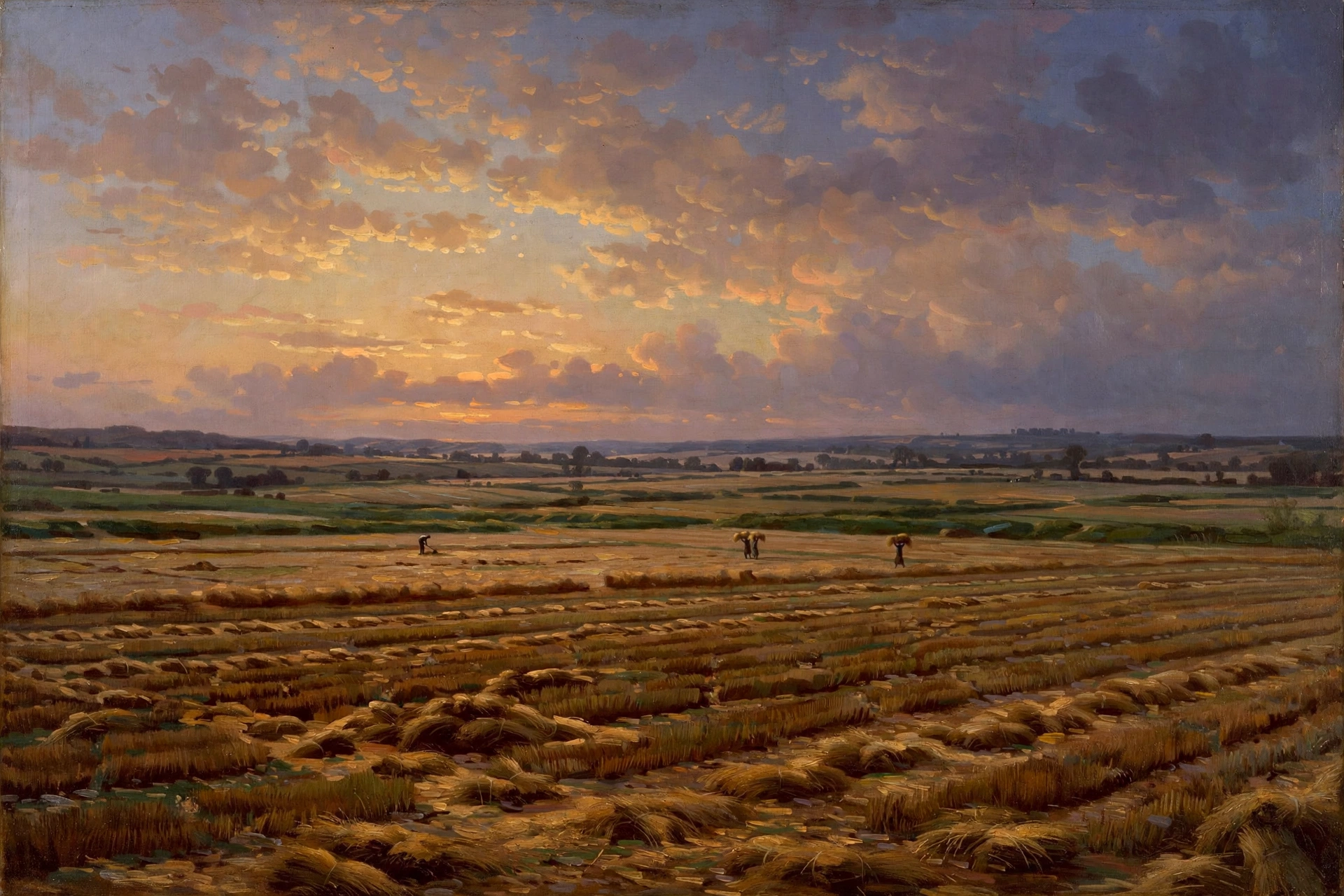
この絵について
描かれているのは、夕暮れの広大な畑である。刈り取られた穀物の束が畝に並び、遠くに小さく、束を担ぐ人々と鍬を取る人の影が見える。画面を占めるのは人の姿ではなく、畑と空である。特定の人物の肖像ではない。
地平線まで続くこの畑の広がりは、入口で見た「勞」の像——火の下で力を尽くすこと——が日々繰り返される場所である。労働とは何かという問いは、この畑の夕暮れの中にある。場面で争われるのは、その労苦が罰なのか、所有の根拠なのか、誰かに吸い取られるものなのか、である。
※モチーフは、「労働」について一般に共有されている像(畑で働く人々と収穫の束)を既定として選んだ。絵は差し替え可能とする。
労働とは何か。——最初に響いたのは、罰としての労働の声だった。汝は顔に汗してパンを食らい、ついに土に帰る。労働は、楽園を追われた人間に課された運命として始まった、と。
God(神)立てる ― 汝は顔に汗してパンを食らい、ついに土に帰る
汝は顔に汗してパンを食らい、ついに土に帰る。
原文
In the sweat of thy face shalt thou eat bread, till thou return unto the ground;
— (various)『The King James Version of the Bible』 Genesis 3:17(King James Version (1611) 訳) / `bible_kjv#L334`
ヘシオドスは、その罰を誇りへ反転させた。仕事は恥ではない。恥なのは怠惰である。汗して得るパンは、呪いであると同時に、人の値打ちの証だった、と。
Hesiod(ヘシオドス)覆す ― 仕事は恥ではない。恥なのは怠惰である
仕事は恥ではない。恥なのは怠惰である。
原文
Work is no disgrace: it is idleness which is a disgrace.
— Hesiod『Hesiod, the Homeric Hymns, and Homerica』 HESIOD’S WORKS AND DAYS(Hugh G. Evelyn-White 訳) / `hesiod_theogony_works_and_days#L1818`
ロックは、労働を所有の根へ置いた。泉に流れる水は万人のものだが、水差しの中の水が、それを汲み出した者だけのものであることを、誰が疑えようか。彼の労働が、それを、共有で自然のすべての子供に等しく属していた自然の手から取り出し、それによってそれを自分のものにしたのだ、と。
John Locke(ロック)ずらす ― 労働が、共有の自然から取り出したものをその人のものにする
泉に流れる水は万人のものだが、水差しの中の水が、それを汲み出した者だけのものであることを、 誰が疑えようか。彼の労働が、それを、共有で自然のすべての子供に等しく属していた自然の手か ら取り出し、それによってそれを自分のものにしたのである。
原文
Though the water running in the fountain be every one’s, yet who can doubt, but that in the pitcher is his only who drew it out? His labour hath taken it out of the hands of nature, where it was common, and belonged equally to all her children, and hath thereby appropriated it to himself.
— John Locke『Second Treatise of Government』 CHAPTER. V / `locke_second_treatise#L736`
マルクスは、その所有の裏側を見せた。資本とは死んだ労働であり、吸血鬼のように生きた労働を吸うことによってのみ生き、多く吸えば吸うほどますます生きる。労働者が労働する時間は、資本家が彼から買った労働力を消費する時間である、と。
Karl Marx(マルクス)覆す ― 資本は死んだ労働であり、吸血鬼のように生きた労働を吸う
資本とは死んだ労働であり、吸血鬼のように生きた労働を吸うことによってのみ生き、多く吸えば 吸うほどますます生きる。労働者が労働する時間は、資本家が彼から買った労働力を消費する時間 である。
原文
Capital is dead labour, that vampire-like, only lives by sucking living labour, and lives the more, the more labour it sucks. The time during which the labourer works, is the time during which the capitalist consumes the labour-power he has purchased of him.
— Karl Marx『Capital: A Critique of Political Economy, Vol. 1』 CH X(Samuel Moore and Edward Aveling 訳) / `marx_capital_v1#L12004`
最後にニーチェが、労働礼賛そのものを疑った。『仕事』の讃美と、『労働の祝福』についての絶え間ない語りの中に、彼は一般の利益のための行為への賛辞と同じ秘かな底意、すなわち個人的なものすべてへの恐れを見た。仕事は最良の警察であり、すべての人を抑えつけ、理性と独立への欲望の発達を妨げる。いまや安全こそが至高の神として崇められているのだ、と。
Friedrich Nietzsche(ニーチェ)締め ― 「労働の祝福」の賛美の裏には、個人的なものすべてへの恐れがある
仕事の追従者たち。「仕事」の讃美と、「労働の祝福」についての絶え間ない語りの中に、私は、 一般の利益のための没個人的な行為への賛辞のうちに見るのと同じ秘かな底意、すなわち、個人的 なものすべてへの恐れを見る。というのも、仕事、つまり朝から晩までの厳しい労苦を目にすると、 われわれは、それが最良の警察であり、すべての人を抑えつけ、理性と貪欲と独立への欲望の発達 を効果的に妨げる、と感じるからである。 仕事は、神経力の途方もない割合を使い果たして、省察、瞑想、夢想、心配、愛、憎しみからそれ を奪い去り、労働者の目の前に重要でない目標をぶら下げ、容易で規則的な満足を与える。 こうして、仕事が絶えず遂行される社会は、より大きな安全を享受することになり、いまや安全こ そが至高の神として崇められている。――そしてなんと恐ろしいことに、いま危険になったのは「 労働者」自身である。世界じゅうが「危険な個人」でうようよしており、その後ろには、危険の中 の危険、すなわち個体が続いている。
原文
THE FLATTERERS OF WORK.—In the glorification of “work” and the never-ceasing talk about the “blessing of labour,” I see the same secret _arrière-pensée_ as I do in the praise bestowed on impersonal acts of a general interest, viz. a fear of everything individual. For at the sight of work—that is to say, severe toil from morning till night—we have the feeling that it is the best police, viz. that it holds every one in check and effectively hinders the development of reason, of greed, and of desire for independence. For work uses up an extraordinary proportion of nervous force, withdrawing it from reflection, meditation, dreams, cares, love, and hatred; it dangles unimportant aims before the eyes of the worker and affords easy and regular gratification. Thus it happens that a society where work is continually being performed will enjoy greater security, and it is security which is now venerated as the supreme deity.—And now, horror of horrors! it is the “workman” himself who has become dangerous; the whole world is swarming with “dangerous individuals,” and behind them follows the danger of dangers—_the_ individuum!
— Friedrich Nietzsche『The Dawn of Day』 BOOK III(J. M. Kennedy 訳) / `nietzsche_dawn_of_day#L5147`
罰としての労働、恥ではない仕事、所有を生む労働、吸血鬼に吸われる労働、そして人を抑えつける警察としての仕事。——労働の意味は、声ごとに違う顔を見せた。
控えの一句 ON THE BENCH
Krishna(クリシュナ)
軸1 ― 「正しい行いを汝の動機とせよ、そこから生じる果実をではなく。そして行為のうちに生きよ! 働け!」。結果から切り離された労働
だが汝は、欲するな!求めるな!正しきことのうちに、正しきを行うことの十分な報いを見いだせ! 正しい行いを汝の動機とせよ、そこから生じる果実をではなく。 そして行為のうちに生きよ! 働け!
原文
But thou, want not! ask not! Find full reward Of doing right in right! Let right deeds be Thy motive, not the fruit which comes from them. And live in action! Labour!
— (various)『The Song Celestial; or, Bhagavad-Gita』 CH II(Edwin Arnold 訳) / `bhagavad_gita#L511`
Aristotle(アリストテレス)
軸2 ― 「生は労働と休息、戦争と平和に分かれ、戦争は平和を得るために、労働は休息のためにある」。閑暇を上に置く古典の基準
理論的なものと実践的なもの、この区分はこの部分についても必要と思われる。 行為についても同じ類比が当てはまる。 より優れた性質をもつ行為は、それを選びうる者によって常に選ばれるべきである。 最善の目的をもたらすものが、だれにとっても常に最も望ましいからである。 さて、生は労働と休息、戦争と平和に分かれ、われわれのなすことの対象は、一部は必要で有用な もの、一部は高貴なものである。そしてわれわれは、魂の諸部分とその活動のあいだに置くのと同 じ優先を、これらのあいだにも置くべきである。 すなわち、戦争は平和を得るために、労働は休息のために、有用なものは高貴なもののためにある。 それゆえ、法を編む政治家は、あらゆることに目を配らねばならない。 魂の諸部分とその活動、とりわけより優れた性質と目的をもつもの、同じように人間の生とその種 々の行為にも。人々は労働と戦争にも備えられるべきだが、むしろ[1333b]休息と平和にこ そ備えられるべきであり、必要で有用なことをも行うべきだが、むしろ美しく高貴なことを行うべ きである。
原文
the theoretic and the practical; which division therefore seems necessary for this part also: the same analogy holds good with respect to actions; of which those which are of a superior nature ought always to be chosen by those who have it in their power; for that is always most eligible to every one which will procure the best ends. Now life is divided into labour and rest, war and peace; and of what we do the objects are partly necessary and useful, partly noble: and we should give the same preference to these that we do to the different parts of the soul and its actions, as war to procure peace; labour, rest; and the useful, the noble. The politician, therefore, who composes a body of laws ought to extend his views to everything; the different parts of the soul and their actions; more particularly to those things which are of a superior nature and ends; and, in the same manner, to the lives of men and their different actions. They ought to be fitted both for labour and war, but rather [1333b] for rest and peace; and also to do what is necessary and useful, but rather what is fair and noble.
— Aristotle『Politics: A Treatise on Government』 CHAPTER XIV(William Ellis 訳) / `aristotle_politics#L8189`
Adam Smith(アダム・スミス)
軸5 ― 「労働の生産力の最大の改善は、分業の結果であった」。『国富論』の冒頭、分業の賛歌
労働の生産力の最大の改善と、それがどこで向けられ、応用されるにせよ、その際の技能、熟練、 判断の大部分は、分業の結果であったように思われる。 社会の一般的な事業における分業の効果は、それがある特定の製造業でどのように作用するかを考 えることによって、より容易に理解されるだろう。
原文
The greatest improvements in the productive powers of labour, and the greater part of the skill, dexterity, and judgment, with which it is anywhere directed, or applied, seem to have been the effects of the division of labour. The effects of the division of labour, in the general business of society, will be more easily understood, by considering in what manner it operates in some particular manufactures.
— Adam Smith『An Inquiry into the Nature and Causes of the Wealth of Nations』 CHAPTER I / `smith_wealth_of_nations#L226`
Adam Smith(アダム・スミス)
軸5 ― 「全生涯をいくつかの単純な作業を行うことに費やす人間は、人間という生き物がなりうるかぎり愚かで無知になる」。同じスミスによる分業批判。スミスは控えの双方に置く
分業の進展につれて、労働によって生きる人々の圧倒的大部分、すなわち人民の大多数の仕事は、 少数のきわめて単純な作業に限られるようになる。 しばしば一つか二つにである。ところが、大部分の人間の理解力は、必然的に、その通常の仕事に よって形づくられる。全生涯を、いくつかの単純な作業を行うことに費やす人間――その作業の効 果も、おそらくいつも同じか、ほぼ同じである――は、決して生じない困難を除く方策を見いだす ために、理解力を働かせたり、発明力を行使したりする機会がない。 それゆえ彼は、自然にそのような努力の習慣を失い、一般に、人間という生き物がなりうるかぎり 愚かで無知になる。
原文
In the progress of the division of labour, the employment of the far greater part of those who live by labour, that is, of the great body of the people, comes to be confined to a few very simple operations; frequently to one or two. But the understandings of the greater part of men are necessarily formed by their ordinary employments. The man whose whole life is spent in performing a few simple operations, of which the effects, too, are perhaps always the same, or very nearly the same, has no occasion to exert his understanding, or to exercise his invention, in finding out expedients for removing difficulties which never occur. He naturally loses, therefore, the habit of such exertion, and generally becomes as stupid and ignorant as it is possible for a human creature to become.
— Adam Smith『An Inquiry into the Nature and Causes of the Wealth of Nations』 PART III / `smith_wealth_of_nations#L28008`
the old Turk(老いたトルコ人)
軸1 ― 「労働は我々を三つの大きな悪——退屈、悪徳、貧乏——から守ってくれます」。呪いを受け入れて生き方に変える一句。話者は母データの表記のまま
「わずか二十エーカーしかありません」と老人は答えた。 「わたしと子どもたちとで耕しています。 労働は我々を三つの大きな悪――退屈、悪徳、貧乏――から守ってくれます。」
原文
"I have only twenty acres," replied the old man; "I and my children cultivate them; our labour preserves us from three great evils--weariness, vice, and want."
— Voltaire『Candide』 CH XXX([要確認] 訳) / `voltaire_candide#L4097`