Mathematics
idea-no-tane の全引用から選んだ超精選による、概念ごとの読み物。
入口 THE WORD
この概念が扱うのは、数学的真理の身分である。それは経験に先立つ必然なのか、観察からの一般化なのか。数や図形は実在するのか、それとも精神が抽象し、構成するものなのか。場面の声は、数学の確実さの根拠と、その対象のありかをめぐって争う。
語源 ― mathēma「学ばれること」
英語の mathematics は、ギリシア語の mathēmatikē (tekhnē)「数学の術」に由来する。その形容詞 mathēmatikos は「学ぶことに向いた、学問的な」という意味であり、名詞 mathēma は「学ばれること、知識、課(レッスン)」を意味し、動詞 manthanein「学ぶ」から来ている(Online Etymology Dictionary「mathematics」「mathematic」)。
つまりこの語は、もともと数や図形の名ではなかった。「学ばれること」一般の名が、アリストテレスの理論科学の三分(第一哲学・自然学・数学)の一つとして数や量を扱う学を指すようになり、やがて数・量・空間の学として姿を狭めていった(同上)。
場面の絵に選んだのは、砂の上に描かれた円と三角形である。砂に図形を引くことは、学ばれるものの原型であり、同時に、消えやすい砂の上の図形が経験を超えた確実さを担うという、この概念の緊張そのものでもある。
日本語の「数学」 ― 熟語の再利用と、1882年の議決
「数学」という熟語自体は古い。中国・宋の秦九韶による『数書九章』(1247年)の書名はもとは『数学』だったとされ、日本でも和算家たちが関孝和の『数学雑著』をはじめ、この語を数学一般という広い意味で使っていた(Wikipedia「数学」)。
ただし、mathematics の定訳として固定したのは明治である。1882年(明治15年)1月7日、東京数学会社(現・日本数学会)の訳語会は、Mathematics の訳語を「数学」とすることを議決した。それ以前は定訳がなく、1814年の『諳厄利亜語林大成』では「数学」は arithmetic の訳語に当てられ、mathematics には「測度數之学」が当てられていた(同上)。
ギリシア語の「学ばれること」という広い原義に比べると、日本語の「数学」は「数」の一字を冠し、数の学として姿を定めた訳語だと言える。その狭さのなかで、場面の声たちは今も、この学の対象と確実さを問い直している。
場面 THE SCENE
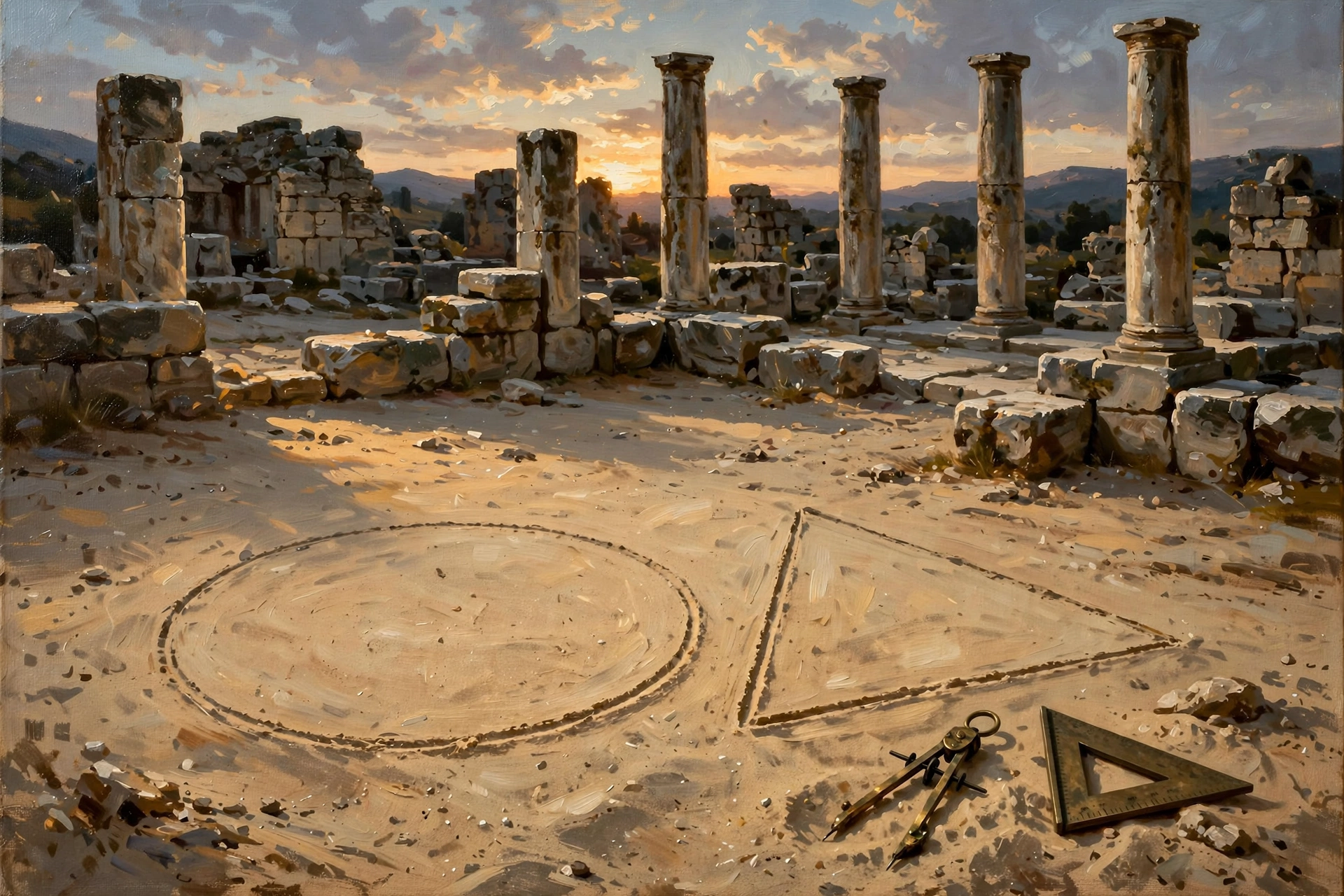
この絵について
砂の上に、円と三角形が引かれている。古代ギリシアの遺跡の柱が背後に立ち、真鍮のコンパスと三角定規が砂の上に置かれている。
幾何学の図形は、数学の最も古い姿である。砂に引かれた線は消えやすいが、その図形の必然性は経験を超えて成り立つと主張されてきた。消える線と、消えない真理。その緊張が、この概念の入口にふさわしい。
絵はモチーフの置き換えが可能であり、この絵でなければならない必然はない。一般に共有される数学の像として、幾何学の図形を選んだ。
場面は「数」から始まる。アリストテレスが伝えるピタゴラス派の言葉は、万物の質料であり元素であるものとして数を置く。数学の対象は精神の外に実在する、という立場の原型である。
ピタゴラス派(Pythagoreans)立てる
これらの原理のうち数が本性上第一のものであり、数のうちに、存在し生成する事物との多くの類 似を見たので——ある数の変容が正義であり、別のものが魂と理性であり、別のものが好機である ——……彼らは数の要素を万物の要素と考え、天界全体を音階であり数であると考えた。
原文
Since of these principles numbers are by nature the first, and in numbers they seemed to see many resemblances to the things that exist and come into being—more than in fire and earth and water (such and such a modification of numbers being justice, another being soul and reason, another being opportunity—and similarly almost all other things being numerically expressible +); since, again, they saw that the attributes and the ratios of the musical scales were expressible in numbers ; since, then, all other things seemed in their whole nature to be modelled after numbers, and numbers seemed to be the first things in the whole of nature, they supposed the elements of numbers to be the elements of all things, and the whole heaven to be a musical scale and a number.
— Aristotle『Metaphysica (The Works of Aristotle, vol. 8)』 BK I (Α)(W. D. Ross 訳) / `aristotle_metaphysics#L1506`
カントは、数学の確実さを別のところに求める。数学的判断は総合的でありながらアプリオリであり、経験からは与えられない必然性を伴う。対象が実在するかを問う前に、判断の形式そのものが確実さを担うのだ、という転回である。
カント(Immanuel Kant)軸を分ける
一。数学的判断はつねに総合的である。 この事実は、疑いなく真であり、その帰結においてきわめて重要であるにもかかわらず、これまで 人間精神の分析者たちの目を逃れてきたように思われ、それどころか、彼らのあらゆる推測に完全 に反しているように思われる。というのも、数学的結論はすべて矛盾律(あらゆる必当然的確実性 の本性がこれを要求する)に従って進むことが認められたため、人々はこの学の根本原理も同じ仕 方で認識され、承認されると確信するようになったからである。 しかし、この想念は誤っている。総合的命題はたしかに矛盾律によって識別できるが、それは、そ の命題がそこから導かれる別の総合的命題が先行するときにのみ可能であり、決してそれ自体によ ってではない。何よりもまず、固有の数学的命題はつねにアプリオリな判断であって、経験的な判 断ではないことに注意すべきである。なぜなら、それらは経験からは与えられない必然性の概念を 伴うからである。
原文
1. Mathematical judgements are always synthetical. Hitherto this fact, though incontestably true and very important in its consequences, seems to have escaped the analysts of the human mind, nay, to be in complete opposition to all their conjectures. For as it was found that mathematical conclusions all proceed according to the principle of contradiction (which the nature of every apodeictic certainty requires), people became persuaded that the fundamental principles of the science also were recognized and admitted in the same way. But the notion is fallacious; for although a synthetical proposition can certainly be discerned by means of the principle of contradiction, this is possible only when another synthetical proposition precedes, from which the latter is deduced, but never of itself. Before all, be it observed, that proper mathematical propositions are always judgements à priori, and not empirical, because they carry along with them the conception of necessity, which cannot be given by experience.
— Immanuel Kant『The Critique of Pure Reason』(J. M. D. Meiklejohn 訳) / `kant_critique_of_pure_reason#L1704`
ミルは真っ向から覆す。算術や代数の定理は帰納的一般化であり、公理すら観察と経験に基づく真理にすぎない。先立つ必然という像は、ここで経験の積み重ねに置き換えられる。
ミル(John Stuart Mill)覆す
残る問いは、公理に対する我々の信念の根拠は何か、それらはどんな証拠に基づくのか、である。 私は答える。それらは経験的な真理であり、観察からの一般化である。
原文
It remains to inquire, what is the ground of our belief in axioms—what is the evidence on which they rest? I answer, they are experimental truths; generalizations from observation.
— John Stuart Mill『A System of Logic, Ratiocinative and Inductive』 BK II, CH V / `mill_system_of_logic#L8347`
ウィトゲンシュタインは、対象が実在するかどうかという問いの立て方自体をずらす。数学は論理的方法であり、等式は疑似命題であって、思考を表現しない。実在か構成かという二択の外側から、数学の働き方を見よという声である。
ウィトゲンシュタイン(Ludwig Wittgenstein)ずらす
数学は一つの論理的方法である。数学の命題は等式であり、したがって擬似命題である。
原文
Mathematics is a logical method. The propositions of mathematics are equations, and therefore pseudo-propositions.
— Ludwig Wittgenstein『Tractatus Logico-Philosophicus』 §6.2(C. K. Ogden 訳) / `wittgenstein_tractatus#L4275`
最後にベルクソンが、数学の届く範囲に線を引く。数学が捉えるのは間隔の両端だけで、その中間の持続は逃れていく。実在をめぐる争いのあとに残るのは、数学が何を捉え損なうかという問いである。
ベルクソン(Henri Bergson)締める
それでも、間隔がどれほど小さいと想定されようとも、数学がつねに身を置くのは間隔の端点であ る。間隔そのもの、持続と運動そのものは、必然的に方程式から除外される。
原文
Nevertheless, however small the interval is supposed to be, it is the extremity of the interval at which mathematics always places itself. As for the interval itself, as for the duration and the motion, they are necessarily left out of the equation.
— Henri Bergson『Time and Free Will』 CHAPTER II(F. L. Pogson 訳) / `bergson_time_and_free_will#L3690`
数学とは何かという問いは、決着していない。数が世界の原理だという声に始まり、判断の形式、経験の一般化、論理的方法、そして数学が捉え損なうものへの指摘が続いた。確かさの根拠をどこに置くかで、数学の姿は変わる。この概念の入口は、その争いの見取り図である。
控えの一句 ON THE BENCH
ヒューム(David Hume)
軸1
第一の種類に属するのは、幾何学、代数学、算術の諸学、要するに直観的または論証的に確実なあ らゆる肯定である。「斜辺の平方は他の二辺の平方に等しい」という命題は、これらの図形の間の 関係を表す。「五の三倍は三十の半分に等しい」という命題は、これらの数の間の関係を表す。 この種の命題は、宇宙のどこかに存在するものに依存せず、思考の働きだけによって発見できる。
原文
Of the first kind are the sciences of Geometry, Algebra, and Arithmetic; and in short, every affirmation which is either intuitively or demonstratively certain. _That the square of the hypothenuse is equal to the square of the two sides_, is a proposition which expresses a relation between these figures. _That three times five is equal to the half of thirty_, expresses a relation between these numbers. Propositions of this kind are discoverable by the mere operation of thought, without dependence on what is anywhere existent in the universe.
— David Hume『An Enquiry Concerning Human Understanding』 PART I / `hume_enquiry_human_understanding#L709`
アクィナス(Thomas Aquinas)
軸2
異論三への答え。数学の学は、その対象が精神によって抽象されたものであるかのように扱うが、 それは実在において抽象されているのではない。
原文
Reply Obj. 3: The science of mathematics treats its object as though it were something abstracted mentally, whereas it is not abstract in reality.
— Thomas Aquinas『Summa Theologica, Part I (Prima Pars)』 I, Q. 44, Art. 1(Fathers of the English Dominican Province 訳) / `aquinas_summa_prima_pars#L21353`
ベーコン(Francis Bacon)
軸3
自然の多くの部分は、数学の助けと介在なしには、十分な精妙さをもって発見することも、十分な 明晰さをもって論証することも、十分な巧みさをもって用途に適合させることもできない。 その種のものには、遠近法、音楽、天文学、宇宙誌、建築術、機械術、その他さまざまなものがあ る。
原文
For many parts of Nature can neither be invented with sufficient subtlety, nor demonstrated with sufficient perspicuity, nor accommodated unto use with sufficient dexterity, without the aid and intervening of the mathematics, of which sort are perspective, music, astronomy, cosmography, architecture, engineery, and divers others.
— Francis Bacon『The Advancement of Learning』 THE SECOND BOOK / `bacon_advancement_of_learning#L3533`
ニュートン(Isaac Newton)
軸3
私は同じ一般的な意味で衝撃という語を用い、この論考では力の種類または物理的性質を定義せず、 力の量とその数学的比例を探究する。これは先に「定義」で述べたとおりである。 数学では、想定されたあらゆる条件から帰結する力の量とその比例を探究しなければならない。 次いで自然学に入ると、それらの比例を自然の現象と比較し、力のどの条件がさまざまな種類の引 力をもつ物体に対応するかを知るのである。
原文
In the same general sense I use the word impulse, not defining in this treatise the species or physical qualities of forces, but investigating the quantities and mathematical proportions of them; as I observed before in the Definitions. In mathematics we are to investigate the quantities of forces with their proportions consequent upon any conditions supposed; then, when we enter upon physics, we compare those proportions with the phænomena of Nature, that we may know what conditions of those forces answer to the several kinds of attractive bodies.
— Isaac Newton『Newton's Principia: The Mathematical Principles of Natural Philosophy』 SECTION XI(Andrew Motte 訳) / `newton_principia#L8715`
ホッブズ(Thomas Hobbes)
軸4
もし「三角形の三つの角は四角形の二つの角に等しい」ということが、誰かの支配権または支配す る人々の利益に反する事柄であったなら、その教説は、論争されなかったとしても、関係者がなし うるかぎり、幾何学のすべての書物を焼くことによって抑圧されていただろう。 このことを私は疑わない。
原文
For I doubt not, but if it had been a thing contrary to any mans right of dominion, or to the interest of men that have dominion, That The Three Angles Of A Triangle Should Be Equall To Two Angles Of A Square; that doctrine should have been, if not disputed, yet by the burning of all books of Geometry, suppressed, as farre as he whom it concerned was able.
— Thomas Hobbes『Leviathan』 CHAPTER XI / `hobbes_leviathan#L3327`