NATURAL LAW
idea-no-tane の全引用から選んだ超精選による、概念ごとの読み物。
入口 THE WORD
この概念が扱うのは、人間が作る法の上に、それを作らなかった法があるか、という問いである。あるとすれば、その法はどこから来て、誰が読み取るのか。場面の声は、書かれざる法の在り処をめぐって争う。
語源 ― ius naturale と lex naturalis
「自然法」に当たるラテン語には、二つの形がある。ius naturale と lex naturalis である。ius は法・正しさ・権利を広く指す語で、lex は制定された法、立法者の命令としての法の色が強い(Philopedia「Natural Law Theory」)。ローマの法学者ウルピアヌスは、ius naturale を「自然がすべての動物に教えた法」とし、人間だけの法ではないとした。ガイウスは、自然の理性がすべての人の間に定めた法を ius gentium(万民法)と呼んだ(Dictionary of the History of Ideas「Natural Law」)。キケロは『国家について』で「真の法とは、自然に適った正しい理性である」と書いた(同)。
中世になると、アクィナスが lex naturalis を「永遠法の、理性的被造物による分有」として体系の中心に置いた(Philopedia「Natural Law Theory」)。場面の冒頭に置かれるアクィナスの声は、この定義そのものである。つまり自然法の語史は、動物にまで届く「自然の教え」から、人間の理性が読み取る「秩序への参与」への、重心の移動の歴史でもある。
場面の絵に選んだのは、野原に立つ、何も刻まれていない石板である。制定法は、石や紙に刻まれて初めて法になる。しかし自然法は、誰かが刻む前から立っていると主張される法である。刻まれていない石板は、その主張の像である。
日本語の「自然法」 ― 「自然」という訳語
日本語の「自然法」は、natural law の訳語である。ただし明治初期には、「自然」という語自体が nature の訳語としてまだ定着しておらず、natural rights(自然権)は「天賦人権」と意訳されて紹介された(「天賦人権論」の解説)。西周は国際法を自然法的なものとして受け止め、『万国公法』にその理解を記している(同)。「自然法」という訳語がいつ、どのように定着したかの詳細は未確認である。
場面 THE SCENE
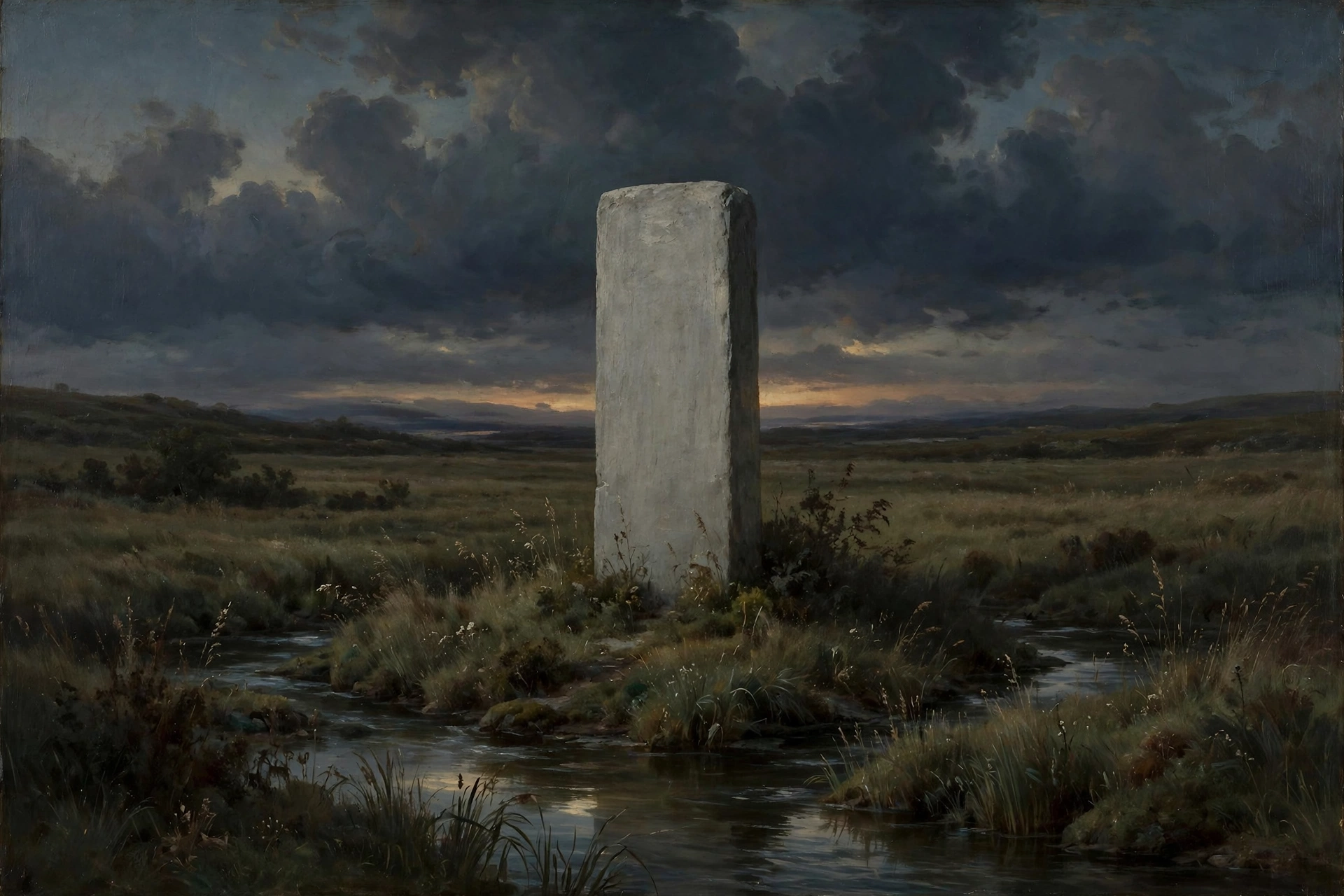
この絵について
描かれているのは、夕暮れの野原に立つ大きな石板である。表面は滑らかで、何も刻まれていない。足元には小川が流れ、草原が地平線まで続き、空には暗い雲が広がっている。人は描かれていない。
この石板は、入口で見た自然法の像である。制定法は、立法者が石や紙に刻んで初めて法になる。しかし自然法は、誰かが刻む前から立っていると主張される法である。刻まれていないのに立っている石板は、その主張そのものの姿である。場面で争われるのは、この石板に本当に読み取るべきものがあるのか、それとも読む者が自分の考えを映しているだけなのか、である。
※モチーフは、「自然法」について一般に共有されている像(書かれざる法)を、入口の像と重ねて選んだ。絵は差し替え可能とする。
自然法とは何か。——最初に口を開いたのはアクィナスだった。自然法が永遠法とは別の何かであるならば、この論証は成り立つだろう。しかし、上述したように、自然法は永遠法の分有にほかならない、と。自然法はまず、人間が作る法の外にありながら、人間の理性が分け持つ秩序として置かれて始まった。
Thomas Aquinas(トマス・アクィナス)立てる ― 自然法は永遠法とは別の法ではなく、その分有である
異論一への答え。この論証は、自然法が永遠法とは別の何かであるならば成り立つだろう。 しかし、上述したように、自然法は永遠法の分有にほかならない。
原文
Reply Obj. 1: This argument would hold, if the natural law were something different from the eternal law: whereas it is nothing but a participation thereof, as stated above.
— Thomas Aquinas『Summa Theologica, Part I-II (Prima Secundae)』 I-II, Q. 91, Art. 2(Fathers of the English Dominican Province 訳) / `aquinas_summa_prima_secundae#L39322`
ユスティニアヌスは、その法の届く先を制度の側から示した。戦争が起こり、それに捕囚と奴隷制が続いたが、これらは自然法に反する。自然法によれば、すべての人は初めから自由な者として生まれたからである、と。奴隷制は万民法の制度でありながら、自然法の側からは初めから反しているとされた。普遍の法は、現にある制度を裁く物差しとして置かれた。
Justinian I(ユスティニアヌス)広げる ― 自然法によれば、すべての人は初めから自由な者として生まれた
たとえば、戦争が起こり、それに捕囚と奴隷制が続いたが、これらは自然法に反する。 自然法によれば、すべての人は初めから自由な者として生まれたからである。 また、万民法はほとんどすべての契約、たとえば売買、賃貸借、組合、寄託、消費貸借、その他き わめて多くの契約の源泉である。
原文
For instance, wars arose, and then followed captivity and slavery, which are contrary to the law of nature; for by the law of nature all men from the beginning were born free. The law of nations again is the source of almost all contracts; for instance, sale, hire, partnership, deposit, loan for consumption, and very many others.
— Justinian I『The Institutes of Justinian』 BOOK I(J. B. Moyle 訳) / `justinian_institutes#L220`
ホッブズは、その物差しの置き場所をずらした。自然法と市民法とは互いを包含し、等しい範囲をもつ。衡平や正義から成る自然法は、単なる自然状態では厳密には法ではなく、人を平和と服従へ向かわせる性質にすぎない。国家がひとたび確立されれば、そのときにはじめて、それらは現実に法となる、と。上位の基準としての自然法は、国家の命令によって法になる法として置き直された。
Thomas Hobbes(ホッブズ)ずらす ― 自然法と市民法は異なる種類の法ではなく、法の異なる部分である
4.自然法と市民法とは互いを包含し、等しい範囲をもつ。 衡平、正義、感謝、およびこれらに依存する他の倫理徳から成る自然法は、単なる自然状態では( 第十五章の末尾で前述したように)厳密には法ではなく、人を平和と服従へ向かわせる性質にすぎ ない。国家がひとたび確立されれば、そのときにはじめて、それらは現実に法となる。 それらは国家の命令であり、したがって市民法でもあるからである。 人々の私的な争いにおいて、何が衡平で、何が正義で、何が倫理徳であるかを宣言し、それらに拘 束力を与えるためには、主権者の権力による命令と、それらを破る者に科す刑罰を定めることが必 要である。そして、それらの命令は市民法の一部である。 それゆえ自然法は、世界のすべての国家において市民法の一部である。 反対に、市民法も自然の命令の一部である。 正義、すなわち信約の履行と各人にその人のものを与えることは、自然法の命令だからである。 しかし、国家のすべての臣民は市民法に従うことを信約している(共同の代表者を立てるために集 まるときのように相互に信約するか、剣によって征服され生命を受けるために服従を約束するとき のように代表者と一人ずつ信約する)。 したがって、市民法への服従も自然法の一部である。 市民法と自然法は異なる種類の法ではなく、法の異なる部分である。 その一方は書かれているため市民法と呼ばれ、他方は書かれていないため自然法と呼ばれる。
原文
4. The Law of Nature, and the Civill Law, contain each other, and are of equall extent. For the Lawes of Nature, which consist in Equity, Justice, Gratitude, and other morall Vertues on these depending, in the condition of meer Nature (as I have said before in the end of the 15th Chapter,) are not properly Lawes, but qualities that dispose men to peace, and to obedience. When a Common-wealth is once settled, then are they actually Lawes, and not before; as being then the commands of the Common-wealth; and therefore also Civill Lawes: for it is the Soveraign Power that obliges men to obey them. For in the differences of private men, to declare, what is Equity, what is Justice, and what is morall Vertue, and to make them binding, there is need of the Ordinances of Soveraign Power, and Punishments to be ordained for such as shall break them; which Ordinances are therefore part of the Civill Law. The Law of Nature therefore is a part of the Civill Law in all Common-wealths of the world. Reciprocally also, the Civill Law is a part of the Dictates of Nature. For Justice, that is to say, Performance of Covenant, and giving to every man his own, is a Dictate of the Law of Nature. But every subject in a Common-wealth, hath covenanted to obey the Civill Law, (either one with another, as when they assemble to make a common Representative, or with the Representative it selfe one by one, when subdued by the Sword they promise obedience, that they may receive life;) And therefore Obedience to the Civill Law is part also of the Law of Nature. Civill, and Naturall Law are not different kinds, but different parts of Law; whereof one part being written, is called Civill, the other unwritten, Naturall.
— Thomas Hobbes『Leviathan』 CHAPTER XXVI / `hobbes_leviathan#L8720`
カリクレスは、その「自然」を裏返した。いや、むしろ彼らこそ自然に従って行為する者たちなのだ。われわれは仲間のうち最善で最強の者たちを幼いころから捕らえ、若い獅子のように飼いならし、平等で満足しなければならず、等しいものこそ名誉ある正しいものだと言い聞かせるのだ、と。これはプラトンの対話篇『ゴルギアス』の中で、平等を説く法を「人工的な法」と呼ぶ作中人物の主張である。自然法は、平等を支える基準から、強者の優越を正当化する名へと転じた。
Callicles(カリクレス)覆す ― 強者が優越することこそ、自然の法に従っている
いや、むしろ彼らこそ自然に従って行為する者たちなのだ。 そう、天に誓って、自然の法に従っている。 おそらく、われわれが考案して仲間に課す、かの人工的な法には従っていないだろう。 われわれは仲間のうち最善で最強の者たちを幼いころから捕らえ、若い獅子のように飼いならし、 声の響きで魅了して、平等で満足しなければならず、等しいものこそ名誉ある正しいものだと言い 聞かせるのだ。
原文
Nay, but these are the men who act according to nature; yes, by Heaven, and according to the law of nature: not, perhaps, according to that artificial law, which we invent and impose upon our fellows, of whom we take the best and strongest from their youth upwards, and tame them like young lions,—charming them with the sound of the voice, and saying to them, that with equality they must be content, and that the equal is the honourable and the just.
— Plato『Gorgias』(Benjamin Jowett 訳) / `plato_gorgias#L4407`
最後にベンサムが、語そのものを退けた。自然法とは、それを追い求める者の想像のなかで、あるときは習俗を、あるときは法律を、あるときは法が何であるかを、あるときは法が何であるべきかを指し示す、曖昧な幻影なのだ、と。書かれざる法は、その存在を主張する声と、その名の曖昧さを衝く声の間に置かれたまま、議論は締められた。
Jeremy Bentham(ベンサム)締め ― 自然法とは、法が何であるかと何であるべきかの間を漂う曖昧な幻影である
自然法なるものを主題とするすべての書物がほとんど避けがたく免れない欠陥である。 自然法とは、それを追い求める者の想像のなかで、あるときは習俗を、あるときは法律を、あると きは法が何であるかを、あるときは法が何であるべきかを指し示す、曖昧な幻影なのだ。
原文
A defect this to which all books must almost unavoidably be liable, which take for their subject the pretended law of nature; an obscure phantom which, in the imaginations of those who go in chase of it, points sometimes to manners, sometimes to laws; sometimes to what law is, sometimes to what it ought to be.
— Jeremy Bentham『An Introduction to the Principles of Morals and Legislation』 Chapter XVII / `bentham_principles_of_morals_and_legislation#L13447`
永遠法の分有としての自然法、制度を裁く普遍の物差し、国家の命令で法になる性質、強者の優越の名、そして曖昧な幻影。——自然法の姿は、声ごとに違う在り処の置き方で描かれた。
控えの一句 ON THE BENCH
Thomas Aquinas(トマス・アクィナス)
軸2 ― 一般原理から人定法が生じる二つの仕方。「殺してはならない」は原理から結論として導かれ、悪をなす者をこの仕方またはあの仕方で罰することは、自然法の規定によって定められる
したがって、あるものは結論として自然法の一般原理から導かれる。 たとえば、「何人にも害をなすべきではない」という原理から、「殺してはならない」が結論とし て導かれうる。他方、あるものはそこから規定によって導かれる。 たとえば、自然法は悪をなす者が罰せられるべきことを定めるが、彼がこの仕方またはあの仕方で 罰せられることは、自然法の規定である。
原文
Some things are therefore derived from the general principles of the natural law, by way of conclusions; e.g. that "one must not kill" may be derived as a conclusion from the principle that "one should do harm to no man": while some are derived therefrom by way of determination; e.g. the law of nature has it that the evil-doer should be punished; but that he be punished in this or that way, is a determination of the law of nature.
— Thomas Aquinas『Summa Theologica, Part I-II (Prima Secundae)』 I-II, Q. 95, Art. 2(Fathers of the English Dominican Province 訳) / `aquinas_summa_prima_secundae#L41015`
Thomas Hobbes(ホッブズ)
軸1/軸4 ― 「他者から自分になされるのが不合理だと思うことを、他者にしてはならない」。自然法はいかなる公布も布告も必要とせず、万人の理性に適合するこの一文に含まれるとする圧縮
まず、もしそれが例外なくすべての臣民を拘束する法であり、彼らがそれを知りうる場所で書かれ ず、他の仕方でも公示されていないなら、それは自然法である。 人が他人の言葉ではなく各自の理性から法として知らなければならないものは、万人の理性に適合 するものでなければならず、それに当たる法は自然法以外にないからである。 それゆえ自然法は、次の、全世界が承認する一文に含まれているため、いかなる公布も布告も必要 としない。「他者から自分になされるのが不合理だと思うことを、他者にしてはならない」。
原文
And first, if it be a Law that obliges all the Subjects without exception, and is not written, nor otherwise published in such places as they may take notice thereof, it is a Law of Nature. For whatsoever men are to take knowledge of for Law, not upon other mens words, but every one from his own reason, must be such as is agreeable to the reason of all men; which no Law can be, but the Law of Nature. The Lawes of Nature therefore need not any publishing, nor Proclamation; as being contained in this one Sentence, approved by all the world, "Do not that to another, which thou thinkest unreasonable to be done by another to thy selfe."
— Thomas Hobbes『Leviathan』 CHAPTER XXVI / `hobbes_leviathan#L8858`
John Locke(ロック)
軸1/軸2 ― 自然状態では自然法の執行が各人の手に委ねられ、各人は違反者を罰する権利をもつ。それを執行する権力をもつ者が誰もいなければ、自然法もむなしいものになるという仕組み
そして、すべての人が他者の権利を侵し互いに害をなすことを抑制され、人類全体の平和と保全を 意志する自然法が遵守されるよう、自然状態では自然法の執行が各人の手に委ねられている。 それによって各人は、その法の違反を妨げうる程度に違反者を罰する権利をもつ。 というのも、この世の人間に関わる他のすべての法と同じく、自然法も、自然状態でそれを執行し、 それによって無辜の者を保全し違反者を抑制する権力をもつ者が誰もいなければ、むなしいものと なるからである。
原文
And that all men may be restrained from invading others rights, and from doing hurt to one another, and the law of nature be observed, which willeth the peace and preservation of all mankind, the execution of the law of nature is, in that state, put into every man’s hands, whereby every one has a right to punish the transgressors of that law to such a degree, as may hinder its violation: for the law of nature would, as all other laws that concern men in this world be in vain, if there were no body that in the state of nature had a power to execute that law, and thereby preserve the innocent and restrain offenders.
— John Locke『Second Treatise of Government』 CHAPTER. II / `locke_second_treatise#L291`
Jean-Jacques Rousseau(ルソー)
軸4 ― 近代の著述家たちは、まず共通の利益のために合意するのが得策な規則を問い、それから、その規則の集合へ自然法という名を与える。共同利益に便利な規則を自然法と呼ぶ循環への鋭い批判
近代の著述家たちは、まず、人間が共通の利益のためにどのような規則に合意するのが得策かを問 い、それから、これらの規則が普遍的に実践されれば生じる善以外に何の証明もなしに、この規則 の集合へ自然法という名を与える。
原文
Modern writers begin by inquiring what rules it would be expedient for men to agree on for their common interest, and then give the name of natural law to a collection of these rules, without any other proof than the good that would result from their being universally practised.
— Jean-Jacques Rousseau『A Discourse on the Origin of Inequality』(G. D. H. Cole 訳) / `rousseau_origin_of_inequality#L8082`
Henry Sumner Maine(メイン)
軸4 ― 自然法は、すべての地方的・都市的境界を飛び越える普遍化の力を持った。しかし、それはその信奉者に何ら特定の改善を約束させなかった。普遍化の力と、改革を命じない弱さを同時に示す歴史的評価
しかし、これらの矛盾を調停する道があった。 彼らは自然法への熱烈な信奉者となった。 自然の法は、すべての地方的・都市的境界を飛び越え、貴族と市民、市民と農民とのあらゆる区別 を無視し、明晰さ、単純さ、体系にもっとも高い地位を与えた。 しかし、それはその信奉者に何ら特定の改善を約束させず、由緒ある、または利益を生むいかなる 技術的手続きも直接には脅かさなかった。 自然法はフランスのコモン・ローになったと言ってよく、少なくとも、その尊厳と主張を認めるこ とは、すべてのフランスの実務家が等しく奉じる唯一の信条であった。
原文
But there was a way to reconcile these contradictions. They became passionate enthusiasts for Natural Law. The Law of Nature overleapt all provincial and municipal boundaries; it disregarded all distinctions between noble and burgess, between burgess and peasant; it gave the most exalted place to lucidity, simplicity and system; but it committed its devotees to no specific improvement, and did not directly threaten any venerable or lucrative technicality. Natural law may be said to have become the common law of France, or, at all events, the admission of its dignity and claims was the one tenet which all French practitioners alike subscribed to.
— Henry Sumner Maine『Ancient Law』 CHAPTER IV / `maine_ancient_law#L2383`