PHILOSOPHY
idea-no-tane の全引用から選んだ超精選による、概念ごとの読み物。
入口 THE WORD
問題の像
この概念が扱うのは、「知を愛し求める営みとその全体」である(概念の定義)。個々の学(science)とは区別される。哲学という語の特異さは、その名前自体に「知を所有していない」ことが刻まれている点にある。哲学者は賢者(sophos)ではなく、知恵を愛する者(philosophos)なのだ。
語源 ― philos と sophia
ギリシャ語の philosophia(フィロソフィア)は、philos(愛する)と sophia(知恵)の合成であり、「知恵を愛すること」を意味する(Merriam-Webster、Wiktionary)。ラテン語の philosophia を経て、英語 philosophy、ドイツ語 Philosophie、フランス語 philosophie へと広がった。いずれもギリシャ語からの借用である。
この名の由来として伝えられるのが、ピュタゴラスの逸話である。ディオゲネス・ラエルティオスが伝える伝承では、ピュタゴラスは自らを「賢者」と呼ばず、「知恵を愛する者(philosophos)」と名乗った最初の人だとされる。場面の最初の声に置いたのは、このピュタゴラス自身の言葉である。ただし、この命名譚はヘラクレイデス・ポンティコスに由来する伝承であり、史実として確定はできない(未確認事項として本入口でも伝承として扱う)。
経緯 ― 学の母体から、残った問いへ
古代から近世まで、philosophia は学知の全体を広く覆う語だった。自然の探究もその一部であり、「自然哲学(natural philosophy)」と呼ばれた。ニュートンの主著の題が『自然哲学の数学的原理』(1687年)であるのは、その名残である。本コレクションの概念定義が検索から「natural philosophy」を除いているのは、この広い用法と今日の哲学とを切り分けるためである(concepts/philosophy.yaml)。
近代以降、主題が確定した分野は、物理学や心理学のように、次々に独立の学として分かれていった(総括の対立軸「哲学と科学の関係」でラッセルが述べる形である)。そのあとに残ったのが、存在・知識・価値・理性といった、どの専門学にも回収されない根本の問いである。もう一つの古典的な地図は、哲学を自然学・倫理学・論理学(問答法)に分ける、ストア派以来の三分法である(総括の一致点)。
つまり哲学の語の歴史は、「全体を覆う学」から「分かれていった学々に残された問い」への収縮の歴史であり、同時に、名前に刻まれた「愛し求める」という姿勢だけは最初から変わっていない。
日本語との対応 ― 哲学という訳語
日本語の「哲学」は、明治初期に西周(にしあまね)が philosophy の訳語として定めた語である(デジタル大辞泉、改訂新版 世界大百科事典)。西周は周敦頤『通書』の「士希賢(士は賢をこいねがう)」という一節にならい、当初は「希哲学」と訳したが、のちに「哲学」と改めた(『百一新論』1874年)。この訳語は『哲学字彙』(1881年)に採用されて一般化し、のちには中国語にも逆輸入された(コトバンク「哲学」)。
訳語の「哲」は「明らかな知」を意味し、「哲学」は「哲(明知)を希求する学」と読める。ギリシャ語の「知恵への愛」と、日本語の訳語に埋め込まれた「賢を希う」という儒教的な響きは、所有ではなく希求である点で響き合っている。入口の像はここにある。哲学とは、知を持っている者の名ではなく、知を求め続ける者の名である。
場面 THE SCENE
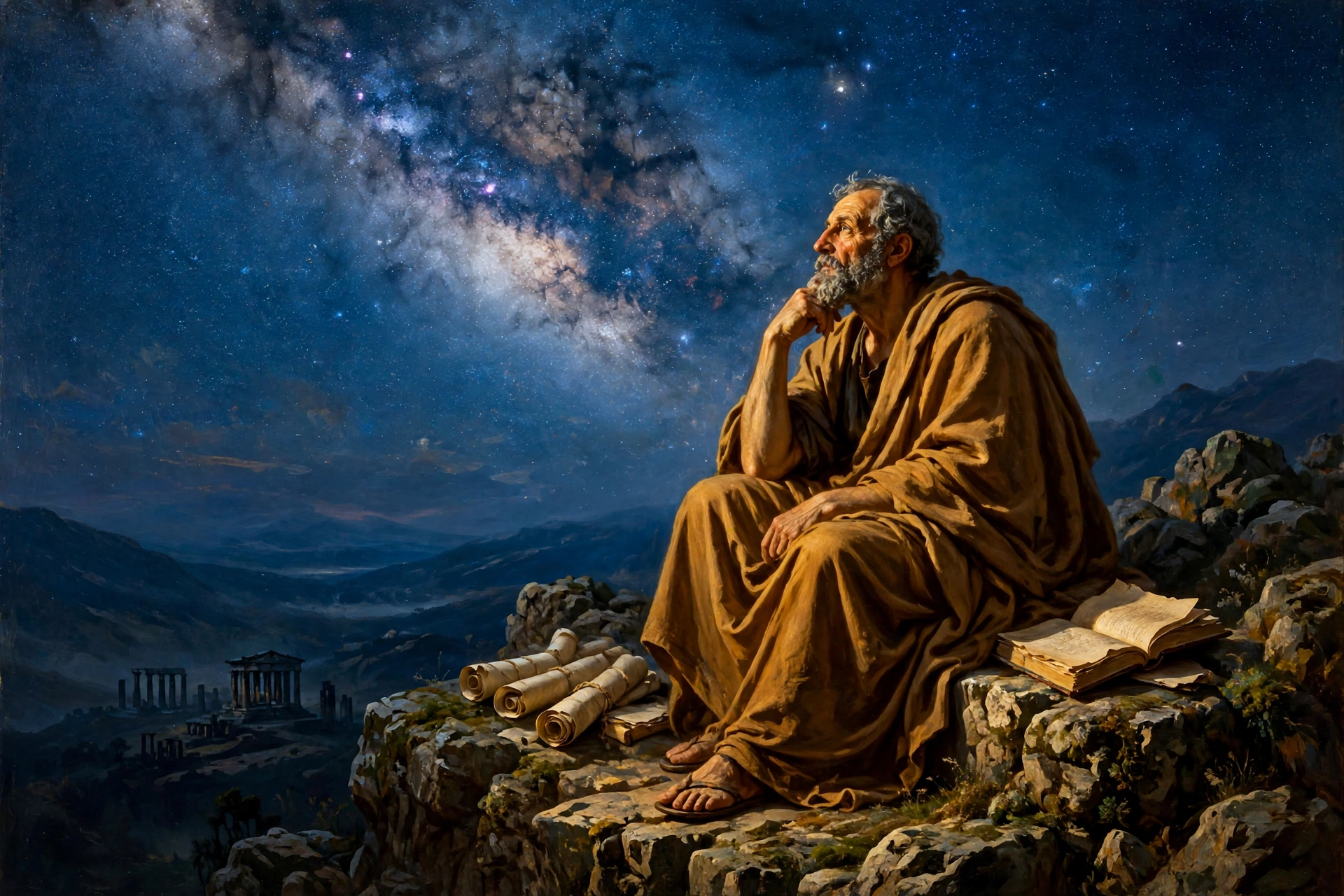
この絵について
描かれているのは、天の川の広がる星空の下で、岩の上に座って思索する一人の老人である。顎に拳を当て、星空を見上げている。足元には巻物と開いた本があり、遠く下方にはギリシャ神殿の柱が見える。
拳に顎をのせて考える人の姿は、哲学について一般に共有されている像である。そして頭上の星空は、場面の二番目の声(アリストテレス)が言う「驚き」――哲学の起源――の対象そのものである。知恵を所有するのではなく、見上げて求め続ける姿が、入口で見た philosophia(知恵を愛すること)の像に重なる。
※モチーフは、この概念について一般に共有されている像を既定として選んだ。絵は後から差し替え可能とする。
「哲学」という名は、そもそも謙遜から生まれた。伝承のなかで、ピュタゴラスは自らを「賢者」とは呼ばなかった。
Pythagoras(ピュタゴラス)立てる ― 名の由来
しかし、哲学という語を初めて考案し、自らを哲学者と呼んだのはピュタゴラスであった。 彼がシキュオンで、シキュオン人あるいはフレイウス人の僭主であったレオンと語り合っていたと きのことである(ポントスのヘラクレイデスが死んだ女について書いた書物の中で伝えているよう に)。というのも、彼は、いかなる人間も賢者と呼ばれるべきではなく、ただ神だけがそう呼ばれ るべきだと言ったからである。以前は、今日哲学(φιλοσοφία)と呼ばれるものは知恵( σοφία)と呼ばれ、それを公言する者は、精神の大きな鋭さと正確さを授かった者として賢者 (σοφοὶ)と呼ばれていた。しかし今では、知恵を抱く者は哲学者(φιλόσοφος)と 呼ばれる。
原文
But Pythagoras was the first person who invented the term Philosophy, and who called himself a philosopher; when he was conversing at Sicyon with Leon, who was tyrant of the Sicyonians or of the Phliasians (as Heraclides Ponticus relates in the book which he wrote about a dead woman); for he said that no man ought to be called wise, but only God. For formerly what is now called philosophy (φιλοσοφία) was called wisdom (σοφία), and they who professed it were called wise men (σοφοὶ), as being endowed with great acuteness and accuracy of mind; but now he who embraces wisdom is called a philosopher (φιλόσοφος).
— Diogenes Laertius『The Lives and Opinions of Eminent Philosophers』 BOOK I(Charles Duke Yonge 訳) / `diogenes_laertius_lives#L398`
アリストテレスは、哲学の始まりを一つの感情に置いた。人間は、驚くことから哲学を始めた、と。
Aristotle(アリストテレス)立てる ― 驚きが起源
人々が今も昔も哲学し始めたのは驚きによってである。…… 困惑し驚く者は自分を無知だと思う(それゆえ神話を愛する者もある意味で知恵を愛する者である。 神話は驚くべきことから成っているのだから)。
原文
For it is owing to their wonder that men both now begin and at first began to philosophize ; they wondered originally at the obvious diffi- culties, then advanced little by little and stated difficulties about the greater matters, e.g. about the phenomena of the moon and those of the sun, and about the stars and about the genesis of the universe. Anda man who is puzzled and wonders thinks himself ignorant (whence even the lover of myth is in a sense a lover of Wisdom, for the myth is com- posed of wonders); therefore since they philosophized in order to escape from ignorance, evidently they were pursuing 20 science in order to know, and not for any utilitarian end. And this is confirmed “by, the facts; for it was when almost all the necessities of life and the things that make for comfort and recreation were present, that such knowledge began to be sought.
— Aristotle『Metaphysica (The Works of Aristotle, vol. 8)』 BK I (Α)(W. D. Ross 訳) / `aristotle_metaphysics#L1080`
ソクラテスは、哲学を学問である前に生き方にした。真の哲学者は、死ぬことの実践に従事している、と彼は言う。
Socrates(ソクラテス)ずらす ― 生き方としての哲学
そして真の哲学者たちは、シミアスよ、常に死ぬことの実践に従事している。 それゆえ彼らにとってこそ、あらゆる人のうちで最も死は恐ろしくないのだ。
原文
And the true philosophers, Simmias, are always occupied in the practice of dying, wherefore also to them least of all men is death terrible.
— Plato『Phaedo』 PHAEDO(Benjamin Jowett 訳) / `plato_phaedo#L1890`
ニーチェは、その伝統を内側から暴いた。あらゆる偉大な哲学は、その創始者の告白であり、無意識の自伝だ、と。
Friedrich Nietzsche(ニーチェ)覆す ― 哲学は告白
これまでのあらゆる偉大な哲学が何から成り立っていたかが、私には次第に明らかになってきた。 すなわち、その創始者の告白であり、一種の意図せぬ無意識の自伝である。
原文
It has gradually become clear to me what every great philosophy up till now has consisted of--namely, the confession of its originator, and a species of involuntary and unconscious auto-biography;
— Friedrich Nietzsche『Beyond Good and Evil』 CHAPTER I(Helen Zimmern 訳) / `nietzsche_beyond_good_and_evil#L276`
ウィトゲンシュタインは、哲学の仕事そのものを定義し直した。哲学は教説ではなく、思考の明晰化という活動だ、と。
Ludwig Wittgenstein(ウィトゲンシュタイン)ずらす ― 活動としての哲学(締め)
哲学の目的は思考の論理的な明晰化である。 哲学は教説ではなく活動である。哲学の仕事は本質的に解明から成る。 哲学の成果は「哲学的命題」の集まりではなく、命題を明晰にすることである。 哲学は、そのままではいわば不透明でぼやけている思考を明晰にし、鋭く境界づけるべきである。
原文
The object of philosophy is the logical clarification of thoughts. Philosophy is not a theory but an activity. A philosophical work consists essentially of elucidations. The result of philosophy is not a number of “philosophical propositions,” but to make propositions clear. Philosophy should make clear and delimit sharply the thoughts which otherwise are, as it were, opaque and blurred.
— Ludwig Wittgenstein『Tractatus Logico-Philosophicus』 §4.112(C. K. Ogden 訳) / `wittgenstein_tractatus#L1984`
哲学とは何か。名は「愛する者」と名乗り、起源は驚きにあり、生き方として実践され、告白として暴かれ、活動として定義し直された。五つの声が示すのは、哲学の自己像の五つの顔である。
控えの一句 ON THE BENCH
場面には出なかったが、場面と並べて置く五件。引用はすべて idea-no-tane の精選から一字一句そのまま写したものである。
Socrates(ソクラテス)
軸1「生き方」・軸5「哲学の値打ち」――吟味されない生は生きるに値しない
そしてもし私が、徳について、また君たちが私が自分自身と他人を吟味しているのを耳にするあの 他の事柄について、日々語り合うことこそ人間にとって最大の善であり、吟味されない生は生きる に値しないのだ、と重ねて言うならば、君たちはなおさら私を信じないだろう。 しかし私は真実を語っているのだ。君たちを説得するのは私には難しいことではあるが。
原文
and if I say again that daily to discourse about virtue, and of those other things about which you hear me examining myself and others, is the greatest good of man, and that the unexamined life is not worth living, you are still less likely to believe me.
— Plato『Apology』(Benjamin Jowett 訳) / `plato_apology#L1306`
Callicles(カリクレス)
軸5「哲学は有害」――度を越した哲学は人生を破滅させる、最古の哲学批判
そしてこれは本当のことだ。哲学を捨ててもっと高いことへ進めば、あなたにも確かめられる。 ソクラテスよ、哲学というのは、ほどほどに、しかるべき年齢で追い求めるならば優雅な教養だが、 度を越した哲学は人生を破滅させる。良い素質を持つ人間でも、哲学を後の人生にまで持ち込めば、 紳士たる者、名誉ある者が知っておくべき事柄のすべてに必ず無知になる。 国の法にも、私事であれ公事であれ人と人との交わりで用いるべき言葉遣いにも不慣れになり、人 間の快楽や欲望、そして人間の性格一般についてまったく無知になるのだ。
原文
And this is true, as you may ascertain, if you will leave philosophy and go on to higher things: for philosophy, Socrates, if pursued in moderation and at the proper age, is an elegant accomplishment, but too much philosophy is the ruin of human life. Even if a man has good parts, still, if he carries philosophy into later life, he is necessarily ignorant of all those things which a gentleman and a person of honour ought to know; he is inexperienced in the laws of the State, and in the language which ought to be used in the dealings of man with man, whether private or public, and utterly ignorant of the pleasures and desires of mankind and of human character in general.
— Plato『Gorgias』(Benjamin Jowett 訳) / `plato_gorgias#L4432`
Cicero(キケロ)
軸5「最高の善」――「おお哲学よ、人生の導き手よ」という讃歌
おお哲学よ、人生の導き手よ。徳を見出す者、悪徳を追い払う者よ。 あなたがいなかったら、私自身はもちろん、人間の生活全体はどうなっていたことか。 都市の起源をもたらしたのはあなたであり、散り散りだった人類を呼び集めて社会の生活へ導いた のもあなたである。あなたは人々を結び合わせた。 まず互いに近く住まわせ、次に婚姻によって、最後に言葉と言語の伝達によって。 あなたは法の発明者であり、道徳と規律における我々の教師であった。 我々はあなたのもとへ逃れ、あなたに助けを求める。 かつて私は大いにあなたに身を委ねたが、いまや私は自分自身をまるごとあなたに引き渡す。 あなたの教えに従ってよく気持ちよく過ごした一日は、誤りのうちに過ごす永遠にまさるのだから。
原文
O Philosophy, thou guide of life! thou discoverer of virtue and expeller of vices! what had not only I myself, but the whole life of man, been without you? To you it is that we owe the origin of cities; you it was who called together the dispersed race of men into social life; you united them together, first, by placing them near one another, then by marriages, and lastly, by the communication of speech and languages. You have been the inventress of laws; you have been our instructress in morals and discipline; to you we fly for refuge; from you we implore assistance; and as I formerly submitted to you in a great degree, so now I surrender up myself entirely to you. For one day spent well, and agreeably to your precepts, is preferable to an eternity of error.
— Cicero『Cicero's Tusculan Disputations』 BK V(Charles Duke Yonge 訳) / `cicero_tusculan_disputations#L5782`
Immanuel Kant(カント)
軸1「活動」――哲学は学べず、哲学することを学ぶだけ
その時までは、われわれは哲学を学ぶことはできない――それは存在しないのである。 もし存在するとすれば、それはどこにあり、誰がそれを所有し、われわれはどのようにしてそれを 知るのか。われわれはただ哲学することを学びうるだけである。
原文
Until that time, we cannot learn philosophy—it does not exist; if it does, where is it, who possesses it, and how shall we know it? We can only learn to philosophize;
— Immanuel Kant『The Critique of Pure Reason』 Chapter III(J. M. D. Meiklejohn 訳) / `kant_critique_of_pure_reason#L20406`
Bertrand Russell(ラッセル)
軸5「哲学の値打ち」――哲学は答えのためでなく問いのために学ばれる
以上、哲学の価値についての議論をまとめれば、哲学は、その問いへの何らかの確定的な答えのた めに学ばれるのではない。確定的な答えは概して真と知られえないからだ。 そうではなく問いそのもののために学ばれる。 問いは可能なものについての我々の考えを広げ、知的想像力を豊かにし、思弁に心を閉ざす独断的 な確信を減らすからであり、何よりも、哲学が観照する宇宙の偉大さを通じて心もまた偉大になり、 その最高善である宇宙との合一を可能にするからである。
原文
Thus, to sum up our discussion of the value of philosophy; Philosophy is to be studied, not for the sake of any definite answers to its questions, since no definite answers can, as a rule, be known to be true, but rather for the sake of the questions themselves; because these questions enlarge our conception of what is possible, enrich our intellectual imagination and diminish the dogmatic assurance which closes the mind against speculation; but above all because, through the greatness of the universe which philosophy contemplates, the mind also is rendered great, and becomes capable of that union with the universe which constitutes its highest good.
— Bertrand Russell『The Problems of Philosophy』 CH. XV / `russell_problems_of_philosophy#L3977`