Privacy
idea-no-tane の全引用から選んだ超精選による、概念ごとの読み物。
入口 THE WORD
この概念が扱うのは、分け離された領域の正体である。それは権利として守られるべきものか。一人でいることは善か、罰か。それとも、私的であることは心の事実そのものの性質なのか。場面の声は、私的なものの置きどころをめぐって争う。
語源 ― privatus「分け離された」
英語の private、privacy の源はラテン語 privatus で、「残りから分け離された、公職や公への参加を奪われた」という意味を持ち、動詞 privare「奪う、分け離す」、さらに privus「単独の、自分だけの」から来ている(Merriam-Webster「private」、Wikipedia「Privacy」)。
privare は「奪う」とも読める動詞であり、privatus はもともと「公のものから外された」という、欠如の含みを持つ語だった。それが「自分だけの、公でない」という意味に転じ、やがて積極的に守られるべき領域の名になっていく。奪われた状態の名が、奪われてはならないものの名になったのである。
場面の絵に選んだのは、店の奥の小さな私室である。モンテーニュが「裏店(arrière-boutique)」と呼んだ、完全に自分のものとして確保する部屋の像と重なる。
日本語の「プライバシー」 ― 1961年、訴訟から広がった語
日本語には古くから「私(わたくし)」「私事」「私生活」という語があるが、「プライバシー」という外来語と、その権利の観念が広く使われ始めたのは、1961年3月に三島由紀夫の小説『宴のあと』をめぐる訴訟が起こされてからだとされる(日本財団図書館『REGIONAL DEVELOPMENT ON INFORMATION AND TELECOMMUNICATION IN JAPAN』)。
1964年9月28日、東京地方裁判所はその判決で、プライバシーの権利を「私生活をみだりに公開されないという法的保障ないし権利」と定義した(同上)。日本語のなかでこの概念は、まず小説と訴訟の場で、権利として姿を現したのである。
なお、idea-no-tane の総括はこの概念に「私秘」という訳し方を当てている。「秘」は隠すことであり、privatus の「分け離された」という像に近い。本ページでも、その像を手がかりに声を並べた。
場面 THE SCENE
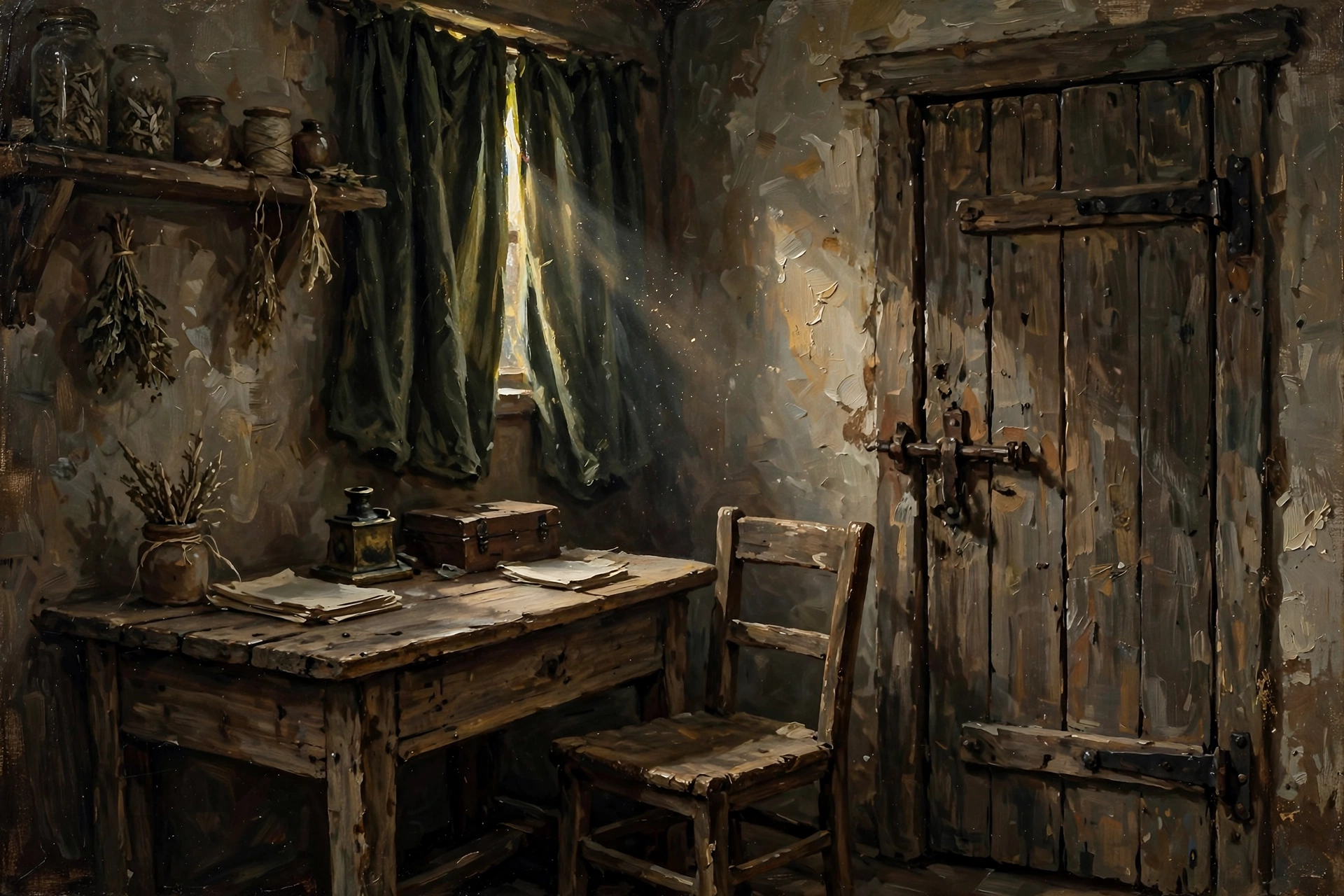
この絵について
木の机と一脚の椅子のある、小さな部屋。重い木の扉は閉ざされ、窓には厚いカーテンが引かれて、細い光だけが差している。
モンテーニュが「裏店」と呼んだ、自分のためだけに確保する部屋の像である。プライバシーは、まずこのような、内側に引かれた境界として思い描かれてきた。その境界が、やがて権利の言葉を獲得する。
絵はモチーフの置き換えが可能であり、この絵でなければならない必然はない。一般に共有される私的な空間の像として、閉ざされた奥の部屋を選んだ。
場面は一人の隠れ家から始まる。モンテーニュは、店の奥に、完全に自分のものとして裏店を確保せよと言う。私的なものは、まず内側に引いた境界として姿を現す。
モンテーニュ(Michel de Montaigne)立てる
妻、子供、財産は、得られる者は持たなければならない。 とりわけ健康も。しかし、我々の幸福がそれらに依存しなければならないほど、それらに心を置い てはならない。我々は、完全に我々自身のもので、完全に自由な裏店(arrière-bout ique)を確保しなければならない。 そこに我々の真の自由、我々の主要な孤独と隠遁を確立するために。 そしてそこで、我々は大部分、自分自身と楽しみ合わなければならない。 異国の知識や交わりをそこに認めないほど私的に。 妻、子供、財産、従者、付き添いなしであるかのように、笑い、語るために。 そうすれば、それらを失わなければならない事態が起こっても、それらなしでいることが新しいこ とではなくなる。
原文
Wives, children, and goods must be had, and especially health, by him that can get it; but we are not so to set our hearts upon them that our happiness must have its dependence upon them; we must reserve a backshop, wholly our own and entirely free, wherein to settle our true liberty, our principal solitude and retreat. And in this we must for the most part entertain ourselves with ourselves, and so privately that no exotic knowledge or communication be admitted there; there to laugh and to talk, as if without wife, children, goods, train, or attendance, to the end that when it shall so fall out that we must lose any or all of these, it may be no new thing to be without them.
— Michel de Montaigne『Essays of Michel de Montaigne — Complete』 CHAPTER XXXVIII(Charles Cotton 訳) / `montaigne_essays_complete#L11747`
ブランダイスは、その境界を権利の言葉に変える。「放っておいてもらう権利」である。なお、この言葉はオルムステッド事件の判決における反対意見の一節であり、盗聴の合憲性をめぐって多数意見に対して書かれたものである。部屋の比喩が、ここでは憲法の保護の対象になる。
ブランダイス(Louis Brandeis)権利として立てる
我々の憲法の起草者たちは、幸福の追求に好都合な条件を確保しようとした。 彼らは人間の精神的な本性、その感情と知性の意義を認めていた。 **生の苦痛と快楽と満足のほんの一部しか物質的なもののうちに見出されないことを知っていた。 **彼らはアメリカ人をその信念、思想、感情、感覚において保護しようとした。 **彼らは政府に対して、放っておいてもらう権利——最も包括的な権利であり、文明人が最も重 んじる権利——を与えたのである。**その権利を守るためには、手段が何であれ、政府による個 人のプライバシーへのあらゆる不当な侵入は、修正4条の違反とみなされねばならない。
原文
The makers of our Constitution undertook to secure conditions favorable to the pursuit of happiness. They recognized the significance of man's spiritual nature, of his feelings and of his intellect. They knew that only a part of the pain, pleasure and satisfactions of life are to be found in material things. They sought to protect Americans in their beliefs, their thoughts, their emotions and their sensations. They conferred, as against the government, the right to be let alone-the most comprehensive of rights and the right most valued by civilized men. To protect, that right, every unjustifiable intrusion by the government upon the privacy of the individual, whatever the means employed, must be deemed a violation of the Fourth Amendment.
— Supreme Court of the United States『Olmstead v. United States, 277 U.S. 438 (1928)』 Olmstead v. United States, 277 U.S. 438 (1928) (Brandeis, J., dissenting) / `case_olmstead_v_united_states_1928#L773`
ヒュームは、一人でいることの評価を裏返す。完全な孤独は考えうる最大の罰であり、どんな快楽もそれを埋め合わせることはできない。守られるべき孤独と、罰としての孤独。同じ隔たりが、まったく違う顔を見せる。
ヒューム(David Hume)覆す
完全な孤独は、おそらく我々が被りうる最大の罰である。 すべての快楽は、仲間から離れて享受されると衰え、すべての苦痛はより残酷で耐えがたいものに なる。
原文
A perfect solitude is, perhaps, the greatest punishment we can suffer. Every pleasure languishes when enjoyed a-part from company, and every pain becomes more cruel and intolerable.
— David Hume『A Treatise of Human Nature』 PART II / `hume_treatise_human_nature#L12640`
ラッセルは、議論の層をずらす。心的事実には物理的事実にない私秘性があり、「私が歯痛を感じる」という事実を知りうるのは私だけである。プライバシーは権利である前に、知識の構造そのものに属する性質だという声である。
ラッセル(Bertrand Russell)ずらす
すべての心的事実と、感覚与件に関するすべての事実には、この同じ私秘性がある。 それが自明でありうるのは、ただ一人の人に対してだけである。 関係する心的なものや感覚与件に親知(acquaintance)を持つことができるのは、た だ一人だけだからである。
原文
All mental facts, and all facts concerning sense-data, have this same privacy: there is only one person to whom they can be self-evident in our present sense, since there is only one person who can be acquainted with the mental things or the sense-data concerned.
— Bertrand Russell『The Problems of Philosophy』 CHAPTER XIII / `russell_problems_of_philosophy#L3379`
最後は、小説のなかの声である。ドミトリイ・カラマーゾフはドストエフスキー『カラマーゾフの兄弟』の登場人物で、これは彼の告白の言葉である。秘密は心のなかに置かれるもので、書き留めれば心は自由になる。権利の議論のあとに、私的なものの行き先は、ふたたび内面へ戻ってくる。
ドミトリイ・カラマーゾフ(Dmitri Karamazov)締める
できないからでも、敢えてしないからでも、損害になるからでもない。 それは些細で取るに足らないことだが——私はしない。 原則の問題だからだ。それは私の私生活であり、私の私生活への侵入は許さない。 それが私の原則だ。あなたの質問は事件とは関係がなく、事件と関係のないものはすべて私の私的 な事柄である。
原文
Not because I couldn’t, or because I shouldn’t dare, or because it would be damaging, for it’s all a paltry matter and absolutely trifling, but—I won’t, because it’s a matter of principle: that’s my private life, and I won’t allow any intrusion into my private life. That’s my principle. Your question has no bearing on the case, and whatever has nothing to do with the case is my private affair.
— Fyodor Dostoyevsky『The Brothers Karamazov』 Chapter IV(Constance Garnett 訳) / `dostoyevsky_brothers_karamazov#L22297`
私的なものは、部屋の比喩から始まり、権利になり、孤独の評価をめぐって揺れ、最後は知識の構造と、心のなかの秘密に行き着いた。分け離された領域を何と呼ぶか——住まい、権利、罰、性質——によって、この概念の姿は変わる。
控えの一句 ON THE BENCH
ダグラス(William O. Douglas)
軸1
**我々は、避妊具の使用の痕跡を探して、夫婦の寝室という神聖な区域を警察が捜索することを 許すだろうか。その考えそのものが、婚姻関係を取り巻くプライバシーの観念にとって厭わしい。 **我々が扱っているのは、権利章典よりも古く、我々の政党よりも古く、我々の学校制度よりも 古いプライバシーの権利である。婚姻とは、良きにつけ悪しきにつけともにあること、願わくは永 続し、神聖と言えるほど親密なものである。 **それは主義主張ではなく生き方を、政治的信条ではなく生活の調和を、商業的・社会的な企て ではなく双方の忠誠を育む結びつきである。 **
原文
Would we allow the police to search the sacred precincts of marital bedrooms for telltale signs of the use of contraceptives? The very idea is repulsive to the notions of privacy surrounding the marriage relationship. We deal with a right of privacy older than the Bill of Rights older than our political parties, older than our school system. Marriage is a coming together for better or for worse, hopefully enduring, and intimate to the degree of being sacred. It is an association that promotes a way of life, not causes; a harmony in living, not political faiths; a bilateral loyalty, not commercial or social projects. Yet it is an association for as noble a purpose as any involved in our prior decisions.
— Supreme Court of the United States『Griswold v. Connecticut, 381 U.S. 479 (1965)』 Griswold v. Connecticut, 381 U.S. 479 (1965) / `case_griswold_v_connecticut_1965#L205`
ショーペンハウアー(Arthur Schopenhauer)
軸2
人は、一人でいる限りにおいてのみ、自分自身であることができる。 孤独を愛さない者は、自由を愛さないだろう。 一人でいるときにのみ、人は本当に自由だからである。
原文
A man can be _himself_ only so long as he is alone; and if he does not love solitude, he will not love freedom; for it is only when he is alone that he is really free.
— Arthur Schopenhauer『Essays: Counsels and Maxims』 SECTION 9(T. Bailey Saunders 訳) / `schopenhauer_counsels_and_maxims#L798`
ソロー(Henry David Thoreau)
軸2
考えたり働いたりする人は、どこにいても常に一人である。 孤独は、人とその仲間の間に介在する空間のマイル数では測られない。
原文
A man thinking or working is always alone, let him be where he will. Solitude is not measured by the miles of space that intervene between a man and his fellows.
— Henry David Thoreau『Walden, and On the Duty of Civil Disobedience』 T. CAREW / `thoreau_walden#L3906`
ウォーレン(Earl Warren)
軸4
役人たちはマニュアルによって告げられる。 「成功する取調べに寄与する主要な心理的要因はプライバシーである——取調べを受ける者と二人 きりになること」。
原文
The officers are told by the manuals that the 'principal psychological factor contributing to a successful interrogation is privacy—being alone with the person under interrogation.'
— Supreme Court of the United States『Miranda v. Arizona, 384 U.S. 436 (1966)』 / `case_miranda_v_arizona_1966#L240`
神(God)
軸5
汝らの奴隷と、まだ成人していない者は、一日に三度、汝らの臨席に入る前に許可を求めよ。 朝の祈りの前、正午に衣服を脱ぐとき、夜の祈りの後である。 これらは汝らの三つの私秘の時間である。 これらの時間の後、互いに仕え合う巡回の際に、許可なく入っても、汝らにも彼らにも咎めはない。
原文
let your slaves, and those of you who have not come of age, ask leave of you, three times a day, ere they come into your presence;-before the morning prayer, and when ye lay aside your garments at mid-day, and after the evening prayer. These are your three times of privacy. No blame shall attach to you or to them, if after these times, when ye go your rounds of attendance on one another, they come in without permission.
— (various)『The Koran (Al-Qur'an)』 Sura XXIV(J. M. Rodwell 訳) / `koran#L24081`