PUNISHMENT
idea-no-tane の全引用から選んだ超精選による、概念ごとの読み物。
入口 THE WORD
この概念が扱うのは、悪しき行為に対して苦を加えることである。それは何のために許されるのか。受けた行為への応報か、これからの害を防ぐためか。場面の声は、罰の正当化をめぐって争う。
語源 ― poinē、償いの支払い
英語の punishment は、ラテン語の punire「罰する」に由来し、その元は poena「罰金、刑罰」である。さらに遡ると、ギリシャ語の poinē「血の代償金、罰金、刑罰」に行き着き、印欧祖語の *kwei-「支払う、償う」に結ばれる(Etymonline)。英語の pain「苦痛」も同じ poena から来た。罰という語の底には、苦そのものよりも先に、「償いとして支払う」という像がある。何を、誰に、どれだけ支払えば釣り合うのか——場面の比例の議論は、この古い像の延長にある。
罰の字 ― 刀を持って罵る、軽い罪
漢字の「罰」について、『説文解字』は「罰、辠(罪)の小なる者なり。刀に从(したが)い、詈(ののしる)に从う。未だ刀を以て賊(そこな)う所あらず、但だ刀を持ちて罵詈すれば、則ち應(まさ)に罰すべし」と解く。金文の形も「刀を持って人を罵る、その罪は比較的軽い」姿を表すとされる(漢語多功能字庫の形義通解)。つまり「罰」の字は、相手を傷つけていない軽い罪への応答として始まった。重い刑の総称ではなかったのである。日本語でも「罰」は、罪や過ちに対する懲らしめ全般を指す語として使われてきた。場面で争われるのは、その応答が何のために、どこまで許されるかである。
場面 THE SCENE
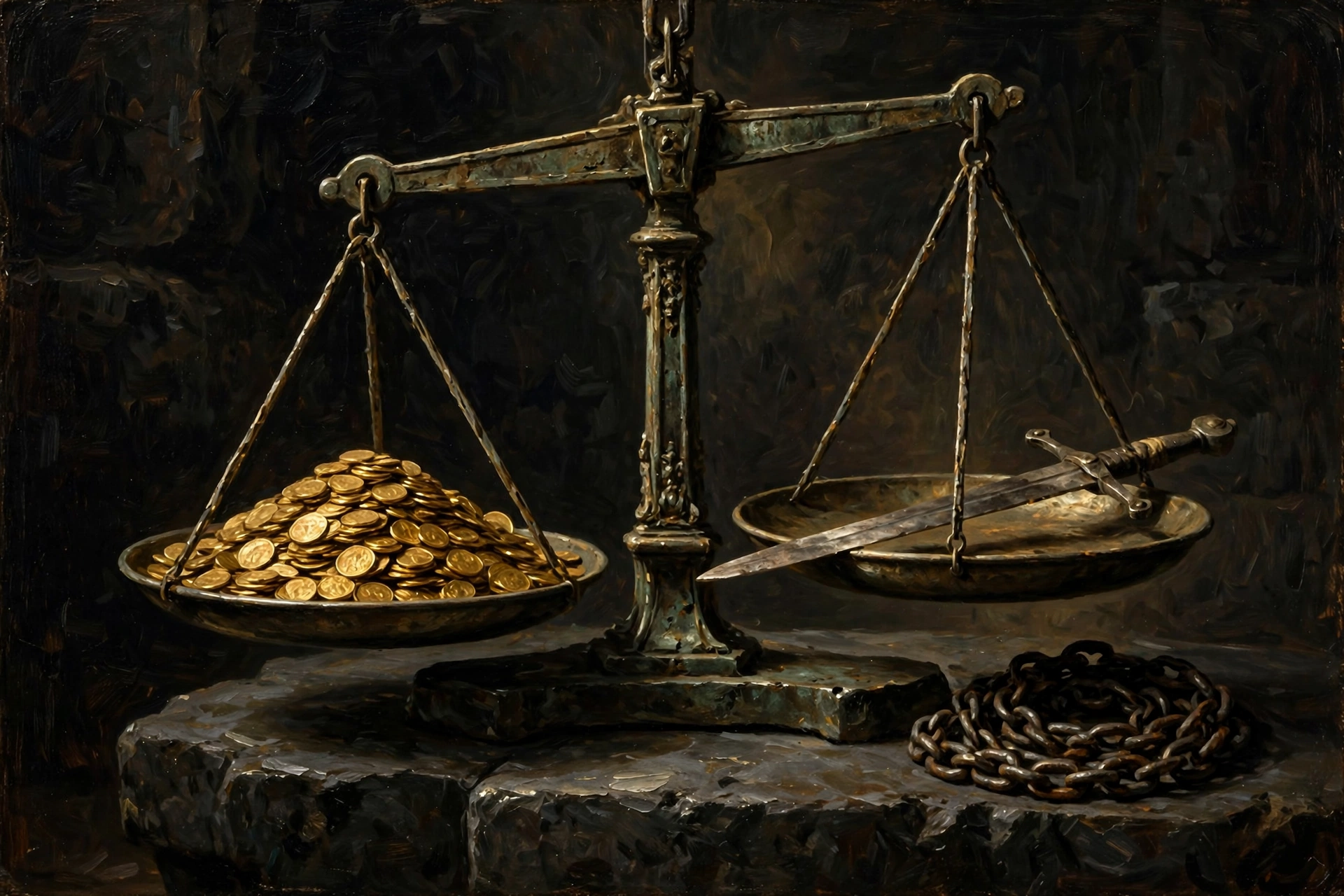
この絵について
描かれているのは、暗い石の台の上に置かれた大きな青銅の天秤である。一方の皿には金貨の山が盛られ、もう一方の皿には一振りの剣が横たわっている。台の脇には、重い鉄の鎖がとぐろを巻いている。人は描かれていない。
金貨の皿は、入口で見た poinē の像である。罰の語の底には「血の代償金」、償いの支払いがあった。剣の皿は、支払いだけでは済まないときに落ちる力である。場面で争われるのは、この天秤を何で釣り合わせるのか——応報か、将来の害の予防か、それとも釣り合いという考え自体の解体か、である。
※モチーフは、「罰」について一般に共有されている像(裁きの天秤と剣)を既定として選び、入口の根の像(poinē=償いの金)と重ねた。絵は差し替え可能とする。
罰とは何か。——最初に口を開いたのはアリストテレスだった。復讐と懲罰には違いがある。懲罰は受ける者の利益のために科され、復讐は科す者の利益のため、つまりその者が満足を得るために科されるのだ、と。同じ苦でも、向き先が違えば別のものになる。
Aristotle(アリストテレス)立てる ― 懲罰は受ける者の利益のために、復讐は科す者の満足のために科される
しかし復讐と懲罰には違いがある。後者は受ける者の利益のために科され、前者は科す者の利益の ため、つまりその者が満足を得るために科される。
原文
But there is a difference between re- venge and punishment ; the latter is inflicted in the interest of the sufferer, the former in the interest of him who inflicts it, that he may obtain satisfaction.
— Aristotle『The \"Art\" of Rhetoric』 BK I(John Henry Freese 訳) / `aristotle_rhetoric#L7861`
カントは、罰の正しさを先に置いた。われわれの実践理性の理念には、道徳法則の違反に伴うものとして、罰に値することがある。罰を科す者が同時に仁愛の目的をもっていたとしても、罰はまず、それ自体として罰、すなわち単なる害として正当化されなければならない。罰であるかぎり、あらゆる罰にはまず正義がなければならず、これがその想念の本質をなすのだ、と。
Immanuel Kant(カント)応報を立てる ― 罰はまず、それ自体として罰として正当化されなければならない
最後に、われわれの実践理性の理念には、道徳法則の違反に伴うものがさらにある。 すなわち罰に値することである。さて、罰そのものの想念は、幸福を分かちもつことの想念とは結 びつけられない。罰を科す者が同時に、その罰をこの目的へ向ける仁愛の目的をもっていても、罰 はまず、それ自体として罰、すなわち単なる害として正当化されなければならず、そこで終わり、 罰される人がその厳しさの背後に隠れた親切をまったく認められなくても、それでも自分には正義 が行われ、報いが行動に完全にふさわしかったと認めなければならないからである。 罰であるかぎり、あらゆる罰にはまず正義がなければならず、これがその想念の本質をなす。
原文
Finally, there is something further in the idea of our practical reason, which accompanies the transgression of a moral law- namely, its ill desert. Now the notion of punishment, as such, cannot be united with that of becoming a partaker of happiness; for although he who inflicts the punishment may at the same time have the benevolent purpose of directing this punishment to this end, yet it must first be justified in itself as punishment, i.e., as mere harm, so that if it stopped there, and the person punished could get no glimpse of kindness hidden behind this harshness, he must yet admit that justice was done him, and that his reward was perfectly suitable to his conduct. In every punishment, as such, there must first be justice, and this constitutes the essence of the notion.
— Immanuel Kant『The Critique of Practical Reason』 CHAPTER I(Thomas Kingsmill Abbott 訳) / `kant_critique_of_practical_reason#L1512`
ベンサムは、その正義の先行を退けた。すべての刑罰は害悪である。すべての刑罰はそれ自体において悪である。功利の原理に照らせば、刑罰がそもそも認められるべきであるとしても、それはより大きな悪を排除すると見込まれるかぎりにおいてのみ認められるべきなのである、と。
Jeremy Bentham(ベンサム)覆す ― すべての刑罰はそれ自体において悪であり、より大きな悪を排除する範囲でのみ認められる
**しかしすべての刑罰は害悪である。 すべての刑罰はそれ自体において悪である。 **功利の原理に照らせば、刑罰がそもそも認められるべきであるとしても、それは**より大き な悪を排除すると見込まれるかぎりにおいてのみ**認められるべきなのである。
原文
But all punishment is mischief: all punishment in itself is evil. Upon the principle of utility, if it ought at all to be admitted, it ought only to be admitted in as far as it promises to exclude some greater evil.
— Jeremy Bentham『An Introduction to the Principles of Morals and Legislation』 CHAPTER XIII / `bentham_principles_of_morals_and_legislation#L5479`
ベッカリーアは、罰が暴力に堕さないための条件を定理の形で置いた。あらゆる刑罰が、一人または多数の人間による一個人に対する暴力行為とならないためには、それは何よりもまず、公開であり、迅速であり、必要であり、与えられた状況において可能なかぎり軽く、犯罪に比例し、法によって定められたものでなければならない、と。
Cesare Beccaria(ベッカリーア)条件を置く ― 罰が暴力でないためには、公開・迅速・必要・最小・比例・法定でなければならない
定理はこうである。「あらゆる刑罰が、一人または多数の人間による一個人に対する暴力行為とな らないためには、それは何よりもまず、**公開であり、迅速であり、必要であり、与えられた状 況において可能なかぎり軽く、犯罪に比例し、法によって定められたもの**でなければならない。」
原文
The theorem is this: ‘In order that every punishment may not be an act of violence, committed by one man or by many against a single individual, it ought to be above all things public, speedy, necessary, the least possible in the given circumstances, proportioned to its crime, dictated by the laws.
— Cesare Beccaria『Crimes and Punishments (including a New Translation of Dei Delitti e delle Pene)』 Dei Delitti e delle Pene (Farrer 訳)(James Anson Farrer 訳) / `beccaria_crimes_and_punishments#L6070`
最後にニーチェが、問いの土台を揺らした。今日では、罰の正確な理由を明確に言うのは不可能である。全過程が混然と含まれる観念はすべて定義を免れる。定義できるのは歴史をもたないものだけである、と。応報と予防の応酬の外側から、罰という観念そのものの来歴が問われた。
Friedrich Nietzsche(ニーチェ)解体する ― 罰の正確な理由は言えない。定義できるのは歴史をもたないものだけである
(今日では、罰の正確な理由を明確に言うのは不可能である。 全過程が混然と含まれる観念はすべて定義を免れる。 定義できるのは歴史をもたないものだけである。)
原文
(It is nowadays impossible to say definitely _the precise reason_ for punishment: all ideas, in which a whole process is promiscuously comprehended, elude definition; it is only that which has no history, which can be defined.)
— Friedrich Nietzsche『The Genealogy of Morals』 SECOND ESSAY. "GUILT," "BAD CONSCIENCE," AND THE LIKE(Horace B. Samuel 訳) / `nietzsche_genealogy_of_morals#L2239`
受ける者の利益のための懲罰、まず正義でなければならない罰、それ自体が悪である刑罰、暴力でないための条件の定理、そして定義を免れる罰の観念。——罰の釣り合いは、声ごとに違う皿に置かれた。
控えの一句 ON THE BENCH
Socrates(ソクラテス)
軸2/軸3 ― 罰を逃れる者は、腐って不正な魂という最大の悪から解放されることも逃れている。罰は魂の治療だという古典の立場
正義を逃れようとする者も同じ状態にある。 彼らは正義が苦痛であることは見ているが、そこから生じる利益には目が見えない。 腐って不正で不敬な魂という道連れが、病んだ身体よりもどれほど惨めなものかを知らないのだ。 それゆえ彼らは、罰を避けるため、そして最大の悪から解放されるのを避けるために、できるかぎ りのことをする。金と友人を用意し、説得の力をとことん磨くのである。
原文
they are in a like case who strive to evade justice, which they see to be painful, but are blind to the advantage which ensues from it, not knowing how far more miserable a companion a diseased soul is than a diseased body; a soul, I say, which is corrupt and unrighteous and unholy. And hence they do all that they can to avoid punishment and to avoid being released from the greatest of evils; they provide themselves with money and friends, and cultivate to the utmost their powers of persuasion.
— Plato『Gorgias』(Benjamin Jowett 訳) / `plato_gorgias#L4208`
Confucius(孔子)
軸7 ― 「人民を法律で導き、罰によって足並みをそろえようとすれば、人民は罰を避けようとするが、恥を感じない」。恐れは徳を育てない
先生は言った。「人民を法律で導き、罰によって足並みをそろえようとすれば、人民は罰を避けよ うとするが、恥を感じない。二。
原文
The Master said, 'If the people be led by laws, and uniformity sought to be given them by punishments, they will try to avoid the punishment, but have no sense of shame. 2.
— Confucius『The Analects of Confucius』 BOOK II(James Legge 訳) / `confucius_analects#L173`
Thomas Aquinas(トマス・アクィナス)
軸6 ― 罪ゆえに科される罰は、各人が自分自身の罪についてのみ受ける。ただし治療としての罰と、自ら進んで引き受ける償いは別だという区別
答えて言う、自ら進んで引き受ける償いとしての罰について言うなら、先に述べたように(第七項)、 何らかの仕方で一つであるかぎり、他者の罰を負うことができる。 しかし罪ゆえに科される罰を、それが刑罰であるかぎりにおいて言うなら、罪の行為は人格に属す るものだから、各人は自分自身の罪についてのみ罰される。 しかし治療としての罰について言うなら、他者の罪のために罰されることはある。 というのも、身体的な財や身体そのものに受ける災いは、魂の健康を目指す治療としての罰だと述 べたからである(第七項)。それゆえ、神であれ人間であれ、他者の罪のためにある人へこの種の 罰を科してはならない理由はない。例えば。
原文
_I answer that,_ If we speak of that satisfactory punishment, which one takes upon oneself voluntarily, one may bear another's punishment, in so far as they are, in some way, one, as stated above (A. 7). If, however, we speak of punishment inflicted on account of sin, inasmuch as it is penal, then each one is punished for his own sin only, because the sinful act is something personal. But if we speak of a punishment that is medicinal, in this way it does happen that one is punished for another's sin. For it has been stated (A. 7) that ills sustained in bodily goods or even in the body itself, are medicinal punishments intended for the health of the soul. Wherefore there is no reason why one should not have such like punishments inflicted on one for another's sin, either by God or by man; e.
— Thomas Aquinas『Summa Theologica, Part I-II (Prima Secundae)』 I-II, Q. 87, Art. 8(Fathers of the English Dominican Province 訳) / `aquinas_summa_prima_secundae#L37808`
Henri Bergson(ベルクソン)
軸8 ― 笑いはある種の欠点を罰するが、「無実の者を倒し、有罪の者を見逃す」。法の外にある間接的な制裁の不正確さ
それは自然に飛び出し、仕返しをする。 どこに当たるか見る暇はない。笑いは、病気がある種の過剰を罰するのといくらか似た仕方で、あ る種の欠点を罰し、無実の者を倒し、有罪の者を見逃し、全体的な結果を目指しながら、個別の場 合を一つずつ扱うことができない。
原文
It goes off spontaneously and returns tit for tat. It has no time to look where it hits. Laughter punishes certain failing's somewhat as disease punishes certain forms of excess, striking down some who are innocent and sparing some who are guilty, aiming at a general result and incapable of dealing separately with each individual case.
— Henri Bergson『Laughter: An Essay on the Meaning of the Comic』 CHAPTER III(Cloudesley Brereton / Fred Rothwell 訳) / `bergson_laughter#L3718`
Leo Tolstoy(トルストイ)
軸3 ― 「刑罰は矯正せず、受ける者を堕落させるだけだ」。復讐の法が愛の法に置き換えられたことを知りながらの処罰への問い
キリスト教徒なら復讐の法は愛の法に置き換えられたと知り、教育ある者なら刑罰は矯正せず、受 ける者を堕落させるだけだと知りながら、なぜ人が罪を犯したからといって、法廷へ行き、その裁 判と処罰に参加すべきなのか。
原文
Why should I go to the law courts to take part in the trial and punishment of men because they have sinned, knowing, if I am a Christian, that the law of vengeance is replaced by the law of love, and, if I am an educated man, that punishments do not reform, but only deprave those on whom they are inflicted?
— Leo Tolstoy『\"The Kingdom of God Is Within You\』 CHAPTER IX(Constance Garnett 訳) / `tolstoy_kingdom_of_god_within_you#L8132`