Responsibility
idea-no-tane の全引用から選んだ超精選による、概念ごとの読み物。
入口 THE WORD
この概念が扱うのは、誰が、何について、誰に答えるのかという線引きである。ある行為をその人のものとして帰するには、どんな条件が要るのか。責任はどこまで広がり、どこで限られるのか。場面の声は、その線の引き方をめぐって争う。
語源 ― respondere「答え返す、約束に応える」
英語の responsibility は、名詞としては比較的新しい語で、Online Etymology Dictionary は1787年の用例を引く。形容詞 responsible「答えるべき、説明責任のある」は17世紀にフランス語 responsable から入り、その源はラテン語 respondere「答える、見返りに約束する」で、re-「返す」と spondere「誓う、約束する」に分かれる(Online Etymology Dictionary「responsibility」「responsible」)。
つまりこの語の根にあるのは、「問われれば答える」「約束に応える」という応答の像である。責任とはまず、呼びかけに対して答える立場のことだった。ドイツ語の Verantwortung も、Antwort「答え」を核に持つ。
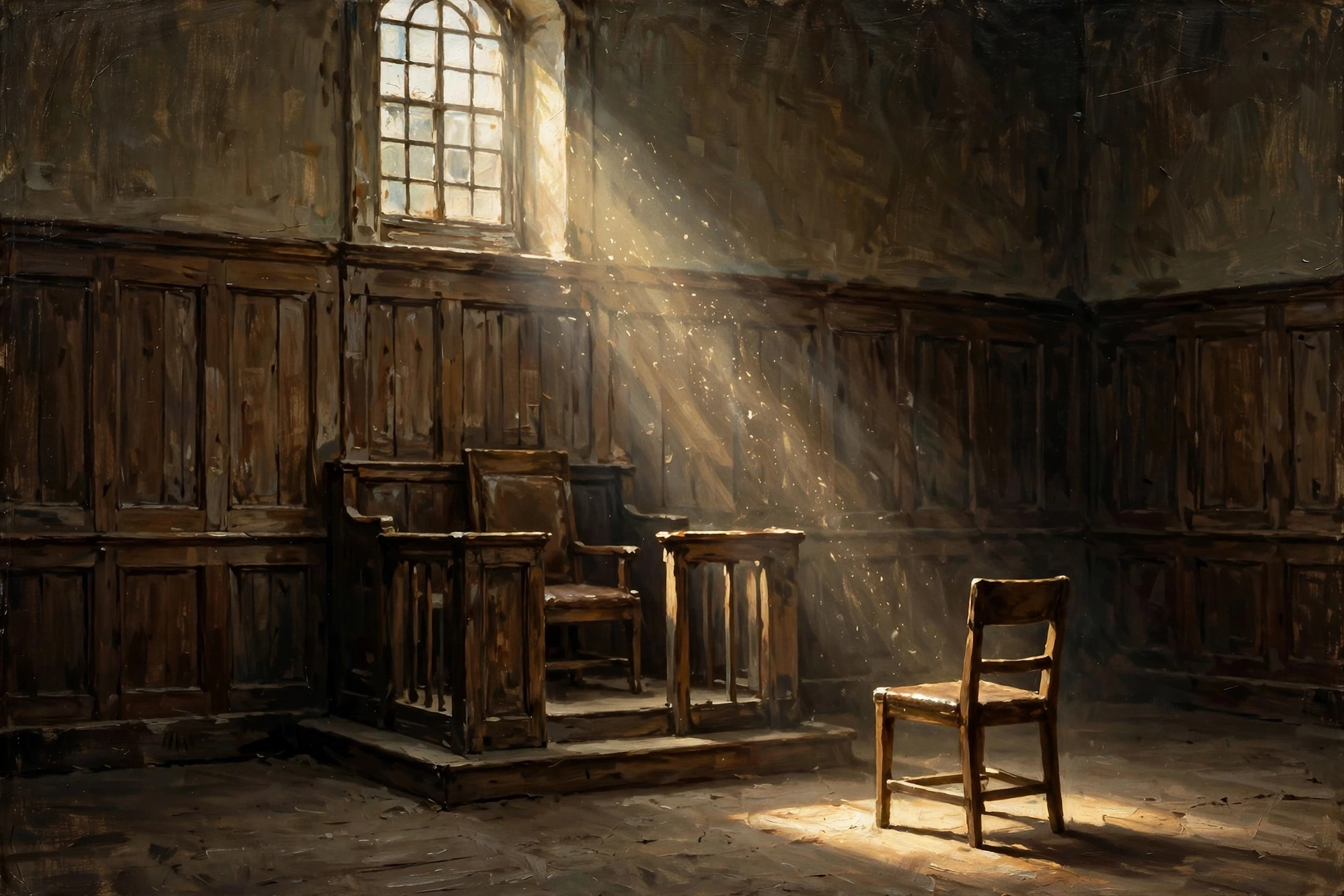
場面の絵に選んだのは、誰もいない法廷の証言台である。答えるべき席だけが残され、まだ誰も座っていない。責任の議論は、その空席に誰を座らせるかから始まる。
日本語の「責任」 ― 借りてきた熟語と、「責め」のずれ
日本語の「責任」は、明治に新しく造られた訳語ではない。中国語由来の既存の熟語であり、「責」は責める・求めること、「任」は担う・務めることを表す。明治期に responsibility の訳語として、この既存の語がそのまま当てられて定着した(Okano Note の翻訳語調査)。
ただし、respondere の「応答」という含みは、「責任」の字面には現れない。むしろ「責め」の意が強く出る。そのため、西洋語の中心にある「答える義務」と、日本語の「責任」が帯びる「責めを引き受ける」という像とのずれが、しばしば指摘されてきた(慶應義塾大学SFCの問答ページ)。場面の声のなかでは、スミスの「説明責任を負う存在」という定義が、語源の応答の像に最も近い。
場面 THE SCENE
この絵について
木の羽目板に囲まれた法廷のなかに、証言台と、その前に置かれた一脚の椅子がある。窓から一筋の光が差し、空席の上に落ちている。
responsibility の語源 respondere は「答え返す、約束に応える」という意味だった。責任の議論は、この空席に誰を座らせ、どこまでのことに答えさせるかを決める作業である。
絵はモチーフの置き換えが可能であり、この絵でなければならない必然はない。一般に共有される「答える席」の像として、法廷の証言台を選んだ。
場面は帰責の条件から始まる。アクィナスは、あることが人の力のうちにあり、その人がそれを支配するとき、それはその人に帰せられると言う。責任とはまず、力と支配の範囲の問題である。
アクィナス(Thomas Aquinas)立てる
行為は、それが行為者に帰せられることによって、賞賛や非難に値すると言われる。 賞賛や非難とは、誰かにその行為の悪性や善性を帰することにほかならないからである。 行為は、それが行為者の力のうちにあり、彼がそれを支配するときに、行為者に帰せられる。 人は意志によって自分の行為を支配するからである。
原文
For an action is said to deserve praise or blame, from its being imputed to the agent: since to praise or to blame means nothing else than to impute to someone the malice or goodness of his action. Now an action is imputed to an agent, when it is in his power, so that he has dominion over it: because it is through his will that man has dominion over his actions, as was made clear above (Q.
— Thomas Aquinas『Summa Theologica, Part I-II (Prima Secundae)』 I-II, Q. 21, Art. 2(Fathers of the English Dominican Province 訳) / `aquinas_summa_prima_secundae#L10358`
ホームズはその条件を、機会の側から具体化する。人を責任に問えるのは、害を避ける公正な機会があったときに限られる。力の範囲という抽象的な条件が、ここでは「避けることができたか」という問いに置き換わる。
ホームズ(Oliver Wendell Holmes Jr.)条件を引く
責任を道徳的な基準に帰することの真の説明は、それが人々の心を改善するためではなく、人を責 任に問う前に、彼に害を避ける公正な機会を与えるためである。 それは、事故が落ちた場所に放置する政策と、他者の合理的な自由とを、個人を傷害から保護する ことと調和させることを意図している。
原文
The true explanation of the reference of liability to a moral standard, in the sense which has been explained, is not that it is for the purpose of improving men's hearts, but that it is to give a man a fair chance to avoid doing the harm before he is held responsible for it. It is intended to reconcile the policy of letting accidents lie where they fall, and the reasonable freedom of others with the protection of the individual from injury.
— Oliver Wendell Holmes Jr.『The Common Law』 LECTURE IV. -- FRAUD, MALICE, AND INTENT.--THE THEORY OF TORTS / `holmes_common_law#L4161`
ニーチェは、責任の観念そのものを裏返す。自由意志が否定されれば、行為は完全に無垢であり、責任は消える。彼はその境地を「最も苦い一滴」と呼ぶ。帰責の条件を整える議論の足元が、ここで揺らぐ。
ニーチェ(Friedrich Nietzsche)覆す
人間が自分の行為と本性について完全に無責任であること、これは、責任と義務のうちに自らの人 間性の貴族の証書を見ることに慣れていた者が、理解したときに飲み下さねばならない最も苦い一 滴である。彼のあらゆる評価、区別、嫌悪はそれによって価値を奪われ偽りとなる。 受難者と英雄への彼の最も深い感情は誤謬に基づいていた。 彼はもはや賞賛も非難もしてはならない。 自然と必然を賞賛し非難するのは不合理だからである。
原文
The complete irresponsibility of man for his actions and his nature is the bitterest drop which he who understands must swallow if he was accustomed to see the patent of nobility of his humanity in responsibility and duty. All his valuations, distinctions, disinclinations, are thereby deprived of value and become false,--his deepest feeling for the sufferer and the hero was based on an error; he may no longer either praise or blame, for it is absurd to praise and blame nature and necessity.
— Friedrich Nietzsche『Human, All-Too-Human, Part 1』 Div. II, §107(Helen Zimmern 訳) / `nietzsche_human_all_too_human#L2930`
そこへ、条件をすべて取り払う声が来る。ゾシマ長老はドストエフスキー『カラマーゾフの兄弟』の登場人物であり、これは修道士の教えの言葉である。「各人はすべての人に対して、すべてのことについて責任がある」。力の範囲も、避ける機会も問わない。責任は最大限まで広げられる。
ゾシマ長老(Elder Zosima)広げる
知ってください、愛する者たちよ。我々の一人一人は、すべての人々と地上のすべてのことについ て、疑いなく責任がある。創造の一般的な罪深さを通じてのみではなく、各人が個人的に、全人類 と一人一人の人間について責任がある。
原文
For know, dear ones, that every one of us is undoubtedly responsible for all men and everything on earth, not merely through the general sinfulness of creation, but each one personally for all mankind and every individual man.
— Fyodor Dostoyevsky『The Brothers Karamazov』 Chapter I(Constance Garnett 訳) / `dostoyevsky_brothers_karamazov#L7471`
ハミルトンは、最初の条件へ引き戻す。責任は、その人の力のうちにある対象についてのみ、その人に帰せられる。「すべての人に責任がある」という声と、「力の範囲で限る」という声は、真正面からぶつかったままである。総括もこの衝突を未決着としており、場面はその緊張を抱えたまま閉じる。
ハミルトン(Alexander Hamilton)締める
責任は、合理的であるためには、責任を負う当事者の力のうちにある対象に限定されなければなら ない。効果的であるためには、構成員が容易かつ適切な判断を形成できる、その力の行使に関係し なければならない。
原文
Responsibility, in order to be reasonable, must be limited to objects within the power of the responsible party, and in order to be effectual, must relate to operations of that power, of which a ready and proper judgment can be formed by the constituents.
— Hamilton, Madison, Jay『The Federalist Papers』 No. LXIII / `federalist_papers#L13873`
責任の線は、一か所には引かれなかった。力と支配の範囲に限る声、機会の公正さを問う声、責任そのものを消す声、すべての人へ広げる声、そして再び力の範囲へ引き戻す声。総括が未決着とした衝突は、この場面でも解けていない。それが、この概念の現在の姿である。
控えの一句 ON THE BENCH
カント(Immanuel Kant)
軸1
この自由(後者の真の意味における)がなければ、それだけが実践的にアプリオリであるのだが、 道徳法則も道徳的な帰責も可能ではない。 まさにこの理由により、時間における出来事の必然性は、因果性の物理法則に従って、自然の機構 と呼ばれることがある。ただし、それに服する事物が実際に物質的な機械でなければならないとい う意味ではない。
原文
Without this freedom (in the latter and true sense), which alone is practical a priori, no moral law and no moral imputation are possible. Just for this reason the necessity of events in time, according to the physical law of causality, may be called the mechanism of nature, although we do not mean by this that things which are subject to it must be really material machines.
— Immanuel Kant『The Critique of Practical Reason』 CHAPTER III(Thomas Kingsmill Abbott 訳) / `kant_critique_of_practical_reason#L3860`
ブラックストーン(William Blackstone)
軸4
第一に、公務の遂行において非難すべきことは、国王に帰せられることはなく、彼は個人的にその 国民に対して答える義務はない。この教義は、我々の自由で活動的で、それゆえ複合的な憲法にお ける権力の均衡に必要な、王冠の憲法上の独立を完全に破壊するからである。
原文
First, that whatever is exceptionable in the conduct of public affairs is not to be imputed to the king, nor is he answerable for it personally to his people: for this doctrine would totally destroy that constitutional independence of the crown, which is necessary for the balance of power, in our free and active, and therefore compounded, constitution.
— William Blackstone『Commentaries on the Laws of England, Book the First』 OF THE KING'S PREROGATIVE / `blackstone_commentaries_v1#L8857`
トルストイ(Leo Tolstoy)
軸3
私は政府の会議に参加できないのだから、その悪行に責任はない。 確かに、しかし我々は自分自身の悪行に責任がある。 そして、支配者の悪行は、それが悪行であることを知りながら、その実行を助けるとき、我々自身 のものになる。
原文
I cannot take part in the councils of government, and therefore I am not responsible for its misdeeds.. Indeed, but we are responsible for our own misdeeds. And the misdeeds of our rulers become our own, if we, knowing that they are misdeeds, assist in carrying, them out.
— Leo Tolstoy『\"The Kingdom of God Is Within You\』 CHAPTER I(Constance Garnett 訳) / `tolstoy_kingdom_of_god_within_you#L1034`
スミス(Adam Smith)
軸5
人は道徳的であると考えられる。彼は説明責任を負う存在とみなされるからである。 しかし説明責任を負う存在とは、その言葉が表すように、自分の行為について他者に説明を与えな ければならない存在であり、その結果、この他者の好みに従ってそれらを調整しなければならない 存在である。
原文
Man is considered as a moral, because he is regarded as an accountable being. But an accountable being, as the word expresses, is a being that must give an account of its actions to some other, and that consequently must regulate them according to the good liking of this other.
— Adam Smith『The Theory of Moral Sentiments』 PART III / `smith_moral_sentiments#L4886`
釈迦(Buddha)
軸3
自分で悪をなし、自分で苦しむ。自分で悪をなさず、自分で清まる。 清浄も不浄も自分による。誰も他人を清めることはできない。
原文
165. By oneself the evil is done, by oneself one suffers; by oneself evil is left undone, by oneself one is purified. Purity and impurity belong to oneself, no one can purify another.
— (various)『Dhammapada, a Collection of Verses』 CH XII v.165(F. Max Müller 訳) / `dhammapada#L730`