SLAVERY
idea-no-tane の全引用から選んだ超精選による、概念ごとの読み物。
入口 THE WORD
この概念が扱うのは、一人の人間が他人の所有物となり、その支配に服するという制度と、それを支える論理と、それを崩す論理である。身分は自然の秩序なのか、人が作った法なのか。場面の声は、その境界をめぐって争う。
語源 ― slave は「スラヴ人」の名だった
英語の slave は、中英語の sclave、古フランス語の esclave を経て、中世ラテン語の sclavus に遡る。これはもともと Sclavus「スラヴ人」という民族名で、中世初期に中央ヨーロッパでスラヴ人が頻繁に奴隷化されたため、民族の名がそのまま身分の名になった(Merriam-Webster)。後期ラテン語で sclavus が「奴隷」の意で使われるのは9〜10世紀ごろからで、英語に入ったのは1300年ごろとされる(Merriam-Webster/Etymonline)。なお、古典ラテン語で奴隷を指したのは servus で、こちらは英語の serf(農奴)や service の語源になった。つまり英語には、「誰が奴隷にされたか」の歴史を刻んだ語と、「仕えること」の関係を刻んだ語とが、別々に残っている。語源は語の来歴であって、制度の本質を決めるものではないが、この来歴自体が、奴隷制が特定の人々を標的にしてきた歴史の痕跡である。
日本語の「奴隷」 ― 律令の身分「奴婢」から、明治の訳語へ
「奴隷」は漢語である。中国では奴婢が奴隷の通称で、奴は男の奴隷、婢は女の奴隷を指し、「奴隷」もその表現の一つだった(Weblio辞書「奴婢」)。「隷」の字は「隷属」の隷で、属し、従うことを意味する。日本では律令制のもとで奴婢(ぬひ)が制度上の身分として置かれ、良民に対する賤民の一区分だった。日本語の「奴隷」の初出は1662年の『羅山先生文集』とされ、当初は身分の低い者を指す語だったが、明治になって英語 slave の訳語として定着した(ピクシブ百科事典「奴隷」)。明治以前の日本で奴隷的身分を指したのは、奴婢のほか、生口(せいこう)、やっこ、下人などの語だった。場面で争われるのは、この身分が自然の秩序なのか、法が作ったものなのか、である。
場面 THE SCENE
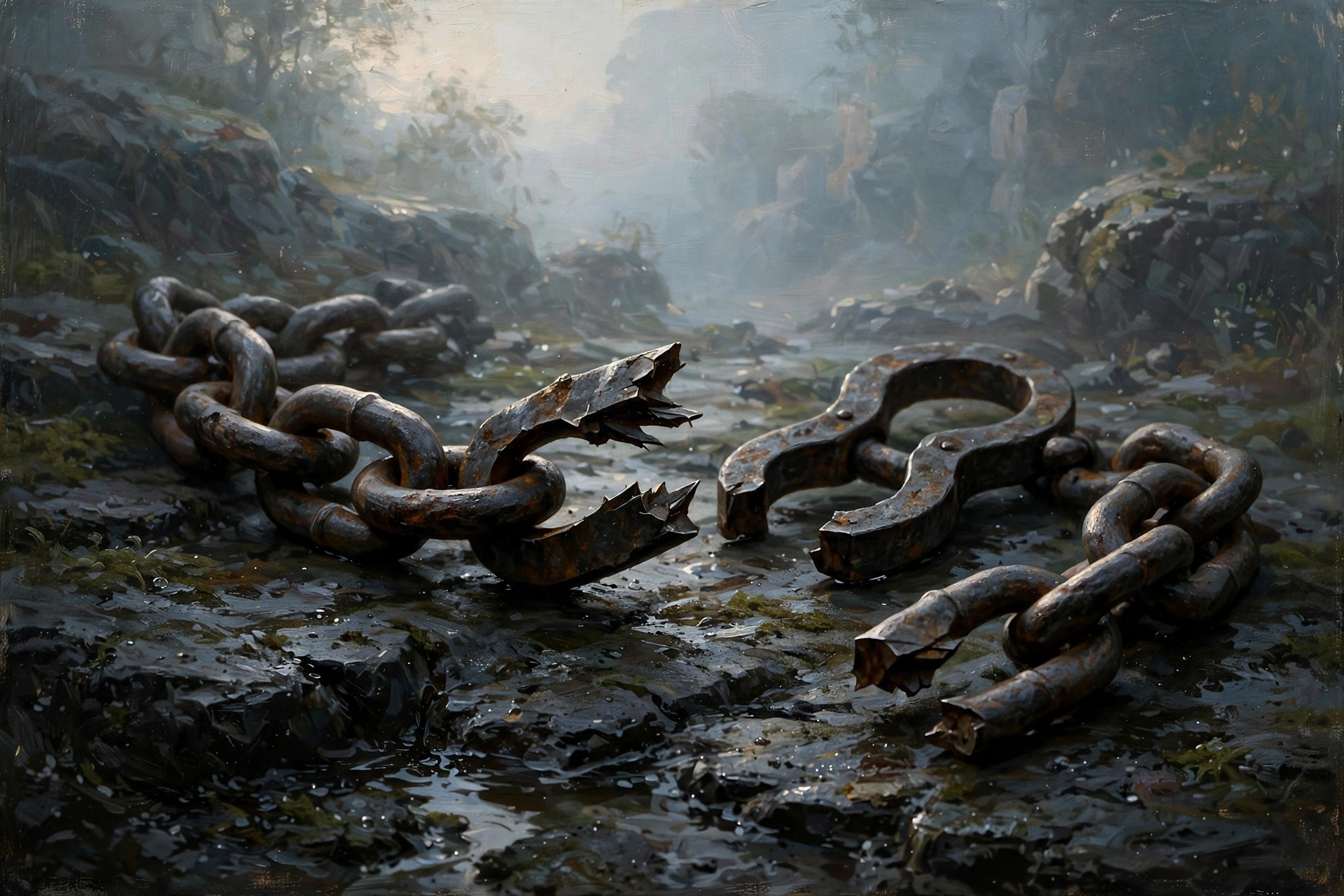
この絵について
描かれているのは、霧のかかる岩場の地面に横たわる、太い鉄の鎖である。鎖は中央で断ち切られ、その脇には開いた鉄の足枷が転がっている。朝の光が霧の向こうから差し、濡れた石を光らせている。人は描かれていない。
この鎖は、入口で見た身分の像である。奴隷制は、人を人に縛りつける制度だった。場面で争われるのは、その縛りが自然の秩序なのか、法が作ったものなのか、そして誰がそれを断ち切る言葉を持つのか、である。断ち切られた鎖は、議論の結論ではなく、その問いのかたちとして置かれている。
※モチーフは、「奴隷制」について一般に共有されている像(人を縛る鎖)を既定として選んだ。絵は差し替え可能とする。
奴隷とは何か。——最初に口を開いたのはアリストテレスだった。身体が魂に劣るのと同じだけ他者に劣る人々は、本性による奴隷であり、常に支配のもとにあることが彼らに有益である。理性があると知るだけの理性はあるが、それを用いる力は備えていない者がそれだ、と。ただし彼は、留保も添えた。この規則は常に成り立つわけではなく、奴隷が自由人の身体を持つことも、時には魂を持つこともある。魂の優劣は、身体の美しさほど容易には見定められない、と。
Aristotle(アリストテレス)立てる ― 本性による奴隷がおり、隷属はその者に有益である
したがって、身体が魂に劣るのと同じだけ他者に劣る人々は、このように扱われるべきである。 彼らの適切な用い方は、その卓越性が宿る身体を用いることだからである。 そして私の述べたことが真実であるなら、彼らは本性による奴隷であり、常に支配のもとにあるこ とが彼らに有益である。したがって、他者の動産となる適性を持ち、そのため現にそうなっていて、 理性という能力があると知るだけの理性はあるが、それを用いる力は備えていない者は、本性上奴 隷となるように形づくられている。他の動物は理性をまったく知覚せず、全面的に欲求に導かれる からであり、実際、両者の用途にはほとんど違いがない。 奴隷からも飼いならされた動物からもわれわれが受ける利益は、その身体の力がわれわれの必要に 役立つことから生じるからである。奴隷と自由人の身体を互いに異なるものとするのは自然の意図 であって、一方を必要な労働に耐える頑健なものとし、他方を直立して、奴隷の仕事には役立たな くても、戦争と平和の務めに分かれる市民生活に適したものとする。 しかしこの規則は常に成り立つわけではなく、奴隷が自由人の身体を持つことも、時には魂を持つ こともある。そこで、ある身体が他の身体より優れている程度が、神々の像が人間の姿より優れて いる程度に等しいことが明らかであれば、劣った者は優れた者の奴隷であるべきだと誰もが認める だろう。そしてこれが身体について真実であるなら、魂を考察するときには、同じ仕方で決めるこ とはいっそう正しい。ただし魂の美しさは身体の美しさほど容易には知覚できない。 したがって、ある人々は本性による奴隷であり、他の人々は自由人なのだから、隷属が誰かに有益 であるなら、その者を奴隷とすることは正しいと明らかになる。
原文
Those men therefore who are as much inferior to others as the body is to the soul, are to be thus disposed of, as the proper use of them is their bodies, in which their excellence consists; and if what I have said be true, they are slaves by nature, and it is advantageous to them to be always under government. He then is by nature formed a slave who is qualified to become the chattel of another person, and on that account is so, and who has just reason enough to know that there is such a faculty, without being indued with the use of it; for other animals have no perception of reason, but are entirely guided by appetite, and indeed they vary very little in their use from each other; for the advantage which we receive, both from slaves and tame animals, arises from their bodily strength administering to our necessities; for it is the intention of nature to make the bodies of slaves and freemen different from each other, that the one should be robust for their necessary purposes, the others erect, useless indeed for what slaves are employed in, but fit for civil life, which is divided into the duties of war and peace; though these rules do not always take place, for slaves have sometimes the bodies of freemen, sometimes the souls; if then it is evident that if some bodies are as much more excellent than others as the statues of the gods excel the human form, every one will allow that the inferior ought to be slaves to the superior; and if this is true with respect to the body, it is still juster to determine in the same manner, when we consider the soul; though it is not so easy to perceive the beauty of [1255a] the soul as it is of the body. Since then some men are slaves by nature, and others are freemen, it is clear that where slavery is advantageous to any one, then it is just to make him a slave.
— Aristotle『Politics: A Treatise on Government』 CHAPTER V(William Ellis 訳) / `aristotle_politics#L776`
セネカは、その関係の内側をひっくり返した。恩恵と不正とは対をなす。主人から不正を受けうるのであれば、奴隷は主人に恩恵を施すこともできる、と。奴隷は物ではなく、傷つき、与えることのできる道徳的な主体として置かれた。
Seneca(セネカ)ずらす ― 奴隷も主人に恩恵を施すことができる
恩恵と不正とは対をなす。主人から不正を受けうるのであれば、奴隷は主人に恩恵を施すこともで きる。
原文
Benefits and wrongs are opposites; a slave can bestow a benefit upon his master, if he can receive a wrong from his master.
— Seneca『L. Annaeus Seneca on Benefits』 BOOK III(Aubrey Stewart 訳) / `seneca_on_benefits#L2380`
ユスティニアヌスの法典は、定義だけを置いた。奴隷制とは万民法の制度であって、自然に反して一人の人を他人の支配に服させるものである、と。制度でありながら、自然に反する。その二重性が一行に畳まれている。
Justinian(ユスティニアヌス)定義を引く ― 奴隷制は万民法の制度であり、自然に反する
奴隷制とは万民法の制度であって、自然に反して一人の人を他人の支配に服させるものである。
原文
slavery is an institution of the law of nations, against nature subjecting one man to the dominion of another.
— Justinian I『The Institutes of Justinian』 BK I(J. B. Moyle 訳) / `justinian_institutes#L307`
ルソーは、その定義の先で、権利そのものを消した。どの側面から問題を眺めても、奴隷の権利は無効である。不当であるからというだけでなく、それが不条理で無意味だからである、と。自然か法かの争いの外側から、奴隷にする権利など初めから存在しないと切った。
Jean-Jacques Rousseau(ルソー)覆す ― 奴隷の権利は無効である
だから、どの側面から問題を眺めても、奴隷の権利は無効である。 不当であるからというだけでなく、それが不条理で無意味だからである。
原文
So, from whatever aspect we regard the question, the right of slavery is null and void, not only as being illegitimate, but also because it is absurd and meaningless.
— Jean-Jacques Rousseau『The Social Contract & Discourses』 CHAPTER IV(G. D. H. Cole 訳) / `rousseau_social_contract#L1994`
最後に声を上げたのは、論者ではなく、スリナムの奴隷本人だった。年に二度、着るものとして麻のズボン下を一枚。砂糖黍の畑で指が圧搾機に挟まれれば手を切り落とし、逃げようとすれば脚を切る。これが、ヨーロッパであなたがたが砂糖を食べる代価なのです、と。定義も権利も論じられてきた席に、代価を払ってきた身体の証言が置かれた。
the slave of Surinam(スリナムの奴隷)締め ― これが、ヨーロッパであなたがたが砂糖を食べる代価なのです
「そうです、旦那」と黒人は言った。「それが慣習なのです。 年に二度、着るものとして麻のズボン下を一枚くれます。 砂糖黍の畑で働いていて、指が圧搾機に挟まれると手を切り落とし、逃げようとすると脚を切りま す。その両方がわたしに起こりました。 これが、ヨーロッパであなたがたが砂糖を食べる代価なのです。 けれども母がギニアの海岸でわたしを十パタゴンで売ったとき、母はこう言いました。 『いとしい子よ、私たちの物神を祝福し、永遠にあがめなさい。 おまえを幸せに暮らさせてくださるから。 おまえは私たちの主人である白人の奴隷になる名誉を得て、父と母の財産をつくるのだよ。』 ああ、わたしが両親の財産をつくったのかどうかは知りません。 わかっているのは、彼らがわたしの財産をつくらなかったことです。 犬も猿もオウムも、わたしより千倍もみじめではありません。 わたしを改宗させたオランダの物神たちは、毎週日曜日に、我々は黒人も白人もみなアダムの子だ と言います。わたしは系図学者ではありませんが、あの説教師たちが本当のことを言っているなら、 我々はみな又従兄弟です。ところで、親類をこれ以上野蛮に扱うことはできないと、あなたも認め ねばなりません。」
原文
"Yes, sir," said the negro, "it is the custom. They give us a pair of linen drawers for our whole garment twice a year. When we work at the sugar-canes, and the mill snatches hold of a finger, they cut off the hand; and when we attempt to run away, they cut off the leg; both cases have happened to me. This is the price at which you eat sugar in Europe. Yet when my mother sold me for ten patagons[20] on the coast of Guinea, she said to me: 'My dear child, bless our fetiches, adore them for ever; they will make thee live happily; thou hast the honour of being the slave of our lords, the whites, which is making the fortune of thy father and mother.' Alas! I know not whether I have made their fortunes; this I know, that they have not made mine. Dogs, monkeys, and parrots are a thousand times less wretched than I. The Dutch fetiches, who have converted me, declare every Sunday that we are all of us children of Adam--blacks as well as whites. I am not a genealogist, but if these preachers tell truth, we are all second cousins. Now, you must agree, that it is impossible to treat one's relations in a more barbarous manner."
— Voltaire『Candide』 CH XIX([要確認] 訳) / `voltaire_candide#L2312`
本性による秩序、恩恵を施しうる主体、自然に反する制度、無効な権利、そして砂糖の代価を払った身体。——奴隷制の姿は、声ごとに違う場所から描かれた。
控えの一句 ON THE BENCH
William Blackstone(ブラックストン)
軸3(自己売却の限界) ― 「買い手は何も与えず、売り手は何も受け取らない」。自己売却では交換そのものが消えるという、具体的な権原批判
あらゆる売買は価格、すなわち売り手が買い手に移すものの代わりに与えられる対価、等価物を前 提とする。しかし、生命と自由はどちらも(絶対的な奴隷制では)主人の処分に委ねられるとされ るのに、それらに対してどのような等価物を与えられるのか。 彼の財産もまた、受け取るように見えるその代金そのものも、奴隷となった瞬間に、まさにその事 実によって主人へ移る。したがってこの場合、買い手は何も与えず、売り手は何も受け取らない。 あらゆる売買が基づく原理そのものを破壊する売買に、いったいどのような効力がありうるのか。 最後に、奴隷が「作られる」、すなわち取得されるこの二つの方法に加え、奴隷は世襲されること もあるといわれる。「奴隷として生まれる」、つまり取得された奴隷の子も、ある否定的な生得権 によって、自然法上やはり奴隷なのである。
原文
Every sale implies a price, a _quid pro quo_, an equivalent given to the seller in lieu of what he transfers to the buyer: but what equivalent can be given for life, and liberty, both of which (in absolute slavery) are held to be in the master's disposal? His property also, the very price he seems to receive, devolves _ipso facto_ to his master, the instant he becomes his slave. In this case therefore the buyer gives nothing, and the seller receives nothing: of what validity then can a sale be, which destroys the very principles upon which all sales are founded? Lastly, we are told, that besides these two ways by which slaves "_fiunt_," or are acquired, they may also be hereditary: "_servi nascuntur_;" the children of acquired slaves are, _jure naturae_, by a negative kind of birthright, slaves also.
— William Blackstone『Commentaries on the Laws of England, Book the First』 OF MASTER AND SERVANT / `blackstone_commentaries_v1#L15572`
John Locke(ロック)
軸2 ― 適法な征服者と捕虜のあいだに継続される戦争状態としての隷属。自由主義の中にも残る、戦争と奴隷状態の関係
第二十四節。これが隷属の完全な状態であり、それは適法な征服者と捕虜との間に継続される戦争 状態にほかならない。一方には制限された権力を、他方には服従を定める契約と合意がひとたび両 者の間に入れば、その契約が存続するかぎり、戦争状態と隷属は終わるからである。 すでに述べたように、誰も、自らのうちに持たないもの、すなわち自分の生命への権力を、合意に よって他者へ移せないからである。
原文
Sect. 24. This is the perfect condition of slavery, which is nothing else, but the state of war continued, between a lawful conqueror and a captive: for, if once compact enter between them, and make an agreement for a limited power on the one side, and obedience on the other, the state of war and slavery ceases, as long as the compact endures: for, as has been said, no man can, by agreement, pass over to another that which he hath not in himself, a power over his own life.
— John Locke『Second Treatise of Government』 CHAPTER. IV / `locke_second_treatise#L636`
John Stuart Mill(ミル)
軸3 ― 自分を奴隷として売れば、その一つの行為を越える自由の将来のあらゆる使用を断念する。自由を守るため自己売却を認めない側
しかし、自分を奴隷として売ることによって、彼は自由を放棄し、その一つの行為を越える自由の 将来のあらゆる使用を断念する。
原文
But by selling himself for a slave, he abdicates his liberty; he foregoes any future use of it, beyond that single act.
— John Stuart Mill『On Liberty』 CHAPTER V / `mill_on_liberty#L4249`
Alexis de Tocqueville(トクヴィル)
軸8(廃止は平等を完成させるか) ― 奴隷制という抽象的で一時的な事実が、皮膚の色という身体的で永続的な事実と宿命的に結びついている。制度を廃しても残る印
これは、近代人のあいだでは、奴隷制という抽象的で一時的な事実が、皮膚の色という身体的で永 続的な事実と宿命的に結びついているという事情から生じる。 奴隷制の伝統がその人種を不名誉にし、その人種の特異性が奴隷制の伝統を永続させる。 新世界の岸へ自発的に移住したアフリカ人は一人もいない。 それゆえ、その半球で現在見いだされる黒人はすべて、奴隷か解放奴隷であると推論しなければな らない。
原文
This arises from the circumstance that, amongst the moderns, the abstract and transient fact of slavery is fatally united to the physical and permanent fact of color. The tradition of slavery dishonors the race, and the peculiarity of the race perpetuates the tradition of slavery. No African has ever voluntarily emigrated to the shores of the New World; whence it must be inferred, that all the blacks who are now to be found in that hemisphere are either slaves or freedmen.
— Alexis de Tocqueville『Democracy in America, Volume 1』 Chapter XVIII(Henry Reeve 訳) / `tocqueville_democracy_in_america_v1#L15782`
John Marshall Harlan(ハーラン)
軸8 ― 人種に基づく分離は、憲法が確立した市民的自由および法の前の平等と両立しない「隷属のしるし」である。隔離を隷属の標識とする反対意見
市民が公道上にいる際に、人種に基づいて恣意的に分離することは、憲法が確立した市民的自由お よび法の前の平等とまったく両立しない隷属のしるしである。
原文
The arbitrary separation of citizens, on the basis of race, while they are on a public highway, is a badge of servitude wholly inconsistent with the civil freedom and the equality before the law established by the constitution.
— Supreme Court of the United States『Plessy v. Ferguson, 163 U.S. 537 (1896)』 / `case_plessy_v_ferguson_1896#L798`