SOUL
idea-no-tane の全引用から選んだ超精選による、概念ごとの読み物。
入口 THE WORD
この概念が扱うのは、人の内にあるとされる、身体とは別の何か——魂はあるのか、それは何で、死ねばどうなるのかという問いである。場面に入る前に、まずこの語そのものの旅をたどる。語源は「真の意味」ではない。だが、語がどこから来て、どう意味を変えてきたかという経緯は、後ろに並ぶ偉人たちの議論を読むための地図になる。
語源 ― soul の出どころは、はっきりしない
英語の soul は古英語の sāwol に由来し、8世紀の『ベオウルフ』やヴェスパシアヌス詩篇に見える古い語である。ゴート語の saiwala、ドイツ語の Seele と同系だが、それより深い語源は確定していない。一説には、ゲルマン祖語の *saiwaz「海、湖」と結びつけ、魂は聖なる湖から生まれ湖へ帰るという信仰と結びつけて解かれる(Wikipedia「Soul」の語源節)。確かなのは、英語の soul が初めから「不死の原理」を担う語として現れることだけである。この不確かさ自体が、この概念らしい。魂は、語源の段階ですでに、正体の知れないものとして置かれている。
息の系譜 ― psychē と anima
対して地中海の言葉は、魂を「息」から名づけた。ギリシャ語の psychē は psychein「吹く、冷ます」から来て、もとの意味は「息」である。ラテン語の anima も「息、風」に連なる語で(ギリシャ語 anemos「風」と同根)、ヘブライ語の nephesh は「生命の息」を指した。息をしている間は生きていて、息が止まれば死ぬ——魂の最も古い像は、身体に出入りする息だった。psychē にはもう一つ、「蝶」という意味があった。アリストテレスが『動物誌』で蝶を psychē と呼んでいる。蛹という「死者の殻」から羽のあるものが出てくる姿が、身体を離れる魂の像になったのである。このページのキー画像の蝶は、この二重の意味から来ている。
中国と日本 ― 魂と魄、たましいと心
中国の伝統では、魂は魄と対で語られた。魂(hún)は精神に属し、死ねば天へ昇るとされ、魄(pò)は身体に属し、死ねば地に帰るとされた。人は一つの魂ではなく、昇るものと残るものの組でできている、という像である。日本語の「たましい」は、たま(霊)に由来する古い語で、漢字の「魂」は音読みで「こん」とも読む。日本語はさらに、考える・感じる座を「心」と呼んで魂と使い分けてきた。英語の soul が一語で担うものを、日本語は魂と心に分けて受けたのである。場面で争われる「魂は一つか、部分を持つか」という問いは、この言葉の分かれ方にも映っている。
語の旅をまとめると、魂は出どころの知れない北の言葉と、息を名づけた南の言葉の、二つの生まれを持ち、中国では昇るものと残るものに分かれ、日本語では心と住み分けた。このあとの場面で争われるのは、まさにその正体である。魂は身体の囚人か、身体なしでは無力なものか、作り替えられる仮説か。
場面 THE SCENE
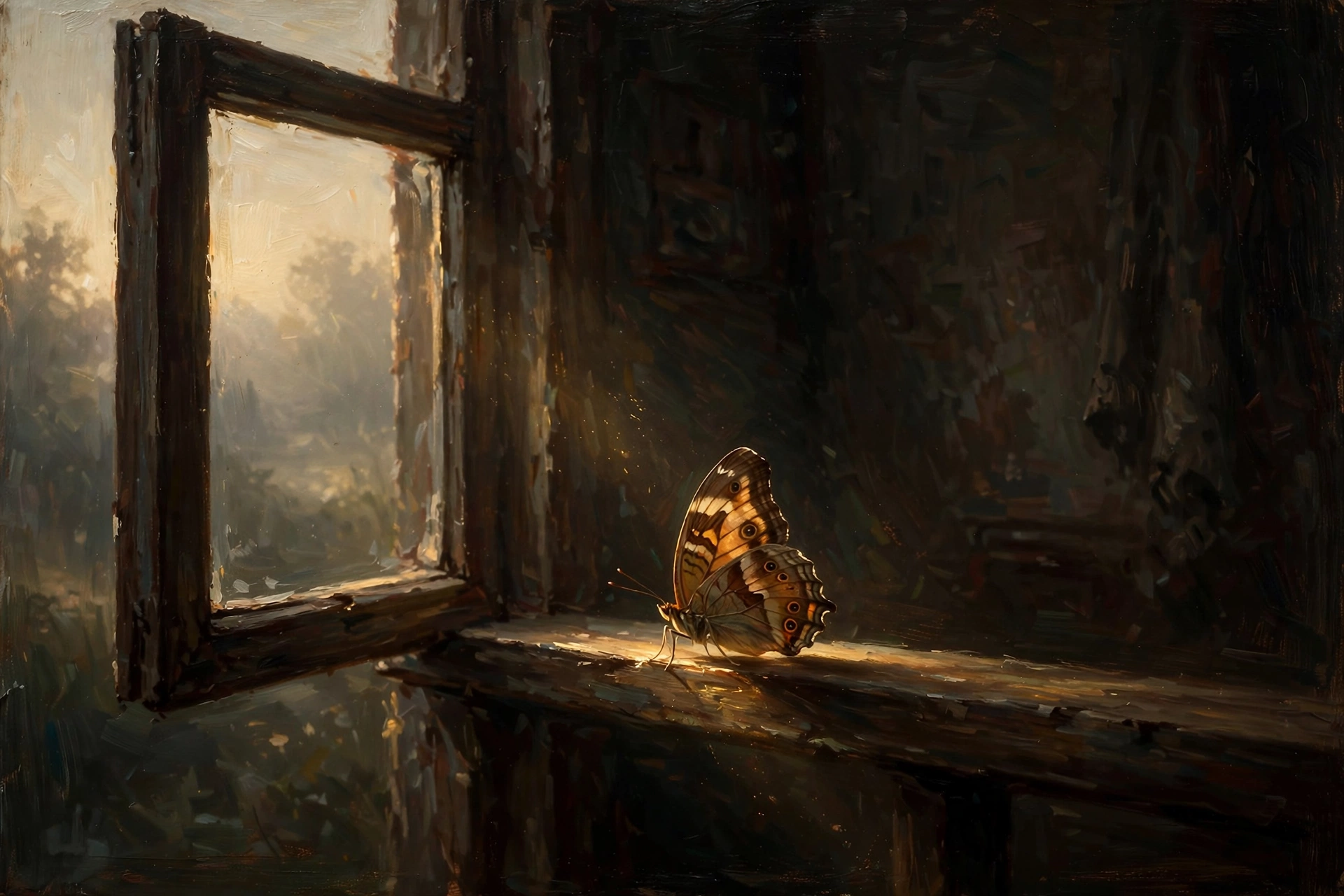
この絵について
描かれているのは、夜明けの光が差し込む開いた窓と、その桟にとまる一匹の蝶である。室内は暗く、蝶の羽だけが光を受けている。人はいない。
入口で見たとおり、ギリシャ語の psychē は「息」であると同時に「蝶」の名でもあった。蛹という殻から羽のあるものが出てくる姿が、身体を離れる魂の像になった。窓辺の蝶は、その二重の意味を一枚に置いたものである。蝶がまだ飛び立たず桟にとどまっているのは、場面の議論が「魂は身体を離れて存続するのか」をめぐって割れたままであることにも重なる。
※モチーフは、「魂」について一般に共有されている像(身体を離れる軽いもの)を既定として選んだ。絵は差し替え可能とする。
魂とは何か。——最初に口を開いたのはソクラテスだった。魂は身体に縛りつけられ、牢獄の格子を通してしか実在を見ることができない、と。
Socrates(ソクラテス)立てる ― 魂は身体という牢獄の囚人である
知を愛する者たちは、魂が単に身体に縛りつけられ、にかわで貼りつけられていたことを意識して いる。哲学が魂を迎えるまで、魂は牢獄の格子を通してしか、自分自身においてでなく、実在を見 ることができなかった。あらゆる種類の無知の泥のなかにのたうち、欲望のために、自らの囚われ の主たる共犯者となっていた。
原文
The lovers of knowledge are conscious that the soul was simply fastened and glued to the body--until philosophy received her, she could only view real existence through the bars of a prison, not in and through herself; she was wallowing in the mire of every sort of ignorance; and by reason of lust had become the principal accomplice in her own captivity.
— Plato『Phaedo』(Benjamin Jowett 訳) / `plato_phaedo#L2813`
弟子のケベスが、その場で反論した。魂が何度も生まれ変わる強さを持つとしても、相次ぐ誕生の労苦に疲れて、いずれかの死で滅びるかもしれないではないか、と。
Cebes(ケベス)覆す ― 何度も生まれ変わる魂も、疲れて滅びるかもしれない
それゆえ私は、魂が死後も存続することを証明するのに、優れた強さに基づく議論に頼りたくない。 あなたが可能だと言う以上のことを認めたとしても、魂が誕生の前に存在しただけでなく、ある者 たちの魂は死後も存在し、存在し続け、何度も生まれ死ぬこと、魂には持ちこたえ何度も生まれる 自然な強さがあることを認めたとしても、それでもなお、魂は相次ぐ誕生の労苦に疲れ、ついには いずれかの死で屈して完全に滅びるかもしれないと考える余地がある。 そして魂に破滅をもたらすこの身体の死と解体は、われわれの誰にも知られえないかもしれない。 われわれの誰もそれを経験したことがないからだ。 そうなら、魂が完全に不死で不滅であることを証明できないかぎり、死について自信を持つ者は愚 かな自信を持っているにすぎない、と私は主張する。 だが魂の不死を証明できないなら、死にゆく者は、身体が分離されたとき魂もまた完全に滅びるか もしれないと恐れる理由を、常に持つであろう。
原文
I would therefore rather not rely on the argument from superior strength to prove the continued existence of the soul after death. For granting even more than you affirm to be possible, and acknowledging not only that the soul existed before birth, but also that the souls of some exist, and will continue to exist after death, and will be born and die again and again, and that there is a natural strength in the soul which will hold out and be born many times--nevertheless, we may be still inclined to think that she will weary in the labours of successive births, and may at last succumb in one of her deaths and utterly perish; and this death and dissolution of the body which brings destruction to the soul may be unknown to any of us, for no one of us can have had any experience of it: and if so, then I maintain that he who is confident about death has but a foolish confidence, unless he is able to prove that the soul is altogether immortal and imperishable. But if he cannot prove the soul's immortality, he who is about to die will always have reason to fear that when the body is disunited, the soul also may utterly perish.
— Plato『Phaedo』(Benjamin Jowett 訳) / `plato_phaedo#L3013`
ルクレティウスは、牢獄の像そのものを退けた。根から引き抜かれた目が何も見られないように、魂も身体から離れては何もできない、と。
Lucretius(ルクレティウス)覆す ― 魂は身体から離れては何もできない
まことに、目だけが根から引き抜かれ、身体全体から離されるなら何も見回すことができないよう に、魂と精神も、それ自体だけでは何もできないように見える。
原文
Verily, as the eye, Alone, up-rended from its roots, apart From all the body, can peer about at naught, So soul and mind it seems are nothing able, When by themselves.
— Lucretius『On the Nature of Things』 BOOK III(William Ellery Leonard 訳) / `lucretius_nature_of_things#L3777`
デカルトは、二元論を立て直した。理性的魂は物質の力から引き出されるものではなく、特別に創造されなければならない。そして身体からまったく独立した本性ゆえに、身体とともに死ぬはずがない、と。
Rene Descartes(デカルト)立て直す ― 理性的魂は特別に創造され、身体とともに死なない
その後、私は理性的魂について述べ、それは私が論じた他のものとは違って、物質の力からはけっ して引き出されえず、とくに創造されなければならないこと、また、船の水先案内人のように人間 の身体に宿っているだけでは、せいぜい四肢を動かすのに役立つにすぎず、われわれのものに似た 感覚と欲求をもち、こうして真の人間を成り立たせるためには、身体にもっと密接に結びつき一体 になる必要があることを示した。私はここで魂の主題をかなり長く論じた。 それが最大の重要性をもつからである。 というのも、神の存在を否定する者たちの誤り(これはすでに十分に論駁したと思う)の次に、弱 い精神を徳の正しい道から踏み外させるのに最も力があるのは、獣の魂がわれわれの魂と同じ本性 であると仮定することだからである。そうなれば、この生ののち、ハエやアリと同じく、われわれ には希望すべきことも恐れるべきこともなくなってしまう。 これに対して、両者がどれほど異なるかを知れば、魂が身体からまったく独立した本性であり、し たがって身体とともに死ぬはずのないことを確立する理由が、はるかによく理解される。 さらに、魂を滅ぼしうる他の原因が観察されない以上、われわれは当然そこから、魂は不死である と判断するに至る。
原文
I had after this described the reasonable soul, and shown that it could by no means be educed from the power of matter, as the other things of which I had spoken, but that it must be expressly created; and that it is not sufficient that it be lodged in the human body exactly like a pilot in a ship, unless perhaps to move its members, but that it is necessary for it to be joined and united more closely to the body, in order to have sensations and appetites similar to ours, and thus constitute a real man. I here entered, in conclusion, upon the subject of the soul at considerable length, because it is of the greatest moment: for after the error of those who deny the existence of God, an error which I think I have already sufficiently refuted, there is none that is more powerful in leading feeble minds astray from the straight path of virtue than the supposition that the soul of the brutes is of the same nature with our own; and consequently that after this life we have nothing to hope for or fear, more than flies and ants; in place of which, when we know how far they differ we much better comprehend the reasons which establish that the soul is of a nature wholly independent of the body, and that consequently it is not liable to die with the latter and, finally, because no other causes are observed capable of destroying it, we are naturally led thence to judge that it is immortal.
— Rene Descartes『Discourse on the Method』 PART V(John Veitch 訳) / `descartes_discourse_on_method#L1540`
最後にニーチェが、問いそのものを作り替えた。魂を捨て去る必要はない。ただし「死すべき魂」「本能と情念の社会的構造としての魂」として、だ。
Friedrich Nietzsche(ニーチェ)締め ― 魂を捨てずに作り替える。本能と情念の社会的構造としての魂
ここだけの話、そのために「魂」を捨て去り、最も古く最も尊重された仮説の一つを放棄する必要 はまったくない。それは、魂にほとんど触れるやいなやそれを失ってしまう博物学者たちの不器用 さにしばしば起こることだ。しかし、魂仮説の新しい受け取り方と洗練への道は開かれている。 そして「死すべき魂」「主観的多様性としての魂」「本能と情念の社会的構造としての魂」といっ た概念は、今後、科学において正当な権利を求めている。
原文
Between ourselves, it is not at all necessary to get rid of "the soul" thereby, and thus renounce one of the oldest and most venerated hypotheses--as happens frequently to the clumsiness of naturalists, who can hardly touch on the soul without immediately losing it. But the way is open for new acceptations and refinements of the soul-hypothesis; and such conceptions as "mortal soul," and "soul of subjective multiplicity," and "soul as social structure of the instincts and passions," want henceforth to have legitimate rights in science.
— Friedrich Nietzsche『Beyond Good and Evil』 CHAPTER I(Helen Zimmern 訳) / `nietzsche_beyond_good_and_evil#L492`
牢の囚人、疲れて滅びるかもしれないもの、抜かれた目、特別な創造、作り替えられる仮説。——魂の正体は、声ごとに違う顔を見せた。
控えの一句 ON THE BENCH
John Locke(ジョン・ロック)
軸5 ― 同じ魂でも意識がなければ同じ人格ではない。人格を魂から切り離す思考実験
誰でも自分を省みて、自分のうちに、自分のなかで思考し、身体が絶えず変わるなかで自分を同じ に保ち、自分自身と呼ぶものである非物質的な精神があると結論してみるがよい。 またそれが、トロイア包囲戦のネストルやテルシテスのうちにあったのと同じ魂であると仮定して みるがよい(魂は、われわれが知るかぎり、その本性において物質のいかなる部分にも無関心なの だから、その仮定に明白な不条理はない)。 それは、いまの他の人の魂であるのと同様に、そうであったかもしれない。 だが彼は、ネストルやテルシテスのどちらの行為についても今や意識をもたないのに、自分をその どちらかと同じ人格だと考えることができるだろうか。
原文
Let any one reflect upon himself, and conclude that he has in himself an immaterial spirit, which is that which thinks in him, and, in the constant change of his body keeps him the same: and is that which he calls HIMSELF: let him also suppose it to be the same soul that was in Nestor or Thersites, at the siege of Troy, (for souls being, as far as we know anything of them, in their nature indifferent to any parcel of matter, the supposition has no apparent absurdity in it,) which it may have been, as well as it is now the soul of any other man: but he now having no consciousness of any of the actions either of Nestor or Thersites, does or can he conceive himself the same person with either of them?
— John Locke『An Essay Concerning Humane Understanding, Volume 1』 CHAPTER XXVII / `locke_essay_human_understanding_v1#L11898`
David Hume(デイヴィッド・ヒューム)
軸6 ― 魂の実体にかかわる問いは、まったく理解不能である。懐疑の到達点
では、全体について最終的な決定を下すなら、魂の実体にかかわる問いは、まったく理解不能であ る。われわれの知覚は、延長をもつものとも持たないものとも、場所的な結合ができない。 それらのうち、あるものは一方の種類であり、あるものは他方の種類だからである。 そして、対象の恒常的連接が原因と結果の本質そのものを構成するのだから、物質と運動は、その 関係についてわれわれがもつ観念のかぎりで、しばしば思考の原因と見なされうる。
原文
To pronounce, then, the final decision upon the whole; the question concerning the substance of the soul is absolutely unintelligible: All our perceptions are not susceptible of a local union, either with what is extended or unextended: there being some of them of the one kind, and some of the other: And as the constant conjunction of objects constitutes the very essence of cause and effect, matter and motion may often be regarded as the causes of thought, as far as we have any notion of that relation.
— David Hume『A Treatise of Human Nature』 PART IV / `hume_treatise_human_nature#L8906`
Immanuel Kant(イマヌエル・カント)
軸2 ― 不死は理論では証明できないが、最高善のために実践理性が要請する
さて、この無限の進歩は、同じ理性的存在の存在と人格の無限の持続(魂の不死と呼ばれるもの) を前提としてのみ可能である。したがって最高善は、実践的には魂の不死を前提としてのみ可能で ある。それゆえこの不死は、道徳法則と不可分に結びついているので、純粋実践理性の要請である (要請とは、そのものとしては証明できないが、無条件のア・プリオリな実践法則の不可分の帰結 である理論的命題のことである)。
原文
Now, this endless progress is only possible on the supposition of an endless duration of the existence and personality of the same rational being (which is called the immortality of the soul). The summum bonum, then, practically is only possible on the supposition of the immortality of the soul; consequently this immortality, being inseparably connected with the moral law, is a postulate of pure practical reason (by which I mean a theoretical proposition, not demonstrable as such, but which is an inseparable result of an unconditional a priori practical law.
— Immanuel Kant『The Critique of Practical Reason』 CHAPTER II(Thomas Kingsmill Abbott 訳) / `kant_critique_of_practical_reason#L4842`
Plotinus(プロティノス)
軸4 ― なぜあなたの魂と私の魂は一つではないのか。個と宇宙の魂の問題
一、各動物の魂が、全身に完全に現前しているために一つであり、ある器官に一部、別の器官に別 の部分をもつのではないから真に一つであるように、また感覚魂が感じるあらゆる存在において等 しく一つであり、植物的魂が成長する植物のすべての部分で、全体として一つであるように、なぜ あなたの魂と私の魂が一つの統一をなさないのか。 なぜすべての魂が一つであってはならないのか。 なぜ、あらゆる存在に現前する普遍的な(魂)が、身体のように分割されず、どこでも同じである ために、一つであってはならないのか。 実際、私の内の魂が一つであり、普遍的な(魂)が同じように一つでないのはなぜか。 この普遍的な(魂)は、私自身の魂と同じく、物質的な延長でも身体でもないのだから。 もし私の魂もあなたの魂も普遍的な(魂)から発し、それが一つであるなら、私の魂とあなたの魂 はともに一つのものをなすはずである。
原文
1. Just as the soul of each animal is one, because she is entirely present in the whole body, and because she is thus really one, because she does not have one part in one organ, and some other part in another; and just as the sense-soul is equally one in all the beings which feel, and just as the vegetative soul is everywhere entirely one in each part of the growing plants; why then should your soul and mine not form a single unity? Why should not all souls form but a single one? Why should not the universal (Soul) which is present in all beings, be one because she is not divided in the manner of a body, being everywhere the same? Why indeed should the soul in myself form but one, and the universal (Soul) likewise not be one, similarly, since no more than my own is this universal (Soul) either material extension, or a body? If both my soul and yours proceed from the universal (Soul), and if the latter be one, then should my soul and yours together form but a single one.
— Plotinus『Plotinos: Complete Works, Volume 1』 INTELLIGENCE CANNOT BE THE FIRST, AND RANKS ALL ELSE(Kenneth Sylvan Guthrie 訳) / `plotinus_complete_works_v1#L4516`
Yama(ヤマ(死神))
軸4 ― アートマンを戦車の主、身体を戦車、知性を御者、心を手綱とする、西洋の外の構造図
アートマン(自己)を戦車の主と知れ。 身体を戦車と。また知性を御者、心を手綱と知れ。
原文
Know the Atman (Self) as the lord of the chariot, and the body as the chariot. Know also the intellect to be the driver and mind the reins.
— (various)『The Upanishads』 Katha-Upanishad, Part Third, III(Swami Paramananda 訳) / `upanishads#L1372`