STATE
idea-no-tane の全引用から選んだ超精選による、概念ごとの読み物。
入口 THE WORD
この概念が扱うのは、人々の集まりの上に立つ大きな仕組み——国家とは何か、それはどこから来て、なぜ人を従わせるのかという問いである。場面に入る前に、まずこの語そのものの旅をたどる。語源は「真の意味」ではない。だが、語がどこから来て、どう意味を変えてきたかという経緯は、後ろに並ぶ偉人たちの議論を読むための地図になる。
語源 ― state は「立っている状態」
英語の state は、ラテン語の status に由来する。status は stare「立つ」から来た語で、もとの意味は「状態、身分、ありよう」だった。ローマ人は status rei publicae「公共の事柄の状態」という言い方をした(Dictionary of the History of Ideas)。同じ根からは estate(身分・財産)と status(地位)も生まれた。三身分を集めた「三部会」はフランス語で États généraux、つまり「身分たちの集まり」である。state は生まれつき、「誰がどう立っているか」という位の言葉だった。このページのキー画像——多数の小さな人々で形作られた巨人——は、その「立ち方」が一つの人格にまとまった姿である。
近代の転回 ― 若い言葉、古いもの
政治の意味での「国家」は、驚くほど若い言葉である。古代ギリシャの polis、ローマの res publica は、支配の装置ではなく共同体そのものの名だった。status の系譜の語が「国家」を指すようになるのは16世紀で、その転回を決定づけたのはマキャヴェリの『君主論』の stato だとされる。ホッブズに至って、civitas・commonwealth・state が同じものとして揃えられた(Dictionary of the History of Ideas)。ただしマキャヴェリの時点でも stato は、まだ「君主の地位・状態」の色を強く残していた。国家という言葉は、「支配者のありよう」から「人々全体を包む仕組み」へ、意味を滑らせながら近代に入ったのである。
日本語との対応 ― 「国家」は国と家
中国語の「國家」は古くは、諸侯の領地と、その領地を治める家——つまり一つの家族が世襲で治めるまとまりを指した。近代になって、この語がヨーロッパの state/nation の訳語として明治期に定着した(翻訳語辞典)。「国(くに)」は領土と共同体の古い語だが、「国家」の二字目には「家」がいる。治めることを家の営みの延長で考える像が、訳語の中に残ったのである。日本語で国家を語るとき、私たちは「状態(status)」の言葉ではなく、「国と家」の言葉で語っている——そのことは、後ろの場面でヘーゲルが国家を人倫と言い、新渡戸が国家と良心の衝突を嘆くときにも、響いてくる。
語の旅をまとめると、国家は「立っている状態」の言葉として生まれ、君主の地位から共同体全体の仕組みへ意味を移し、日本語では「国と家」の二字で迎えられた。このあとの場面で争われるのは、まさにその正体である。国家は自然に先立つ全体か、契約の産物か、暴力の別名か、それとも個人のための道具か。
場面 THE SCENE
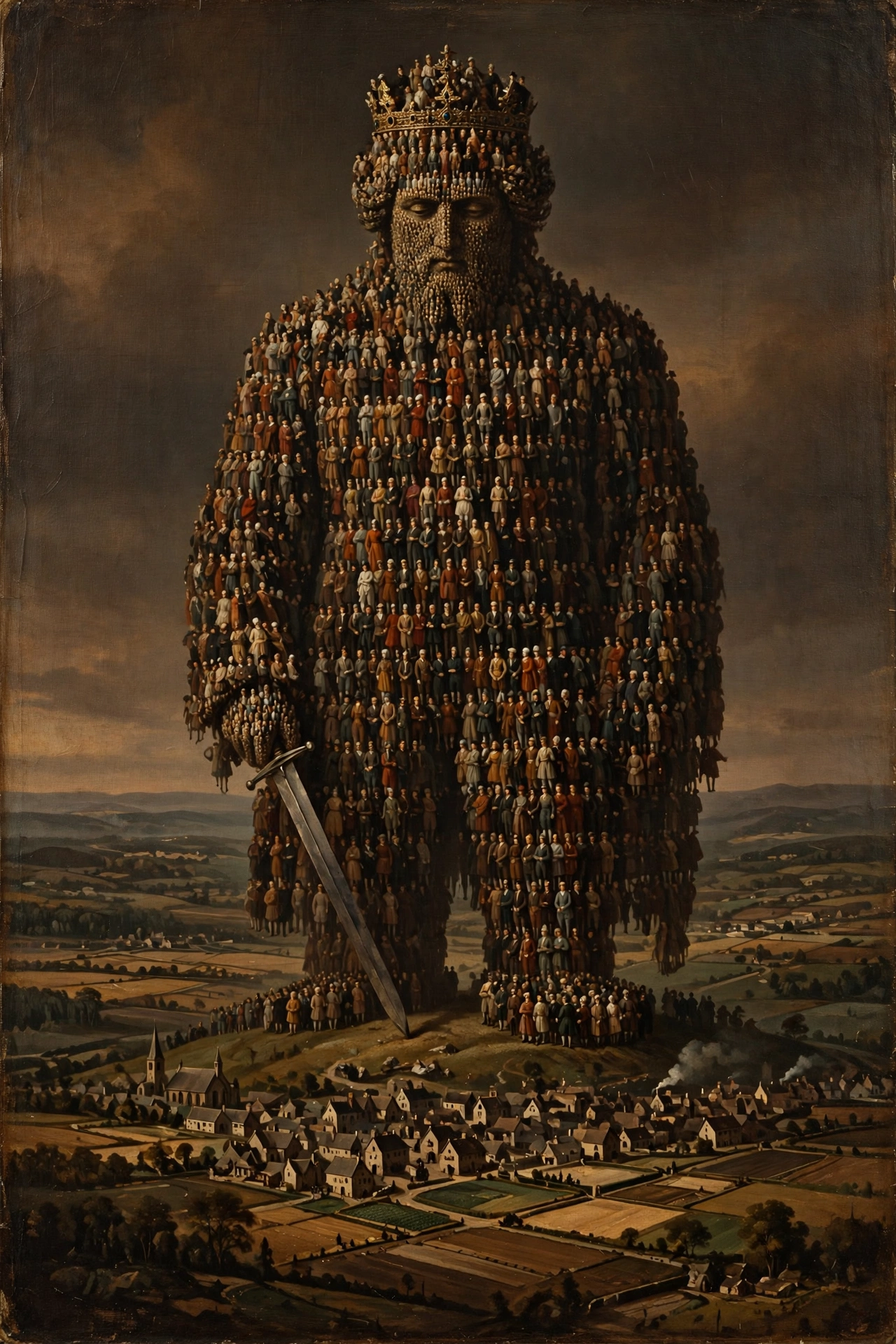
この絵について
描かれているのは、丘の上に立ち、町と畑を見下ろす冠を戴いた巨人である。その身体は、肩を寄せ合う無数の小さな人々で形作られ、手には下向きの大きな剣がある。
これは『リヴァイアサン』(1651年)の口絵に描かれた、国家の最も有名な像である。入口で見たとおり、state の底にあるのは「立っている状態」だった。多数の人が集まって一つの人格として立つ——アリストテレスの「全体は部分に先立つ」と、ホッブズの「一人格に統一された多数者」は、この一枚の絵の中で重なっている。
※モチーフは、「国家」について一般に共有されている像(『リヴァイアサン』口絵の巨人)を既定として選んだ。絵は差し替え可能とする。
国家とは何か。——最初に口を開いたのはアリストテレスだった。国家の観念は、家族や個人の観念に自然に先立つ。全体は部分に先立たねばならない、と。
Aristotle(アリストテレス)立てる ― 国家は個人に自然に先立つ
さらに、国家の観念は家族や個人の観念に自然本性上先立つ。 全体は必然的に部分に先立たねばならないからである。 人間全体を取り去れば、足や手が残っているとは——石の手が作られたと想定するような、名前だ けの意味を除いて——言えない。それは死んだ手にすぎない。 あらゆるものはその働きと力によってこれこれのものと理解されるのだから、それらが失われたと き、もはや同じものとは言えず、同じ名前を持つ別のものにすぎない。 したがって国家が個人に先立つことは明らかである。 個人が自分だけで完全な共同体を成り立たせるに足りないなら、彼は他の部分が全体に対するのと 同じ関係を国家に対して持つ。しかし社会を営むことができない者、あるいは自足していて社会を 必要としない者は、国家の一部をなさない。 獣か神かである。
原文
Besides, the notion of a city naturally precedes that of a family or an individual, for the whole must necessarily be prior to the parts, for if you take away the whole man, you cannot say a foot or a hand remains, unless by equivocation, as supposing a hand of stone to be made, but that would only be a dead one; but everything is understood to be this or that by its energic qualities and powers, so that when these no longer remain, neither can that be said to be the same, but something of the same name. That a city then precedes an individual is plain, for if an individual is not in himself sufficient to compose a perfect government, he is to a city as other parts are to a whole; but he that is incapable of society, or so complete in himself as not to want it, makes no part of a city, as a beast or a god.
— Aristotle『Politics: A Treatise on Government』 BK I(William Ellis 訳) / `aristotle_politics#L637`
ホッブズは、国家を自然ではなく生成の側に置いた。一人格に統一された多数者——それがコモンウェルス、可死の神の生成である、と。
Thomas Hobbes(ホッブズ)立てる ― 契約が一人格を生み、それが可死の神である
これがなされると、一つの人格に統一された多数者は国家(コモンウェルス)、ラテン語でキウィ タスと呼ばれる。これこそが、かの偉大なリヴァイアサン、いやむしろ、より畏敬をこめて言うな ら、可死の神の生成である。我々は不死の神のもとで、この可死の神に平和と防衛を負っている。 この権威が国家の個々人すべてから与えられることによって、彼はこれほど大きな力と強さを委ね られ、その恐怖によって全員の意志を、国内の平和と国外の敵に対する相互の援助へと形づくるこ とができるのである。
原文
This done, the Multitude so united in one Person, is called a COMMON-WEALTH, in latine CIVITAS. This is the Generation of that great LEVIATHAN, or rather (to speake more reverently) of that Mortall God, to which wee owe under the Immortall God, our peace and defence. For by this Authoritie, given him by every particular man in the Common-Wealth, he hath the use of so much Power and Strength conferred on him, that by terror thereof, he is inabled to forme the wills of them all, to Peace at home, and mutuall ayd against their enemies abroad.
— Thomas Hobbes『Leviathan』 CH XVII / `hobbes_leviathan#L5677`
ニーチェは、それを一句で片づけた。国家が契約から始まるとするあの空想的な理論は、片づいたと思う、と。
Friedrich Nietzsche(ニーチェ)覆す ― 国家が契約から始まるという理論は空想である
これが「国家」の起源である。国家が契約から始まるとするあの空想的な理論は、片づいたと思う。
原文
Such is the origin of the "State." That fantastic theory that makes it begin with a contract is, I think, disposed of.
— Friedrich Nietzsche『The Genealogy of Morals』 SECOND ESSAY. "GUILT," "BAD CONSCIENCE," AND THE LIKE(Horace B. Samuel 訳) / `nietzsche_genealogy_of_morals#L2471`
アウグスティヌスは、問いをずらした。生まれが何であれ、正義が取り去られたなら、王国とは大きな盗賊団以外の何であろうか、と。
Augustine of Hippo(アウグスティヌス)ずらす ― 正義が取り去られたなら、王国は大きな盗賊団である
それでは、正義が取り去られたなら、王国とは大きな盗賊団以外の何であろうか。 盗賊団そのものも、小さな王国以外の何であろうか。
原文
Justice being taken away, then, what are kingdoms but great robberies? For what are robberies themselves, but little kingdoms?
— Augustine of Hippo『The City of God, Volume I』 BOOK FOURTH(Marcus Dods 訳) / `augustine_city_of_god_v1#L6022`
最後にミルが、物差しをひっくり返した。国家の値打ちは、長い目で見れば、それを構成する個々人の値打ちである、と。
John Stuart Mill(ミル)締め ― 国家の値打ちは、それを構成する個々人の値打ちである
国家の値打ちは、長い目で見れば、それを構成する個々人の値打ちである。 そして、個々人の精神の拡大と向上という利益を後回しにして、行政上の熟練、あるいは実務が与 えるその見かけを、業務の細部において少しばかり増やすことを優先する国家、自らの手のうちで より従順な道具となるようにと——たとえ善意の目的のためであっても——人間を萎縮させる国家 は、小さくなった人間では本当に大きなことは何一つ成し遂げられないことを思い知るだろう。 そして、そのためにすべてを犠牲にしてきた機構の完璧さも、結局は何の役にも立たないことを。 機械がより滑らかに動くようにと、その国家が追い払うことを選んだ生命力こそが、欠けているの だから。
原文
The worth of a State, in the long run, is the worth of the individuals composing it; and a State which postpones the interests of _their_ mental expansion and elevation, to a little more of administrative skill, or of that semblance of it which practice gives, in the details of business; a State which dwarfs its men, in order that they may be more docile instruments in its hands even for beneficial purposes, will find that with small men no great thing can really be accomplished; and that the perfection of machinery to which it has sacrificed everything, will in the end avail it nothing, for want of the vital power which, in order that the machine might work more smoothly, it has preferred to banish.
— John Stuart Mill『On Liberty』 CH V / `mill_on_liberty#L4724`
先立つ全体、作られる人格、空想と切られた契約、盗賊団の喩え、個人へ返される値打ち。——国家の正体は、声ごとに違う顔を見せた。
控えの一句 ON THE BENCH
Zarathustra(ツァラトゥストラ)
軸3 ― 国家はあらゆる冷たい怪物のうちで最も冷たいもの。「私、国家は民族である」という嘘
国家とは、あらゆる冷たい怪物のうちで最も冷たいものの名である。 冷たく嘘をつき、その口からこの嘘が這い出る。 「私、国家は民族である」と。
原文
A state, is called the coldest of all cold monsters. Coldly lieth it also; and this lie creepeth from its mouth: “I, the state, am the people.”
— Friedrich Nietzsche『Thus Spake Zarathustra』 Part I, \"The New Idol\"(Thomas Common 訳) / `nietzsche_zarathustra#L2361`
G. W. F. Hegel(ヘーゲル)
軸1 ― 国家の法への服従こそ真の自由。国家を自由の条件とする極
そして真の宗教は、服従の誓いの代わりに、国家の法と法的制度への服従を是認する。 その服従はそれ自体が真の自由である。 なぜなら国家は自己を所有し自己を実現する理性、要するに国家における人倫だからである。 こうして、そしてこうしてのみ、法と道徳は存在しうる。
原文
And instead of the vow of obedience, true religion sanctions obedience to the law and the legal arrangements of the state—an obedience which is itself the true freedom, because the state is a self-possessed, self-realising reason—in short, moral life in the state. Thus, and thus only, can law and morality exist.
— G. W. F. Hegel『Hegel's Philosophy of Mind』 SECTION II(William Wallace 訳) / `hegel_philosophy_of_mind#L9823`
Arthur Schopenhauer(ショーペンハウアー)
軸4 ― 国家は利己心から生まれ、その奉仕のためにだけ存在する。ヘーゲルの逆の極
さらにひねくれているのは、国家が道徳的意味での自由の条件であり、それゆえ道徳性の条件だと いう説である。自由は現象を超え、まして人間の制度を超えているからである。 国家は、すでに述べたように、利己心一般に向けられたものではまったくなく、むしろ利己心から 生まれ、その奉仕のためにだけ存在する。 それは自分をよくわきまえ、方法的に進み、一面的な立場を捨てて普遍的な立場をとる利己心であ り、こうして総和として万人の共通の利己心なのである。 国家は、純粋な道徳性、すなわち道徳的根拠からの正しい行為は期待できないという正しい前提の もとに設立されている。そうでなければ国家そのものが余計であろう。 だから幸福を目指す国家は、利己心に向けられているのではなく、多数の利己的個人から生じて互 いに影響し合い彼らの幸福を乱す不利な結果に向けられているだけである。
原文
Still more perverse is the theory that the state is the condition of freedom in the moral sense, and in this way the condition of morality; for freedom lies beyond the phenomenon, and indeed beyond human arrangements. The state is, as we have said, so little directed against egoism in general and as such, that, on the contrary, it has sprung from egoism and exists only in its service—an egoism that well understands itself, proceeds methodically and forsakes the one-sided for the universal point of view, and so by addition is the common egoism of all. The state is thus instituted under the correct presupposition that pure morality, _i.e._, right action from moral grounds, is not to be expected; if this were not the case, it would itself be superfluous. Thus the state, which aims at well-being, is by no means directed against egoism, but only against the disadvantageous consequences which arise from the multiplicity of egoistic individuals, and reciprocally affect them all and disturb their well-being.
— Arthur Schopenhauer『The World as Will and Idea (Vol. 1 of 3)』 FOURTH BOOK(R. B. Haldane; J. Kemp 訳) / `schopenhauer_world_as_will_v1#L13562`
Socrates(ソクラテス)
軸8 ― 国家は大きく鈍い馬、ソクラテスは神に付けられた虻。批判者の位置の原型
もしあなたがたが私を殺せば、私の後継者はたやすくは見つからないだろう。 滑稽な比喩を使ってよければ、私は神によって国家に付けられた一種の虻なのだ。 国家は大きく気高い馬で、その巨体ゆえに動きが鈍く、目を覚まさせるには刺激が要る。
原文
For if you kill me you will not easily find a successor to me, who, if I may use such a ludicrous figure of speech, am a sort of gadfly, given to the state by God; and the state is a great and noble steed who is tardy in his motions owing to his very size, and requires to be stirred into life.
— Plato『Apology』(Benjamin Jowett 訳) / `plato_apology#L1055`
Seneca(セネカ)
軸8 ― 二つの国家。生まれで割り当てられた国と、太陽の光の届くかぎりの国
二つの国家があることを把握しよう。一つは広大で真に「公共の」もので、神々も人間も等しく含 み、そこではこの片隅あの片隅の土地を数えず、国の境界を太陽の光が届くところまで広げる。 もう一つは、生まれの偶然によって我々が割り当てられた国家である。
原文
Let us grasp the fact that there are two republics, one vast and truly “public,” which contains alike gods and men, in which we do not take account of this or that nook of land, but make the boundaries of our state reach as far as the rays of the sun: and another to which we have been assigned by the accident of birth.
— Seneca『Minor Dialogues, Together With the Dialogue on Clemency』 De Otio (Dial. VIII)(Aubrey Stewart 訳) / `seneca_minor_dialogues#L7683`