Torture
idea-no-tane の全引用から選んだ超精選による、概念ごとの読み物。
入口 THE WORD
拷問は、身体への苦痛を、証拠と服従を引き出す手段として制度が用いることの名である。古代ギリシアでは奴隷の証言の信頼を拷問で担保する慣行があり、近世ヨーロッパの刑事裁判では自白を得るための法的手続きとして位置づけられた。場面の声たちは、その証言は信頼できるのか、法は自らに何を命じているのか、そして拷問は消えたのか形を変えただけかをめぐって争う。
語源 ― 「ねじる」こと
torture は後期ラテン語の tortura「ねじれ、身もだえ」に由来し、その動詞 torquere は「ねじる、ひねる」を意味する(Online Etymology Dictionary;Merriam-Webster も同旨)。苦痛そのものよりも、身体をねじり、絞る動作の像が語の根にある。英語で裁判上の拷問の意味が定着するのは16世紀半ばとされる。
日本語の「拷問」 ― 打ち据えて問う
日本語の「拷問」は、拷(打ち据える)と問(問う)の合成であり、打ち据えて問い質すという、手段と目的がそのまま漢字に残った語である。現代の用法では司法の尋問の場を離れ、耐えがたい苦痛一般にも広がって使われる。
場面 THE SCENE
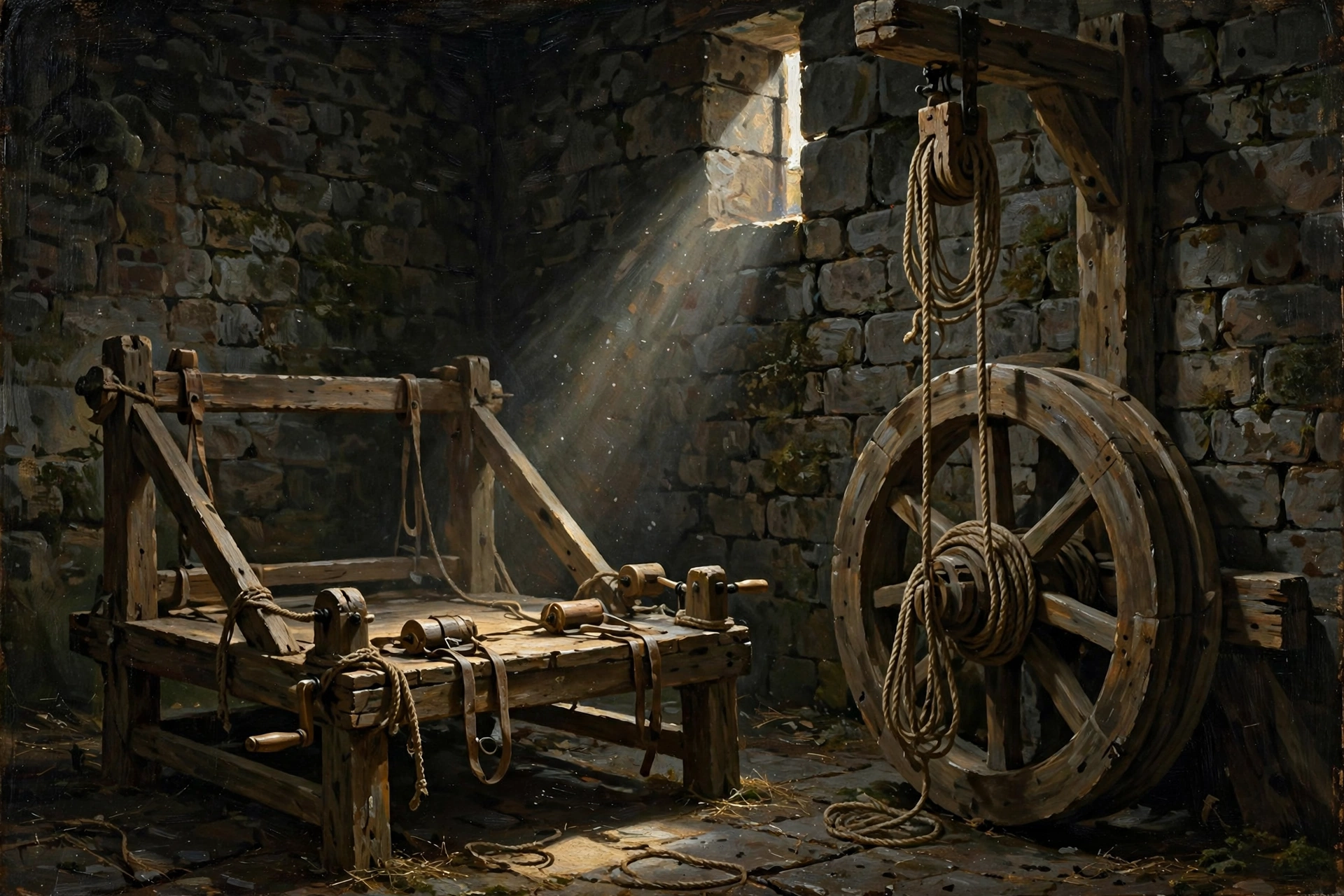
この絵について
暗い石の部屋に、木の引き伸ばし台と、縄の掛かった大きな車輪が置かれている。誰もいない。小さな窓から細い光が差し込むだけである。
torture の語源は「ねじる」ことだった。身体をねじり、引き伸ばす道具は、その語の像をそのまま残している。制度が苦痛を手段として使った時代の道具を、使う者のいない姿で置く。
絵はモチーフの置き換えが可能であり、この絵でなければならない必然はない。一般に共有される拷問の像として、空の拷問台と車輪を選んだ。
場面は、証拠への疑いから始まる。アリストテレスは『弁論術』のなかで、拷問のもとで与えられた証拠は信頼できないと言いうると述べる。苦痛に耐える者は耐え抜いて真実を言わず、耐えられない者は苦痛を見る前に怯む。拷問は真実を引き出すのではなく、耐久の勝負にしてしまうのである。
アリストテレス(Aristotle)立てる
拷問のもとで与えられた証拠は真ではないとも言える。 鈍感で厚顔な者や、強い心を持つ者は、苦痛のもとで英雄的に耐え、臆病で用心深い者は、目の前 に苦痛を見る前に大胆になる。したがって、拷問からの証拠は全く信頼できないとみなされうる。
原文
It may also be said that evidence given under torture is not true ; for many thick-witted and thick-skinned persons, and those who are stout-hearted heroically hold out under sufferings, while the cowardly and cautious, before they see the sufferings before them, are bold enough ; wherefore evidence from torture may be considered utterly untrustworthy.
— Aristotle『The \"Art\" of Rhetoric』 BOOK I(John Henry Freese 訳) / `aristotle_rhetoric#L10585`
ホッブズは、拷問による告発の身分を限定する。それは証言とみなされるべきではなく、さらなる尋問と真実の探究における推測と手がかりの手段としてのみ用いられるべきだ、と。自白は拷問される者を楽にするために語られるのであって、十分な証言の信用は持たない。
ホッブズ(Thomas Hobbes)限定する
そのような告発者の証言は、自発的に与えられなければ、自然によって腐敗させられたと推定され る。したがって受け入れられるべきではない。 人の証言が信用されないところでは、彼はそれを与える義務はない。 また、拷問による告発は、証言とみなされるべきではない。 拷問は、さらなる尋問と真実の探究における、推測と手がかりの手段としてのみ用いられるべきで ある。その場合に自白されたことは、拷問する者を情報で満たすためではなく、拷問される者を楽 にする傾向がある。したがって、十分な証言の信用を持つべきではない。 彼が真の告発によっても虚偽の告発によっても自らを救うとしても、彼は自分の生を保存する権利 によってそれを行うからである。
原文
For the Testimony of such an Accuser, if it be not willingly given, is praesumed to be corrupted by Nature; and therefore not to be received: and where a mans Testimony is not to be credited, his not bound to give it. Also Accusations upon Torture, are not to be reputed as Testimonies. For Torture is to be used but as means of conjecture, and light, in the further examination, and search of truth; and what is in that case confessed, tendeth to the ease of him that is Tortured; not to the informing of the Torturers: and therefore ought not to have the credit of a sufficient Testimony: for whether he deliver himselfe by true, or false Accusation, he does it by the Right of preserving his own life.
— Thomas Hobbes『Leviathan』 CHAPTER XIV / `hobbes_leviathan#L4572`
ベッカリーアは、ジレンマで拷問そのものを退ける。犯罪が確実なら、法の定めた罰で足り、自白は無用である。不確実なら、拷問は無実の者を苦しめるか、頑健な有罪の者を救う。どちらの枝を取っても、拷問の居場所はない。
ベッカリーア(Cesare Beccaria)覆す
次のジレンマは新しいものではない。犯罪は確実か不確実かのどちらかである。 確実なら、それに適した罰は法が定めたもの以外にない。 拷問は無用であり、犯罪者の自白が無用であるのと同じ理由による。
原文
The following dilemma is no new one: either the crime is certain or uncertain; if certain, no other punishment is suitable for it than that affixed to it by law; and torture is useless, for the same reason that the criminal’s confession is useless.
— Cesare Beccaria『Crimes and Punishments (including a New Translation of Dei Delitti e delle Pene)』 CHAPTER XII(James Anson Farrer 訳) / `beccaria_crimes_and_punishments#L3729`
ニーチェは、問題の層をずらす。人が自分に記憶を作ろうとするとき、それは決して血、拷問、犠牲なしには成し遂げられない。拷問は法廷の道具である前に、痛みによって記憶を刻む最も強力な記憶術だったというのである。証拠の道具という像は、ここで文化の起源の像に変わる。
ニーチェ(Friedrich Nietzsche)ずらす
人が自分に記憶を作る必要があると考える時、それは決して血、拷問、犠牲なしには成し遂げられ ない。最も恐ろしい犠牲と没収(その中には長子の犠牲も含まれる)、最も忌まわしい切断(例え ば去勢)、すべての宗教的カルトの最も残酷な儀式(すべての宗教は本当に、残酷さの体系である) ——これらすべては、痛みにその最も強力な記憶術を見出した本能から生じる。
原文
When man thinks it necessary to make for himself a memory, he never accomplishes it without blood, tortures, and sacrifice; the most dreadful sacrifices and forfeitures (among them the sacrifice of the first-born), the most loathsome mutilation (for instance, castration), the most cruel rituals of all the religious cults (for all religions are really at bottom systems of cruelty)--all these things originate from that instinct which found in pain its most potent mnemonic.
— Friedrich Nietzsche『The Genealogy of Morals』 SECOND ESSAY. "GUILT," "BAD CONSCIENCE," AND THE LIKE(Horace B. Samuel 訳) / `nietzsche_genealogy_of_morals#L1579`
最後にブランダイスが、拷問のその後を見せる。発見と発明により、政府は拷問台に引き伸ばすよりもはるかに効果的な手段で、密室の囁きを法廷に引き出せるようになった。なお、この言葉はオルムステッド事件の判決における反対意見の一節である。拷問台は消えても、引き出す力は形を変えて残る。
ブランダイス(Louis Brandeis)締める
発見と発明により、政府は、拷問台に引き伸ばすよりもはるかに効果的な手段で、密室で囁かれた ことの法廷での開示を得ることができるようになった。
原文
Discovery and invention have made it possible for the government, by means far more effective than stretching upon the rack, to obtain disclosure in court of what is whispered in the closet.
— Supreme Court of the United States『Olmstead v. United States, 277 U.S. 438 (1928)』 / `case_olmstead_v_united_states_1928#L646`
拷問は、証拠の道具としては信頼を失い、ジレンマによって無用と断じられ、記憶を作る技術として起源を遡られ、最後に拷問台より効果的な手段のなかにその変形を見せた。消えたのか、形を変えたのか。その問いが、この概念の現在の姿である。
控えの一句 ON THE BENCH
ベッカリーア(Cesare Beccaria)
軸2
拷問の使用を命じる法は、人にこう言う法である。 「痛みに抵抗せよ。そして、自然があなたの中に消しがたい自己愛を作り、譲ることのできない自 己防衛の権利を与えたなら、私はあなたの中に全く反対の感情、すなわち英雄的な自己嫌悪を作り、 あなた自身を告発し、筋肉の裂傷と骨の脱臼の間で真実を語るよう命じる。」
原文
The law which ordains the use of torture is a law which says to men: ‘Resist pain; and if Nature has created in you an inextinguishable self-love, if she has given you an inalienable right of self-defence, I create in you a totally contrary affection, namely, an heroic self-hatred, and I command you to accuse yourselves, and to speak the truth between the laceration of your muscles and the dislocation of your bones.’
— Cesare Beccaria『Crimes and Punishments (including a New Translation of Dei Delitti e delle Pene)』 CHAPTER XII(James Anson Farrer 訳) / `beccaria_crimes_and_punishments#L3753`
ラ・ブリュイエール(Jean de La Bruyère)
軸1
(51.)拷問は素晴らしい発明であり、虚弱な体質の無実の人を確実に破滅させ、頑健な有罪の 人を救う。
原文
(51.) Torture is an admirable invention, and infallibly destroys an innocent man who has a weak constitution, whilst it saves a guilty man who is hardy.
— Jean de La Bruyère『The Characters』 OF CERTAIN CUSTOMS(Henri Van Laun 訳) / `la_bruyere_characters#L11106`
モンテスキュー(Montesquieu)
軸5
どちらの法がより良いかを判断するためには、次のことを付け加えなければならない。 フランスでは拷問台が犯罪者に対して使われるが、イギリスでは使われない。 フランスでは被告は自分の証人を出すことが許されず、囚人に有利な状況証拠を認めることはめっ たにない。イギリスでは双方の証人を認める。
原文
Now, to be able to judge which of these two laws is the best, we must add, that in France the rack is used against criminals, but not in England; that in France the accused is not allowed to produce his witnesses; and that they very seldom admit of circumstantial evidence in favour of the prisoner; in England they allow of witnesses on both sides.
— Montesquieu『Complete Works, vol. 2 (The Spirit of Laws)』 BOOK XXIX(Thomas Nugent 訳) / `montesquieu_spirit_of_laws_v2#L11107`
トルストイ(Leo Tolstoy)
軸5
命令されれば誰でも殺したり暴行したりする用意のある兵士や武装した警察官がいなければ、死刑、 投獄、終身の流刑の判決に署名する人々の誰も、自分が静かに書斎に座って今命じている人々の千 分の一でも、絞首刑にしたり、投獄したり、あらゆる方法で拷問したりする決心はしないだろう。 彼はそれを見ず、自分では行わず、これらの従順な道具によって遠くからそれを行わせるだけだか らである。
原文
If there were no soldiers or armed policemen, ready to kill or outrage anyone as they are ordered, not one of those people who sign sentences of death, imprisonment, or galley-slavery for life would make up his mind to hang, imprison, or torture a thousandth part of those whom, quietly sitting in his study, he now orders to be tortured in all kinds of ways, simply because he does not see it nor do it himself, but only gets it done at a distance by these servile tools.
— Leo Tolstoy『\"The Kingdom of God Is Within You\』 CHAPTER XII(Constance Garnett 訳) / `tolstoy_kingdom_of_god_within_you#L11035`
タキトゥス(Tacitus)
軸3
彼女は息子を隠していた。兵士たちが、彼女が金も隠していると信じて、拷問のもとで彼をどこに 隠しているかを要求したとき、彼女は腹を指して「彼は隠れている」と答えた。 その後の拷問も、死そのものも、その勇敢で高貴な答えを変えさせることはできなかった。
原文
She had concealed her son, and when the soldiers, who believed that she had hidden some money as well, demanded from her under torture where she was keeping him concealed, she pointed to her belly and replied, 'He is in hiding.' No subsequent tortures nor even death itself could bring her to change that brave and noble answer.
— Tacitus『The Histories』 BOOK II(W. Hamilton Fyfe 訳) / `tacitus_histories#L3456`