Trial
idea-no-tane の全引用から選んだ超精選による、概念ごとの読み物。
入口 THE WORD
裁判は、告発と防御を経て、権威ある場が有罪・無罪や権利の帰属を決める手続の名である。場面の声たちは、その正当性が正しい結果にあるのか正しい手続にあるのか、陪審は事実を認定する者か市民の機関か、手続は多いほど自由を守るのかをめぐって争う。
語源 ― 「ふるい分ける」こと
trial はアングロ・フランス語の trial に由来し、その動詞 trier は古フランス語で「選び出す、ふるい分ける」を意味した。さらに遡るガロ・ロマンス語の形(*triare)の起源は不明とされる(Online Etymology Dictionary)。Merriam-Webster は後期ラテン語 tritare「すり砕く」との関連を示すが、確定的な語源は未確認である。いずれにせよ、物事をふるいにかけ、選び分ける動作の像が、法廷の審査の名になった。
日本語の「裁判」 ― 断ち、分ける
日本語の「裁判」は、裁(断つ、さばく)と判(分ける、決める)の合成である。英語の「ふるい分け」の像と、日本語の「断ち切って分ける」像は、どちらも混ざったものを分けて決着をつける働きを指す。なお trial には裁判のほかに「試行」「試練」の意味もあり、法廷の場面でも、制度そのものが試されているという響きが重なる。
場面 THE SCENE
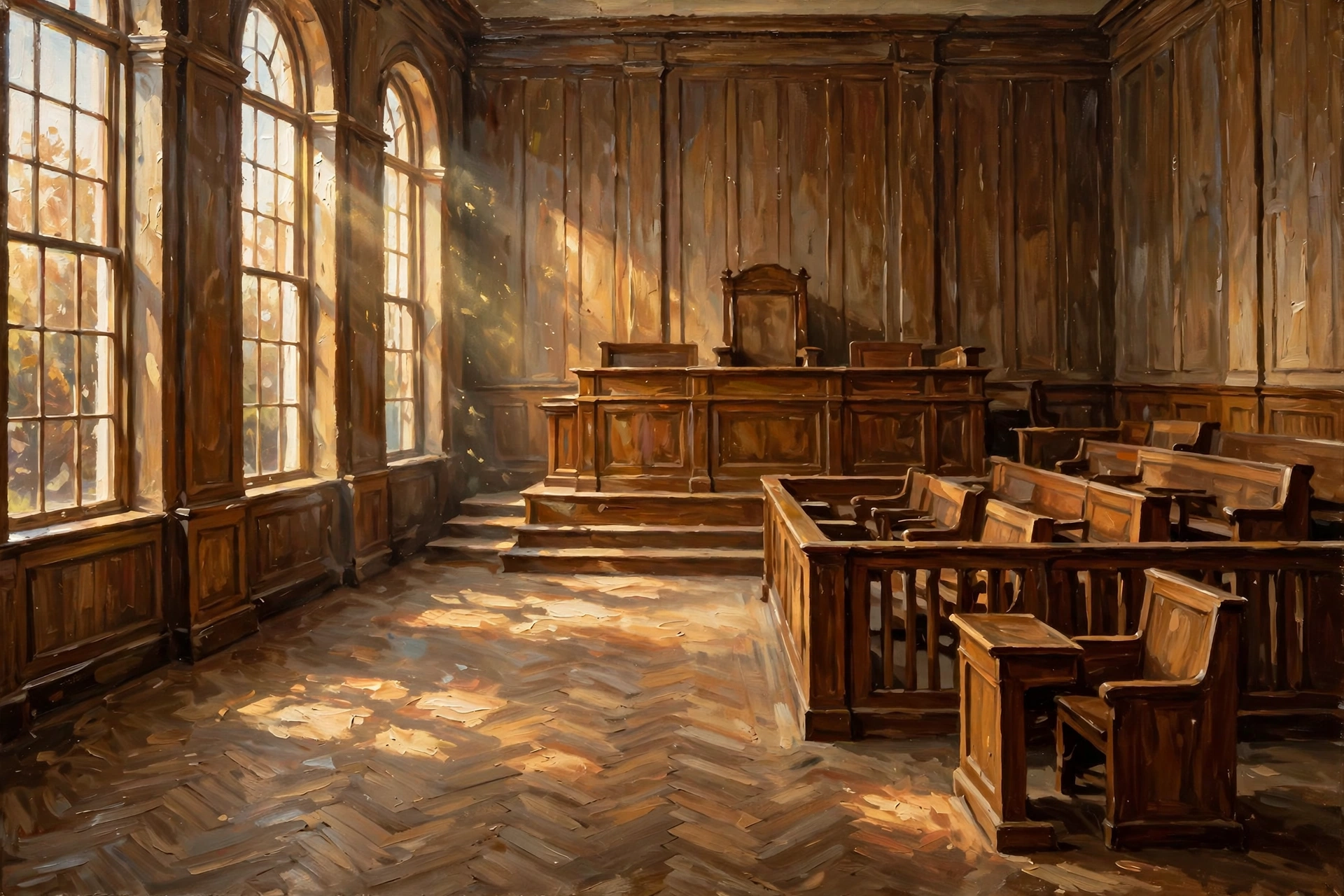
この絵について
木の羽目板に囲まれた法廷に、高い裁判官席と陪審席、証言台が並んでいる。誰もいない。窓から暖かい光が差し込み、空の席の上に落ちている。
trial の語の根には「ふるい分ける」という像があった。混ざったものをふるいにかけ、選び分ける場。その場に誰が座り、どのような手続で分けるのかが、この概念の争いの中心である。
絵はモチーフの置き換えが可能であり、この絵でなければならない必然はない。一般に共有される裁判の像として、空の法廷を選んだ。
場面は、判決の前と後を分ける線から始まる。ベッカリーアは、人は裁判官によって判決が下されるまでは有罪と呼ばれえないと言う。有罪か無辜かが定まらないうちに刑罰を科す権限は、単なる力の権利でしかない。裁判の正当性は、まず手続の順序に置かれる。
ベッカリーア(Cesare Beccaria)立てる
**人は、裁判官によって判決が下されるまでは有罪と呼ばれえない。 **また社会は、その保護が与えられていた条件を彼が破ったと決定されるまでは、彼から保護を 奪うことはできない。それならば、有罪か無辜かがなお定まらぬうちに市民へ刑罰を科す権限を裁 判官に与えるあの権利とは、単なる力の権利以外の何でありうるのか。
原文
A man cannot be called _guilty_ before sentence has been passed on him by a judge, nor can society deprive him of its protection till it has been decided that he has broken the condition on which it was granted. What, then, is that right but one of mere might by which a judge is empowered to inflict a punishment on a citizen whilst his guilt or innocence are still undetermined?
— Cesare Beccaria『Crimes and Punishments (including a New Translation of Dei Delitti e delle Pene)』 Dei Delitti e delle Pene (Farrer 訳)(James Anson Farrer 訳) / `beccaria_crimes_and_punishments#L3724`
カードーゾは、その線を適正手続の概念のなかに位置づける。有罪の宣告は裁判を経た後にのみ下されるべきだという考えは、適正手続の、したがって自由の概念において基本的なものである、と。なお、この引用の和文は判例引用の列挙の途中で終わっており、その形のまま置く(母データの記録は data_notes にある)。
カードーゾ(Benjamin N. Cardozo)根拠づける
有罪の宣告は裁判を経た後にのみ下されるべきだという考えもまた、適正手続の概念、したがって 自由の概念において基本的なものである。 スコット対マクニール事件(合衆国判例集一五四巻三四頁、最高裁判所判例集一四巻一一〇八頁、 弁護士版三八巻八九六頁)、ブラックマー対……事件。
原文
Fundamental too in the concept of due process, and so in that of liberty, is the thought that condemnation shall be rendered only after trial. Scott v. McNeal, 154 U.S. 34, 14 S.Ct. 1108, 38 L.Ed. 896; Blackmer v.
— Supreme Court of the United States『Palko v. Connecticut, 302 U.S. 319 (1937)』 / `case_palko_v_connecticut_1937#L208`
ブラックは、手続の条件を具体化する。貧しくて弁護士を雇えない者に弁護人が付されないかぎり、公正な裁判は保障されない。政府が訴追のために弁護士を雇うという事実こそ、刑事裁判において弁護士は贅沢品ではなく必需品だという信念を示している、と。なお、これはギデオン事件の判決の法廷意見の一節である。
ブラック(Hugo Black)条件を立てる
これらの先例だけでなく、理性と省察もまた、当事者対抗主義をとるわれわれの刑事司法制度にお いて、裁判所へ引き立てられた者が弁護士を雇えないほど貧しい場合、弁護人が付されないかぎり 公正な裁判を保障されないことを、われわれが認めるよう求めている。 これはわれわれには明白な真理と思われる。 州政府も連邦政府も、犯罪の被告人を裁く機構を整えるため、まったく適切に巨額の金を費やして いる。秩序ある社会における公共の利益を守るため、訴追する弁護士はどこでも不可欠とみなされ ている。同様に、犯罪で訴追された被告人のうち、自ら得られる最良の弁護士を雇って防御の準備 と主張をさせない者は、実際ほとんどいない。 政府が訴追のために弁護士を雇い、資力のある被告人が弁護のために弁護士を雇うという事実は、 刑事裁判所において弁護士は贅沢品ではなく必需品だという広範な信念を最も強く示している。 犯罪で訴追された者が弁護人を得る権利は、国によっては公正な裁判にとって基本的かつ不可欠と はみなされないかもしれないが、わが国ではそうみなされる。 当初から、わが国の州および連邦の憲法と法律は、すべての被告人が法の前に平等に立つ、公平な 裁判所による公正な裁判を保障するために設けられた、手続上および実体上の保障をきわめて重視 してきた。犯罪で訴追された貧しい者が、助けてくれる弁護士なしに告発者と対峙しなければなら ないなら、この気高い理想は実現できない。 被告人が弁護士を必要とすることは、……氏の心を動かす言葉ほどよく述べられたものはない。
原文
Not only these precedents but also reason and reflection require us to recognize that in our adversary system of criminal justice, any person haled into court, who is too poor to hire a lawyer, cannot be assured a fair trial unless counsel is provided for him. This seems to us to be an obvious truth. Governments, both state and federal, quite properly spend vast sums of money to establish machinery to try defendants accused of crime. Lawyers to prosecute are everywhere deemed essential to protect the public's interest in an orderly society. Similarly, there are few defendants charged with crime, few indeed, who fail to hire the best lawyers they can get to prepare and present their defenses. That government hires lawyers to prosecute and defendants who have the money hire lawyers to defend are the strongest indications of the wide—spread belief that lawyers in criminal courts are necessities, not luxuries. The right of one charged with crime to counsel may not be deemed fundamental and essential to fair trials in some countries, but it is in ours. From the very beginning, our state and national constitutions and laws have laid great emphasis on procedural and substantive safeguards designed to assure fair trials before impartial tribunals in which every defendant stands equal before the law. This noble ideal cannot be realized if the poor man charged with crime has to face his accusers without a lawyer to assist him. A defendant's need for a lawyer is nowhere better stated than in the moving words of Mr.
— Supreme Court of the United States『Gideon v. Wainwright, 372 U.S. 335 (1963)』 / `case_gideon_v_wainwright_1963#L221`
モンテスキューは、手続を擁護する声の並ぶ場面で、その量に警告を発する。司法の形式は自由に必要だが、数が多すぎれば法そのものの目的に反し、訴訟は終わらず、所有は不確かになり、審理しすぎて両当事者とも破滅する。手続は、多ければよいものではない。
モンテスキュー(Montesquieu)覆す
司法の定まった形式は自由に必要である。 しかしその数が多すぎれば、それを定めた法そのものの目的に反しかねない。 訴訟は終わらず、所有は不確かになり、一方の当事者の財産が審理なしに他方に与えられるか、あ るいは審理しすぎて両者とも破滅するだろう。
原文
The set forms of justice are necessary to liberty; but the number of them might be so great as to be contrary to the end of the very laws that established them; processes would have no end; property would be uncertain; the goods of one of the parties would be adjudged to the other without examining, or they would both be ruined by examining too much.
— Montesquieu『Complete Works, vol. 2 (The Spirit of Laws)』 BK XXIX, CH. I(Thomas Nugent 訳) / `montesquieu_spirit_of_laws_v2#L10920`
最後にトクヴィルが、陪審の身分を変える。陪審は単なる司法制度ではなく、何よりも政治制度であり、人民主権の一形態とみなされなければならない。陪審員の資格を市民の知性と知識だけで論じるのは、問題の最も小さな部分にすぎない、と。法廷の場面は、主権の場面として閉じられる。
トクヴィル(Alexis de Tocqueville)締める
これらの真理の大部分がどれほど明白に見えようとも、普遍的な同意を得てはいない。 そして少なくともフランスでは、陪審裁判制度はなおきわめて不完全にしか理解されていない。 陪審員にふさわしい資格が問題になると、議論は、選任されうる市民の知性と知識に限られ、あた かも陪審が単なる司法制度であるかのようである。 私には、これは問題の最も小さな部分と思われる。 陪審は何よりも政治制度であり、人民主権の一形態とみなされなければならない。 その主権が否定されるとき、陪審は退けられるか、その主権を確立する法律に適合させられなけれ ばならない。陪審は、議会両院が法律を制定する国民の一部を構成するのと同じように、法律の執 行を委ねられた国民の一部である。そして、社会が一貫して統一的に統治されるためには、陪審員 を務める資格を持つ市民の名簿は、選挙人名簿とともに増減しなければならない。 私は、これこそ立法者の注意に最も値する観点であり、残りのすべては付随的なものにすぎないと 考える。陪審が何よりも政治制度であると私は完全に確信しているので、民事事件に適用されると きにも、なおこの観点から陪審を考察する。
原文
However clear most of these truths may seem to be, they do not command universal assent, and in France, at least, the institution of trial by jury is still very imperfectly understood. If the question arises as to the proper qualification of jurors, it is confined to a discussion of the intelligence and knowledge of the citizens who may be returned, as if the jury was merely a judicial institution. This appears to me to be the least part of the subject. The jury is pre-eminently a political institution; it must be regarded as one form of the sovereignty of the people; when that sovereignty is repudiated, it must be rejected, or it must be adapted to the laws by which that sovereignty is established. The jury is that portion of the nation to which the execution of the laws is entrusted, as the Houses of Parliament constitute that part of the nation which makes the laws; and in order that society may be governed with consistency and uniformity, the list of citizens qualified to serve on juries must increase and diminish with the list of electors. This I hold to be the point of view most worthy of the attention of the legislator, and all that remains is merely accessory. I am so entirely convinced that the jury is pre-eminently a political institution that I still consider it in this light when it is applied in civil causes.
— Alexis de Tocqueville『Democracy in America, Volume 1』 Chapter XVI(Henry Reeve 訳) / `tocqueville_democracy_in_america_v1#L12454`
裁判の正当性は、判決の順序に置かれ、適正手続の基本とされ、弁護人という条件で具体化され、手続の量への警告を受け、最後に陪審を主権の機関とする像に行き着いた。正しい結果か、正しい手続か。そして、その場に座るのは誰か。この概念の争いは、その二つの問いのあいだで続いている。
控えの一句 ON THE BENCH
ブラックストン(William Blackstone)
軸1
告発も裁判もなしに人の生命を奪い、または暴力によってその財産を没収することは、あまりにも 甚だしく明白な専制行為であり、王国全体に暴政への警戒をただちに広めずにはおかないだろう。
原文
To bereave a man of life, or by violence to confiscate his estate, without accusation or trial, would be so gross and notorious an act of despotism, as must at once convey the alarm of tyranny throughout the whole kingdom.
— William Blackstone『Commentaries on the Laws of England, Book the First』 OF THE COUNTRIES SUBJECT TO THE LAWS OF ENGLAND / `blackstone_commentaries_v1#L5060`
ハミルトン(Alexander Hamilton)
軸3
すでに自分を有罪と決めてかかった裁判官の指揮下で行動する陪審の評決に、自らの生命と財産を 賭けようとする者がいるだろうか。
原文
Who would be willing to stake his life and his estate upon the verdict of a jury acting under the auspices of judges who had predetermined his guilt?
— Hamilton, Madison, Jay『The Federalist Papers』 No. LXV / `federalist_papers#L14502`
ヘーゲル(G. W. F. Hegel)
軸2
被告人との関係における事件の実際の状態にかかわる、司法上の確信の二つの種類、むしろ二つの 要素を比較すること、すなわち、(一)その確信が単なる状況と他人の証言だけに基づく場合と、 (二)それに加えて被告人の自白を必要とする場合との比較が、いわゆる陪審裁判所の問題におけ る主要点をなす。司法的認識の二つの構成要素、すなわち事実の状態についての判断と、それへの 法の適用としての判断とが、根底では異なる側面として、異なる機能として行使されるべきことは、 本質的な点である。
原文
The comparison of the two species, or rather two elements in the judicial conviction, bearing on the actual state of the case in relation to the accused,—(1) according as that conviction is based on mere circumstances and other people’s witness alone,—or (2) in addition requires the confession of the accused, constitutes the main point in the question of the so-called jury-courts. It is an essential point that the two ingredients of a judicial cognisance, the judgment as to the state of the fact, and the judgment as application of the law to it, should, as at bottom different sides, be exercised as _different functions_.
— G. W. F. Hegel『Hegel's Philosophy of Mind』 SECTION II(William Wallace 訳) / `hegel_philosophy_of_mind#L8910`
カント(Immanuel Kant)
軸1
人間の内なる法廷(その前で「彼の思考が互いに告発し、また弁明する」)の意識が良心である。 すべての人は良心を持ち、脅して畏怖(恐れと結びついた尊敬)を抱かせる内なる裁判官に見張ら れていることを知る。そして、人間の内にある法を監視するこの力は、人間が自ら(恣意的に)作 るものではなく、その存在に組み込まれている。 人が逃れようと考えるときにも、影のようについてくる。 人は快楽や気晴らしによって自らを麻痺させることはできても、ときおり我に返り、目覚めること を避けられず、そのときにはただちにその恐るべき声を知覚する。 極度に堕落していても、それに注意を払わないことはできるが、聞くことは避けられない。 さて、良心と呼ばれるこの根源的な知性的かつ(義務の概念として)道徳的な能力には、その働き が人間の自分自身との事柄であるにもかかわらず、あたかも他の人格の命令によるかのようにそれ を処理することを、自らの理性によって強いられるという特質がある。 というのも、ここでの処理は法廷の前での裁判(causa)の遂行だからである。 しかし、良心によって告発される者を裁判官と同一の人格と考えることは、司法裁判所についての 不合理な概念である。そうであれば、原告はつねに敗訴するだろう。 したがって、自己矛盾を避けるため、人間の良心は、あらゆる義務において、自分以外の者を自ら の行為の裁判官とみなさなければならない。 さて、この他者は、現実の人格でも、理性が自らのために形作る単に理念的な人格でもよい。 そのように理念化された人格(良心の権威ある裁判官)は、心を知る者でなければならない。 法廷は人間の内奥に設けられているからである。 同時に、その者はすべてに義務を課す者でなければならない。 すなわち、すべての義務がその命令としてみなされるべき人格であるか、そのような人格として考 えられなければならない。良心はすべての自由な行為の内なる裁判官だからである。
原文
The consciousness of an internal tribunal in man (before which "his thoughts accuse or excuse one another") is CONSCIENCE. Every man has a conscience, and finds himself observed by an inward judge which threatens and keeps him in awe (reverence combined with fear); and this power which watches over the laws within him is not something which he himself (arbitrarily) makes, but it is incorporated in his being. It follows him like his shadow, when he thinks to escape. He may indeed stupefy himself with pleasures and distractions, but cannot avoid now and then coming to himself or awaking, and then he at once perceives its awful voice. In his utmost depravity, he may, indeed, pay no attention to it, but he cannot avoid hearing it. Now this original intellectual and (as a conception of duty) moral capacity, called conscience, has this peculiarity in it, that although its business is a business of man with himself, yet he finds himself compelled by his reason to transact it as if at the command of another person. For the transaction here is the conduct of a trial (causa) before a tribunal. But that he who is accused by his conscience should be conceived as one and the same person with the judge is an absurd conception of a judicial court; for then the complainant would always lose his case. Therefore, in all duties the conscience of the man must regard another than himself as the judge of his actions, if it is to avoid self-contradiction. Now this other may be an actual or a merely ideal person which reason frames to itself. Such an idealized person (the authorized judge of conscience) must be one who knows the heart; for the tribunal is set up in the inward part of man; at the same time he must also be all-obliging, that is, must be or be conceived as a person in respect of whom all duties are to be regarded as his commands; since conscience is the inward judge of all free actions.
— Immanuel Kant『The Metaphysical Elements of Ethics』 ON CONSCIENCE(Thomas Kingsmill Abbott 訳) / `kant_metaphysical_elements_of_ethics#L1614`
プルタルコス(Plutarch)
軸1
この穏和さと節度のなかで、一つの甚だしい罪に対して彼は一つの甚だしい刑罰を設けた。 すなわち、僭主制を企てる者の生命を裁判なしに奪うことを合法とし、殺害者がその犯罪の証拠を 提出すれば無罪としたのである。これほど大きな企てを抱く者がまったく人目を逃れることはあり そうになかったが、観察されても、力によって裁きを先取りできる可能性はあり、簒奪そのものが その後の裁きを不可能にするため、彼は誰にでも簒奪者を先んじて倒す許可を与えたのである。
原文
Amidst this mildness and moderation, for one excessive fault he instituted one excessive punishment; for he made it lawful without trial to take away any man's life that aspired to a tyranny, and acquitted the slayer, if he produced evidence of the crime; for though it was not probable for a man, whose designs were so great, to escape all notice; yet because it was possible he might, although observed, by force anticipate judgment, which the usurpation itself would then preclude, he gave a license to any to anticipate the usurper.
— Plutarch『Lives of the Noble Grecians and Romans』 POPLICOLA(John Dryden (rev. Arthur Hugh Clough) 訳) / `plutarch_lives#L6189`