TRUTH
idea-no-tane の全引用から選んだ超精選による、概念ごとの読み物。
入口 THE WORD
この概念が扱うのは、偽りでないこと、正しいこと——真理である。場面に入る前に、まずこの語そのものの旅をたどる。語源は「真の意味」ではない。だが、語がどこから来て、どう意味を変えてきたかという経緯は、後ろに並ぶ偉人たちの議論を読むための地図になる。
語源 ― 「忠実」だった truth
英語の truth は、古英語の trēowþ に由来する。ところがその中心にあった意味は、現代の「事実との一致」ではなく、「忠実、忠誠、信義、誓約」だった。ゲルマン祖語の「信義あること」を意味する形に遡り、さらに先には、印欧祖語の「木」を意味する語根——樫のように堅固であること——に結びつける説がある(Etymonline)。事実との一致の意味は、古英語では別の語 sōþ(sooth、真実)が担っていた。つまり英語の truth は、「裏切らないこと」と「事実に合うこと」という二つの意味が、歴史の中で一語に重なった語である。
ギリシャ語 ― aletheia(アレーテイア)
ギリシャ語の真理は aletheia である。a-(否定)に lēthē(忘却、隠れていること)が付いた形で、「隠されていないこと」と読むことができる。哲学者ハイデガーはこの読みを真理論の中心に据え、真理とは覆いを取り除くことだ、と論じた。真理は「作るもの」ではなく「現れるもの」だという像が、この語の底にはある。
ラテン語 ― veritas(ウェーリタース)
ラテン語の真理は veritas で、verus「真の、実際の」から来ている。英語の verify(検証する)や verity(真理)はこの系統である。ドイツ語では、事実との一致の側は Wahrheit が担い、忠誠の側は Treue が担う。英語の truth が一語に重ねた二つの意味を、ドイツ語は分けて持っている。
日本語との対応 ― 真理と真実
日本語の「真理」は、仏教の語である。サンスクリットの satya(真実)の漢訳の系譜にあり、satya は「諦」とも訳されて四諦・二諦の「諦」になった。『岩波仏教辞典』は satya を「真の道理」と説明する(国立国会図書館のレファレンス資料経由)。明治になると、この仏教語が西洋哲学の truth や veritas の訳語として採用され、学術語として定着した。日常語の「真実(しんじつ)」が「実際にあったこと」を指すのに対して、「真理」は普遍的で抽象的な正しさを指す。英語の truth が一語に重ねたものを、日本語は「真実」と「真理」に分けて受け取ったとも言える。なお、明治期の訳語化の経緯の細部は、一般的な解説に基づくものである。
真理の語の底には、「堅固さ」「隠されていないこと」「裏切らないこと」が沈んでいる。このあとの場面で争われるのは、真理が事物との一致なのか、言葉の性質なのか、それとも生き延びるための方便なのか、である。
場面 THE SCENE
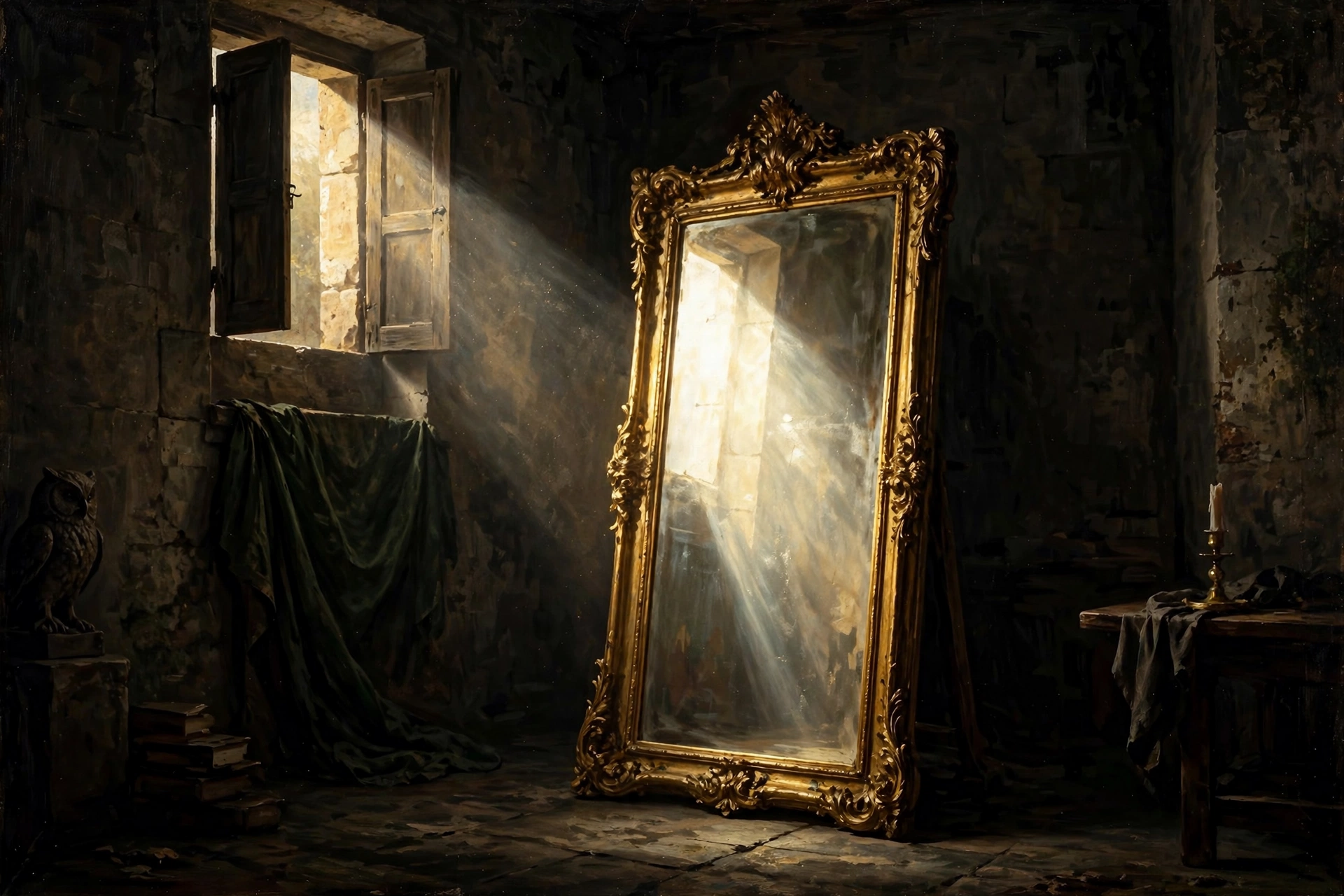
この絵について
描かれているのは、暗い石の部屋に立つ、大きな姿見の鏡である。窓から差した光が鏡面に映り、部屋の暗さの中で鏡だけが明るい。人物は一人もいない。
鏡は、あるものをあるがままに映すものの像として、真理の比喩に長く使われてきた。鏡は対象を作らない。ただ一致するかどうかだけが問われる。この場面で五人が争うのは、その「一致」の意味そのものである。一致は事物とのあいだにあるのか、言葉の中にあるのか、それとも市場の中で試されるのか。
※モチーフは、「真理」について一般に共有されている像(鏡)を既定として選んだ。絵は差し替え可能とする。
真理とは何か。——事物との一致だと言う者、言葉の属性だと言い直す者、役に立つものだと言い換える者、時の娘だと宣言する者、そして市場の競争に委ねる者。五人が集まった。
Aristotle(アリストテレス)立てる ― 定義(対応説)
あるものをあらぬと言い、あらぬものをあると言うのは偽であり、あるものをあると言い、あらぬ ものをあらぬと言うのは真である。
原文
To say of what is that it is not, or of what is not that it is, is false, while to say of what is that it is, and of what is not that it is not, is true;
— Aristotle『Metaphysica (The Works of Aristotle, vol. 8)』 BK IV (Γ)(W. D. Ross 訳) / `aristotle_metaphysics#L5393`
ホッブズは真理の住む場所を移した。真と偽は事物の属性ではない。言葉の属性だ、と。
Thomas Hobbes(ホッブズ)ずらす ― 言葉の属性
真と偽は言葉の属性であって、事物の属性ではない。 そして言葉の無いところには、真も偽も無い。 誤りはありうる——起こらないことを予期するとき、あるいは起こらなかったことを疑うときのよ うに。しかしそのどちらの場合も、人を偽りのかどで責めることはできない。
原文
For True and False are attributes of Speech, not of things. And where Speech in not, there is neither Truth nor Falshood. Errour there may be, as when wee expect that which shall not be; or suspect what has not been: but in neither case can a man be charged with Untruth.
— Thomas Hobbes『Leviathan』 CH IV / `hobbes_leviathan#L1043`
ジェイムズはさらに踏み込んだ。真とは、思考の道行きにおいて好都合なものの名だ、と。
William James(ウィリアム・ジェイムズ)覆す ― 好都合なもの
ごく簡単に言えば、「真」とは我々の思考のやり方において好都合であるものにすぎない。 ちょうど「正しい」が我々の振る舞いのやり方において好都合であるものにすぎないように。 ほとんどどんな仕方であれ好都合であり、そしてもちろん長い目で見て全体として好都合である。 というのも、目下見えている経験のすべてに好都合に合致するものが、必ずしもそれ以上の経験の すべてに等しく満足に合致するとは限らないからだ。 経験は、我々の知るとおり、煮えこぼれて我々に現在の公式を訂正させるという癖がある。
原文
'The true,' to put it very briefly, is only the expedient in the way of our thinking, just as 'the right' is only the expedient in the way of our behaving. Expedient in almost any fashion; and expedient in the long run and on the whole of course; for what meets expediently all the experience in sight won't necessarily meet all farther experiences equally satisfactorily. Experience, as we know, has ways of BOILING OVER, and making us correct our present formulas.
— William James『Pragmatism』 LECTURE VI / `james_pragmatism#L3794`
ベーコンは時間を持ち出した。真理は権威の娘ではない。時の娘だ、と。
Francis Bacon(フランシス・ベーコン)ずらす ― 時の娘
権威に関して言えば、特定の著者に無限の信頼を帰し、あらゆる著者の著者であり、したがってあ らゆる権威の著者である時間に、その固有の特権を拒むのは、最大の弱さである。 真理は、正しくは権威の娘ではなく、時の娘と呼ばれているのだから。
原文
With regard to authority, it is the greatest weakness to attribute infinite credit to particular authors, and to refuse his own prerogative to time, the author of all authors, and, therefore, of all authority. For truth is rightly named the daughter of time, not of authority.
— Francis Bacon『Novum Organum』 ON THE INTERPRETATION OF NATURE AND THE EMPIRE OF MAN([要確認] 訳) / `bacon_novum_organum#L1461`
最後に、判事ホームズが締めた。真理の最良の試験は、思想の市場で受け入れられる力だ、と。
Oliver Wendell Holmes Jr.(ホームズ判事)締め ― 思想の市場
しかし、時が多くの闘う信仰を覆してきたことを悟ったとき、人々は、自分の行動の基盤そのもの を信じる以上に、次のことを信じるようになるかもしれない。 望まれる究極の善は、思想の自由な交易によってよりよく達成されること——真理の最良の試 験は、市場の競争の中で思想が自らを受け入れさせる力であること、そして真理こそが、彼ら の望みを安全に実現できる唯一の基盤であること。 いずれにせよ、それが我々の憲法の理論である。 それは実験である。すべての生が実験であるように。 毎年、いや毎日、我々は不完全な知識に基づく何らかの予言に自らの救いを賭けなければなら ない。
原文
But when men have realized that time has upset many fighting faiths, they may come to believe even more than they believe the very foundations of their own conduct that the ultimate good desired is better reached by free trade in ideas—that the best test of truth is the power of the thought to get itself accepted in the competition of the market, and that truth is the only ground upon which their wishes safely can be carried out. That at any rate is the theory of our Constitution. It is an experiment, as all life is an experiment. Every year if not every day we have to wager our salvation upon some prophecy based upon imperfect knowledge.
— Supreme Court of the United States『Abrams v. United States, 250 U.S. 616 (1919)』 Abrams v. United States, 250 U.S. 616 (1919) (Holmes, J., dissenting) / `case_abrams_v_united_states_1919#L483`
議論は決着しなかった。真理の定義は、今も五人のあいだに置かれたままである。
控えの一句 ON THE BENCH
場面には出なかったが、場面と並べて置く5件。引用はすべて idea-no-tane の精選から一字一句そのまま写したものである。
Thomas Aquinas(トマス・アクィナス)
軸1「真理とは何か」― 真理は知性と事物の一致
すでに述べたとおり、真理は第一義的には知性のうちに存する。 ところであらゆるものは、自らの本性に固有の形相を持つかぎりにおいて真であるから、知性は知 るものであるかぎり、知られる当のものの似像を――それが知るものとしての知性の形相なのだが ――持つかぎりにおいて真でなければならない。 この理由から、真理は知性と事物との一致として定義される。 それゆえこの一致を知ることが、真理を知ることである。 だが感覚はこれをまったく知りえない。 視覚は見られるものの似像を持つけれども、見られるものとのあいだに成り立つ比較を知りはしな いからである。
原文
_I answer that,_ As stated before, truth resides, in its primary aspect, in the intellect. Now since everything is true according as it has the form proper to its nature, the intellect, in so far as it is knowing, must be true, so far as it has the likeness of the thing known, this being its form, as knowing. For this reason truth is defined by the conformity of intellect and thing; and hence to know this conformity is to know truth. But in no way can sense know this. For although sight has the likeness of a visible thing, yet it does not know the comparison which exists between the thing seen and that which itself apprehends concerning it.
— Thomas Aquinas『Summa Theologica, Part I (Prima Pars)』 I, Q. 16, Art. 2(Fathers of the English Dominican Province 訳) / `aquinas_summa_prima_pars#L8689`
Benedict de Spinoza(スピノザ)
軸2「真理の規準」― 真理はそれ自身の基準
最後の問い、すなわち、人がどのようにして、自分の観念が対象と一致していると確信できるかに ついては、すでに十分明らかに指摘したとおりである。 その認識は、対象に対応する観念をもつというまさにその事実から生じる。 言い換えれば、真理はそれ自身の基準なのである。 さらに言い添えれば、われわれの精神は、事物を真に知覚するかぎり、神の無限の知性の一部であ る(II.
原文
As for the last question--as to how a man can be sure that he has ideas that agree with their objects, I have just pointed out, with abundant clearness, that his knowledge arises from the simple fact, that he has an idea which corresponds with its object--in other words, that truth is its own standard. We may add that our mind, in so far as it perceives things truly, is part of the infinite intellect of God (II.
— Benedict de Spinoza『Ethics』 Part II(R. H. M. Elwes 訳) / `spinoza_ethics#L3103`
John Milton(ミルトン)
軸4「真理と闘争」― 真理と虚偽とを組み打ちさせよ
真理が戦場にあるかぎり、許可制と禁止とによって真理の力を疑うのは、真理に対する不当な仕打 ちである。真理と虚偽とを組み打ちさせよ。 自由で開かれた戦いにおいて、真理が負けたためしを誰が知っていようか。
原文
so Truth be in the field, we do injuriously, by licensing and prohibiting, to misdoubt her strength. Let her and Falsehood grapple; who ever knew Truth put to the worse, in a free and open encounter? Her confuting is the best and surest suppressing.
— John Milton『Areopagitica』 / `milton_areopagitica#L1456`
Friedrich Nietzsche(ニーチェ)
軸6「真理の価値」― 人間の真理とは反駁不可能な誤謬
究極の懐疑。――だが結局、人間の真理とは何なのか。 ――それは人間の反駁不可能な誤謬である。
原文
_Ultimate Scepticism._--But what after all are man's truths?--They are his _irrefutable_ errors.
— Friedrich Nietzsche『The Joyful Wisdom (La Gaya Scienza)』 BK III, §265(Thomas Common / Paul V. Cohn / Maude D. Petre 訳) / `nietzsche_joyful_wisdom#L5818`
Henry Sidgwick(ヘンリー・シジウィック)
軸5「真実を語る義務」― 義務の根拠は功利か
第5節。真実を語る義務は、功利主義の基礎に立たない道徳規則の顕著な例として挙げられること がある。しかし、人類の通念がこの義務を教え込む際の留保を注意深く調べると、反対の結果が得 られるように思われる。真実を語ることの一般的な効用は、証明を要しないほど明白であるだけで なく、この効用が欠けているか、特定の悪い結果に上回られると見えるところではどこでも、常識 がこの規則を強制することにためらうからである。 たとえば、人が犯罪的な目的を追求しているなら、他人の言葉を当てにして追求を助けられること は、一見して共同体に有害である。そこでは欺くことは、犯罪に対する防護として一見して正当で ある。もっとも、一度の不誠実な行為でさえ習慣と模範を通じて及ぼす悪影響を考えると、功利主 義の原理からはその場合は疑わしくなる。 そして、これがまさに常識の見方である。 また、真実を知ることは一般に人の利益になるが、たとえば病人が悪い知らせを聞く場合のように、 有害となる例外的な場合があり、ここでも常識は規則を停止する傾向にある。 さらに、誠実さが正確には何に存するかを定義することが難しいことも分かった。 話された言葉に真実を求めることも、話し手がそこから引き出されると予見する推論に真実を求め ることも、その両方に求めることもできるからである。 完全な率直さなら、疑いなく両方に求めるだろう。 しかし、それが得策でないように思われる種々の状況では、常識がこの二重の義務の一方または他 方を免除することに、少なくとも半ば乗り気であることが少なくない。 こうして、宗教的真理は歴史的虚構によって伝えられてもよいと主張する立派な思想家の一派があ ることも分かった。他方、完全な率直さが現在の社会関係にそぐわないことは、礼儀の通例の規則 によって認められており、それはしばしば、真実を伏せ、偽りをほのめかす必要をわれわれに課す。 これらのどの場合でも、常識が不誠実を支持すると全面的に断言するつもりはない。 だが功利主義もまた決定的ではない。真実を語る一般的な習慣を維持することの効用はきわめて大 きく、規則を破る強い特別の理由によってさえ、それが明らかに上回られると証明するのは容易で ないからである。
原文
§ 5. The duty of Truth-speaking is sometimes taken as a striking instance of a moral rule not resting on a Utilitarian basis. But a careful study of the qualifications with which the common opinion of mankind actually inculcates this duty seems to lead us to an opposite result: for not only is the general utility of truth-speaking so manifest as to need no proof, but wherever this utility seems to be absent, or outweighed by particular bad consequences, we find that Common Sense at least hesitates to enforce the rule. For example, if a man be pursuing criminal ends, it is _prima facie_ injurious to the community that he should be aided in his pursuit by being able to rely on the assertions of others. Here, then, deception is _prima facie_ legitimate as a protection against crime: though when we consider the bad effects on habit, and through example, of even a single act of unveracity, the case is seen to be, on Utilitarian principles, doubtful: and this is just the view of Common Sense. Again, though it is generally a man’s interest to know the truth, there are exceptional cases in which it is injurious to him--as when an invalid hears bad news--and here, too, Common Sense is disposed to suspend the rule. Again, we found it difficult to define exactly wherein Veracity consists; for we may either require truth in the spoken words, or in the inferences which the speaker foresees will be drawn from them, or in both. Perfect Candour, no doubt, would require it in both: but in the various circumstances where this seems inexpedient, we often find Common Sense at least half-willing to dispense with one or other part of the double obligation. Thus we found a respectable school of thinkers maintaining that a religious truth may properly be communicated by means of a historical fiction: and, on the other hand, the unsuitability of perfect frankness to our existing social relations is recognised in the common rules of politeness, which impose on us not unfrequently the necessity of suppressing truths and suggesting falsehoods. I would not say that in any of these cases Common Sense pronounces quite decidedly in favour of unveracity: but then neither is Utilitarianism decided, as the utility of maintaining a general habit of truth-speaking is so great, that it is not easy to prove it to be clearly outweighed by even strong special reasons for violating the rule.
— Henry Sidgwick『The Methods of Ethics』 CHAPTER III / `sidgwick_methods_of_ethics#L18204`